
Connecting the Dots: Integrating Oracle Fusion Cloud ERP with CRM, eCommerce, and Legacy Tools
 technology footprint than the "897 applications" figure implies.
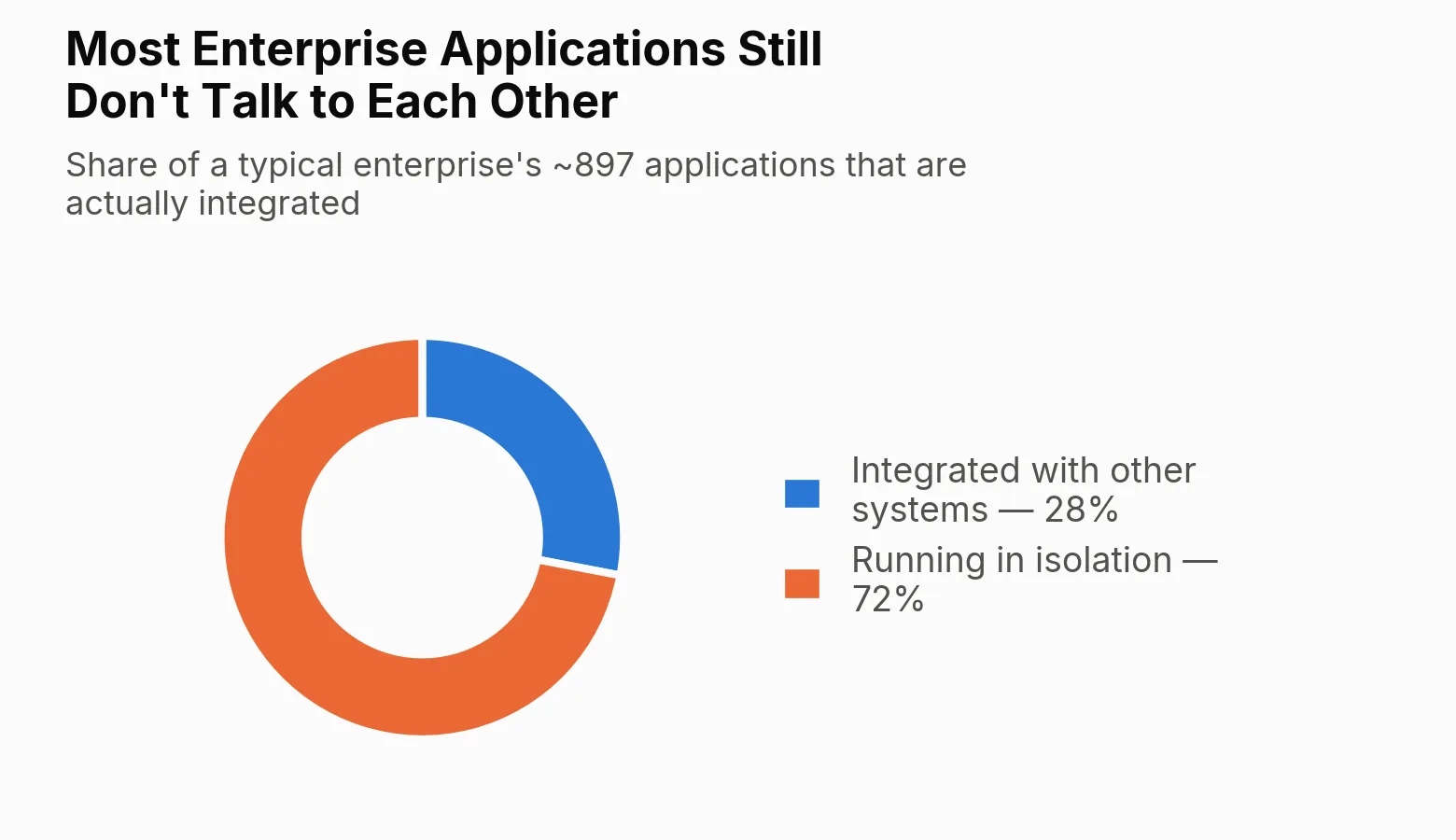
Roughly three-quarters of enterprise applications operate without meaningful integration to the rest of the technology stack.
Source: DreamFactory, 2026.
technology footprint than the "897 applications" figure implies.
Roughly three-quarters of enterprise applications operate without meaningful integration to the rest of the technology stack.
Source: DreamFactory, 2026.
The consequences compound in ways that are easy to underestimate. Ninety-five percent of IT leaders now identify poor integration as the single biggest barrier to adopting AI effectively — a telling statistic, because it means the current wave of AI investment many companies are making is being built on top of the same fragmented data foundation that's caused reporting and reconciliation headaches for years. AI can't meaningfully analyze or act on data it can't reliably access.
72%
of the average enterprise's software applications run in isolation, disconnected from the rest of the technology stack — meaning most companies' 'system of record' is really several partial records that don't fully agree.
Source: DreamFactory, 2026
Why Oracle Fusion Cloud's approach to integration matters here
Fusion Cloud ERP is built with a fairly extensive set of pre-built connectors and a modern API layer specifically to reduce the amount of custom integration work needed to connect it to the other systems a business already depends on — a CRM for sales, a specialized eCommerce platform, an industry-specific tool that does one thing better than any generalist ERP module could. Rather than requiring a bespoke, point-to-point integration built from scratch for every connection (traditional
© Orpington Technologies Inc. www.orpingtontech.com
Page No. 2 of 4