
Manufacturing Operations in Oracle Fusion Cloud ERP: Planning, Costing, and Quality
Ask a plant manager how efficiently their operation is actually running, and you'll often get a confident answer that has little to do with what a rigorous measurement would show. It's not that plant managers are dishonest — it's that "efficient" tends to get judged by how busy the floor looks and how many orders shipped, rather than by the harder, more precise metric that actually captures performance
 ORACLE FUSION CLOUD ERP FOR GROWING BUSINESSES
Manufacturing Operations in
Oracle Fusion Cloud ERP: Planning,
Costing, and Quality
The 25-point gap between average plants and world-class ones
Oracle Fusion Cloud ERP: Planning,
Costing, and Quality
Ask a plant manager how efficiently their operation is actually running, and you'll often get a
confident answer that has little to do with what a rigorous measurement would show. It's not that
plant managers are dishonest — it's that "efficient" tends to get judged by how busy the floor looks
and how many orders shipped, rather than by the harder, more precise metric that actually captures
performance: Overall Equipment Effectiveness, or OEE, which measures availability, performance,
and quality together into a single number.
confident answer that has little to do with what a rigorous measurement would show. It's not that
plant managers are dishonest — it's that "efficient" tends to get judged by how busy the floor looks
and how many orders shipped, rather than by the harder, more precise metric that actually captures
performance: Overall Equipment Effectiveness, or OEE, which measures availability, performance,
and quality together into a single number.
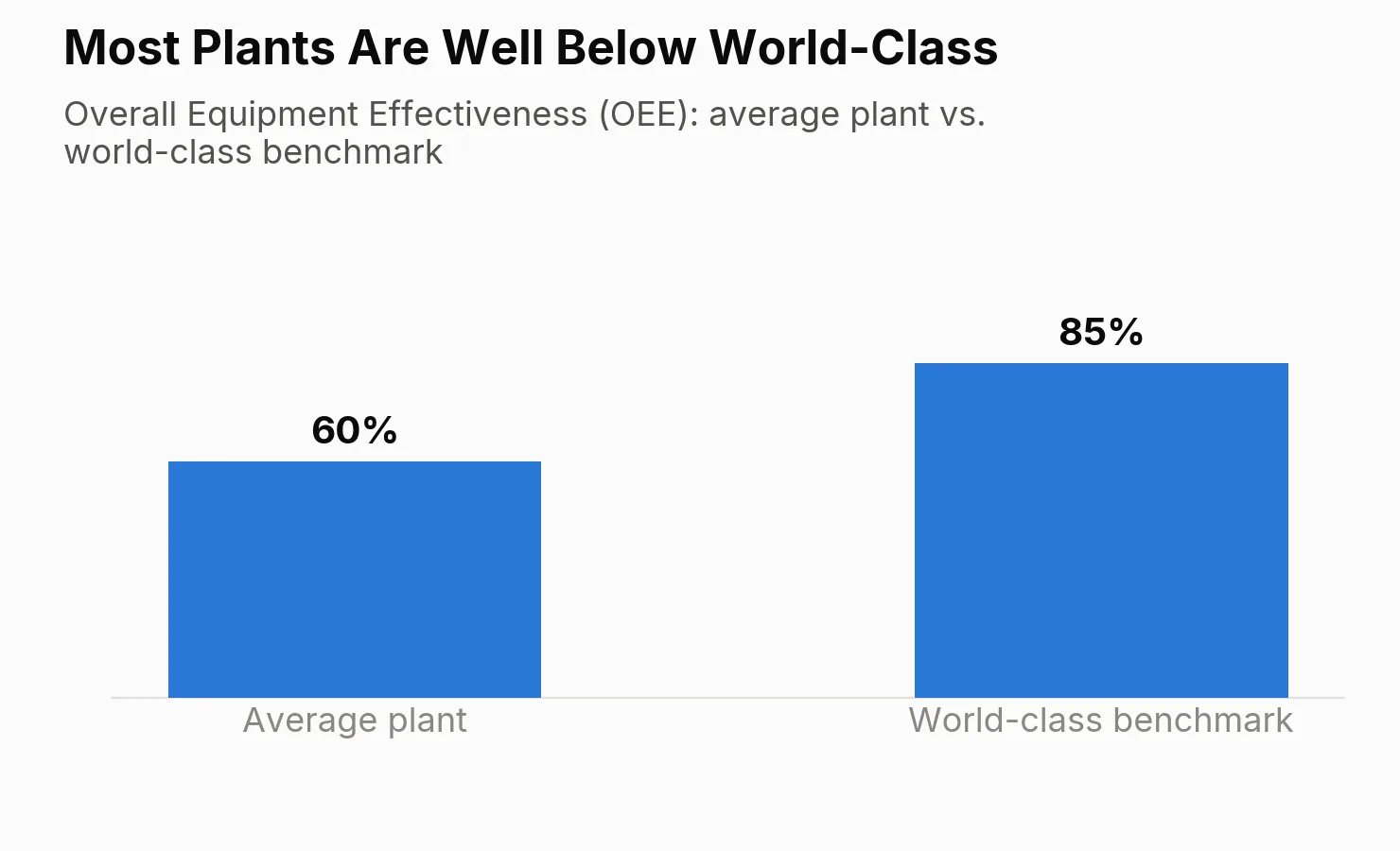
That number tends to be humbling. The widely used benchmark for world-class manufacturing
performance is an OEE of 85%. The average plant runs closer to 60% — a 25-point gap that
represents an enormous amount of lost capacity sitting in plain sight, disguised as "normal"
operations.
Where the 25 points actually go
performance is an OEE of 85%. The average plant runs closer to 60% — a 25-point gap that
represents an enormous amount of lost capacity sitting in plain sight, disguised as "normal"
operations.
OEE losses get grouped into what the industry calls the "six big losses," and they rarely show up as
one dramatic event. They accumulate from small stops, minor speed reductions, and quality defects
that individually look unremarkable but compound into a large gap over a full production run. In some
documented cases, reduced running speed alone accounts for over 58% of total losses in a given
© Orpington Technologies Inc. www.orpingtontech.com
Page No. 1 of 4
one dramatic event. They accumulate from small stops, minor speed reductions, and quality defects
that individually look unremarkable but compound into a large gap over a full production run. In some
documented cases, reduced running speed alone accounts for over 58% of total losses in a given
operation; in others, idling and minor stops account for more than 62%. Changeover time between
product runs has been identified as the single largest cause of OEE decline in some analyses,
responsible for roughly 37% of the gap on its own.
The gap between average and world-class OEE represents a substantial, largely hidden reserve of manufacturing capacity.
Source: Godlan, 2026.
product runs has been identified as the single largest cause of OEE decline in some analyses,
responsible for roughly 37% of the gap on its own.
The financial exposure tied to unplanned downtime specifically is enormous at scale — Siemens
research puts the cost of unplanned downtime across the world's 500 largest companies at roughly
11% of annual revenue, a combined $1.4 trillion. The per-hour cost varies enormously by industry: an
hour of downtime in automotive manufacturing runs an estimated $2.3 million, while the same hour
in fast-moving consumer goods production is closer to $36,000. Even at the lower end of that range,
an SMB manufacturer losing a handful of unplanned hours a month is looking at a real, recurring cost
that rarely gets tracked as precisely as it deserves.
25 pts
research puts the cost of unplanned downtime across the world's 500 largest companies at roughly
11% of annual revenue, a combined $1.4 trillion. The per-hour cost varies enormously by industry: an
hour of downtime in automotive manufacturing runs an estimated $2.3 million, while the same hour
in fast-moving consumer goods production is closer to $36,000. Even at the lower end of that range,
an SMB manufacturer losing a handful of unplanned hours a month is looking at a real, recurring cost
that rarely gets tracked as precisely as it deserves.
the gap between average plant OEE (about 60%) and the world-class benchmark (85%) —
representing capacity that already exists on the floor but isn't being captured.
Source: Godlan, 2026
representing capacity that already exists on the floor but isn't being captured.
Why so much of this comes down to visibility, not
equipment
It would be easy to assume the fix for a 25-point OEE gap is new machinery, and sometimes it is. But
a large share of the gap in a typical mid-sized manufacturer traces back to something less
© Orpington Technologies Inc. www.orpingtontech.com
Page No. 2 of 4
a large share of the gap in a typical mid-sized manufacturer traces back to something less
capital-intensive: not knowing, in real time, why a line stopped, how long a changeover actually took
versus how long it was supposed to take, or which specific defect category is driving quality losses
on a given product line. Without that visibility, problems get treated as one-off incidents rather than
patterns, and the same losses repeat month after month without ever being formally identified.
versus how long it was supposed to take, or which specific defect category is driving quality losses
on a given product line. Without that visibility, problems get treated as one-off incidents rather than
patterns, and the same losses repeat month after month without ever being formally identified.
This is the specific gap Oracle Fusion Cloud ERP's manufacturing functionality is built to close, by
connecting production execution, quality management, and costing into the same system that runs
financials and supply chain. Work orders, material consumption, labor time, and machine downtime
get captured as they happen rather than reconstructed later from paper travelers or a shift
supervisor's notes. Quality holds and non-conformances feed directly into both production reporting
and cost accounting, so a defect isn't just a shop-floor event — it's visible, in real terms, in the cost of
the product it affected.
connecting production execution, quality management, and costing into the same system that runs
financials and supply chain. Work orders, material consumption, labor time, and machine downtime
get captured as they happen rather than reconstructed later from paper travelers or a shift
supervisor's notes. Quality holds and non-conformances feed directly into both production reporting
and cost accounting, so a defect isn't just a shop-floor event — it's visible, in real terms, in the cost of
the product it affected.
The maintenance strategy shift that shows up in the
numbers
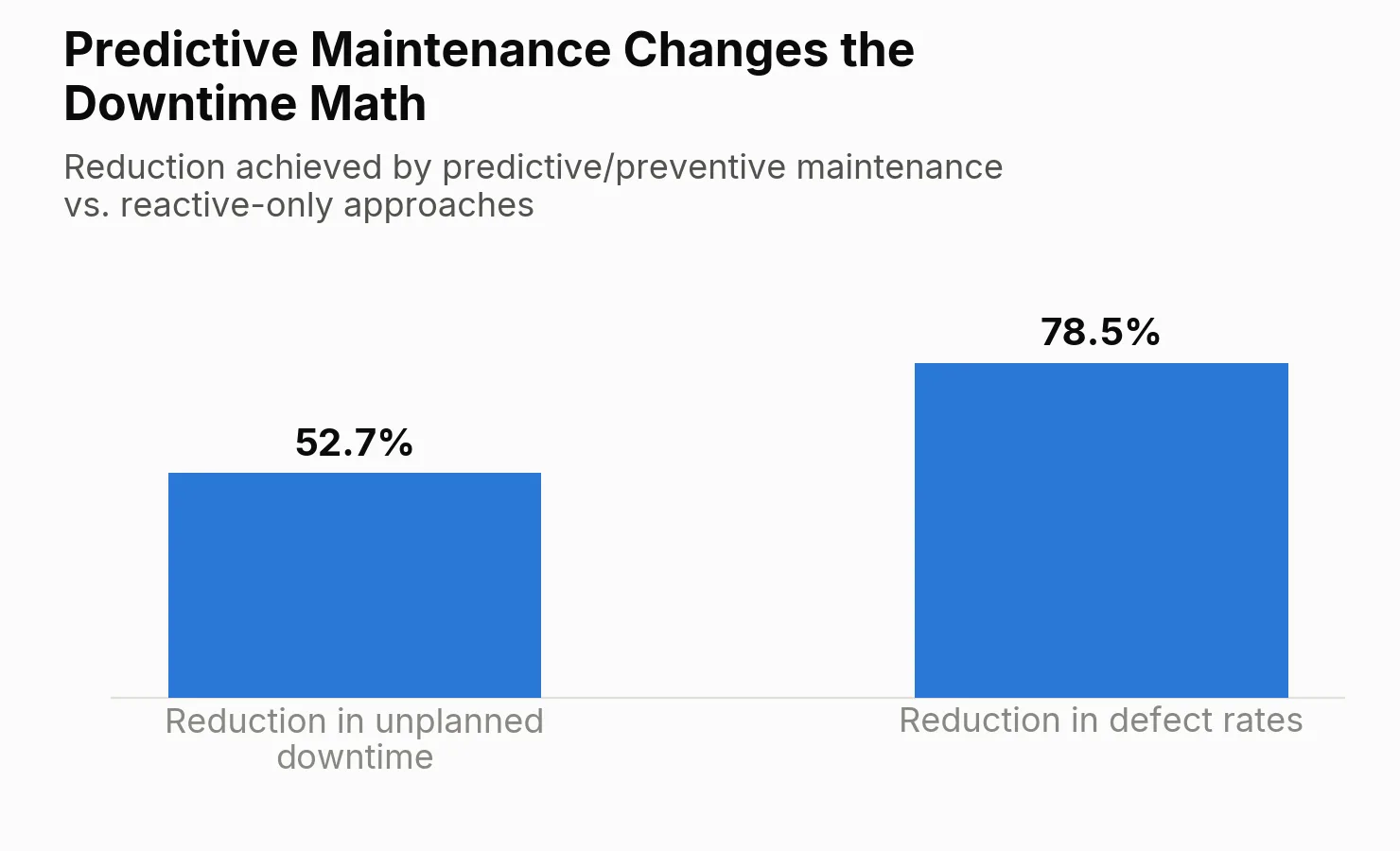
One of the more concrete, well-documented levers here is the shift from reactive to predictive or
preventive maintenance. Plants that lean into predictive and preventive maintenance strategies see
unplanned downtime drop by an estimated 52.7% compared with reactive-only approaches,
alongside a 78.5% reduction in defect rates — a striking figure that reflects how much unplanned
downtime and quality problems are actually connected, since equipment running outside normal
parameters tends to produce both.
Predictive maintenance strategies deliver outsized reductions in both downtime and defects compared with reactive-only
approaches. Source: Godlan, 2026.
preventive maintenance. Plants that lean into predictive and preventive maintenance strategies see
unplanned downtime drop by an estimated 52.7% compared with reactive-only approaches,
alongside a 78.5% reduction in defect rates — a striking figure that reflects how much unplanned
downtime and quality problems are actually connected, since equipment running outside normal
parameters tends to produce both.
An ERP system doesn't perform maintenance, obviously, but it's what makes a predictive approach
practical at a company that isn't running a dedicated reliability engineering function. Equipment
usage data, maintenance history, and production schedules living in the same system make it
© Orpington Technologies Inc. www.orpingtontech.com
Page No. 3 of 4
practical at a company that isn't running a dedicated reliability engineering function. Equipment
usage data, maintenance history, and production schedules living in the same system make it
possible to trigger maintenance based on actual condition and usage patterns rather than a fixed
calendar interval that either wastes maintenance budget on equipment that didn't need it yet, or
misses a failure that a calendar-based schedule wasn't tuned to catch.
What tends to trip up smaller manufacturers specifically
calendar interval that either wastes maintenance budget on equipment that didn't need it yet, or
misses a failure that a calendar-based schedule wasn't tuned to catch.
Manufacturing modules are among the more complex parts of any ERP to implement well, because
they need to accurately reflect a company's actual production processes — bills of materials,
routings, work centers, costing methods — and smaller manufacturers sometimes discover
mid-implementation that their existing process documentation is far less precise than assumed. A
bill of materials that's "close enough" for a paper-based system becomes a real liability in an ERP that
uses it to drive costing and material planning automatically.
they need to accurately reflect a company's actual production processes — bills of materials,
routings, work centers, costing methods — and smaller manufacturers sometimes discover
mid-implementation that their existing process documentation is far less precise than assumed. A
bill of materials that's "close enough" for a paper-based system becomes a real liability in an ERP that
uses it to drive costing and material planning automatically.
It's also worth noting that manufacturing costing methodologies (standard costing versus actual
costing, for instance) carry real tradeoffs, and getting this decision wrong early tends to create
reporting headaches that surface months after go-live, when the business has already made
decisions based on numbers that didn't mean quite what everyone assumed. This is exactly the kind
of configuration decision worth validating carefully, ideally with someone who's seen it go wrong
before, rather than defaulting to whatever the implementation template suggests.
Continuing the series
costing, for instance) carry real tradeoffs, and getting this decision wrong early tends to create
reporting headaches that surface months after go-live, when the business has already made
decisions based on numbers that didn't mean quite what everyone assumed. This is exactly the kind
of configuration decision worth validating carefully, ideally with someone who's seen it go wrong
before, rather than defaulting to whatever the implementation template suggests.
Manufacturing operations produce an enormous amount of data — machine performance, quality
metrics, cost variances — that's only valuable if someone can actually turn it into a decision. That's
where the series goes next: what real-time analytics and reporting look like inside Oracle Fusion
Cloud ERP, and why so many companies with plenty of data still struggle to get a straight answer out
of it.
Sources
1. The Six Big Losses in OEE: 2026 Manufacturing Data, Costs, and Benchmarks, Godlan —
https://godlan.com/oee-six-big-losses/
© Orpington Technologies Inc. www.orpingtontech.com
Page No. 4 of 4
metrics, cost variances — that's only valuable if someone can actually turn it into a decision. That's
where the series goes next: what real-time analytics and reporting look like inside Oracle Fusion
Cloud ERP, and why so many companies with plenty of data still struggle to get a straight answer out
of it.