
After Go-Live: Making Your S/4HANA Investment Last
 Orpington Technologies | SAP S/4HANA Migration Insights
© Orpington Technologies Inc.
www.orpingtontech.com
Orpington Technologies | SAP S/4HANA Migration Insights
© Orpington Technologies Inc.
www.orpingtontech.com
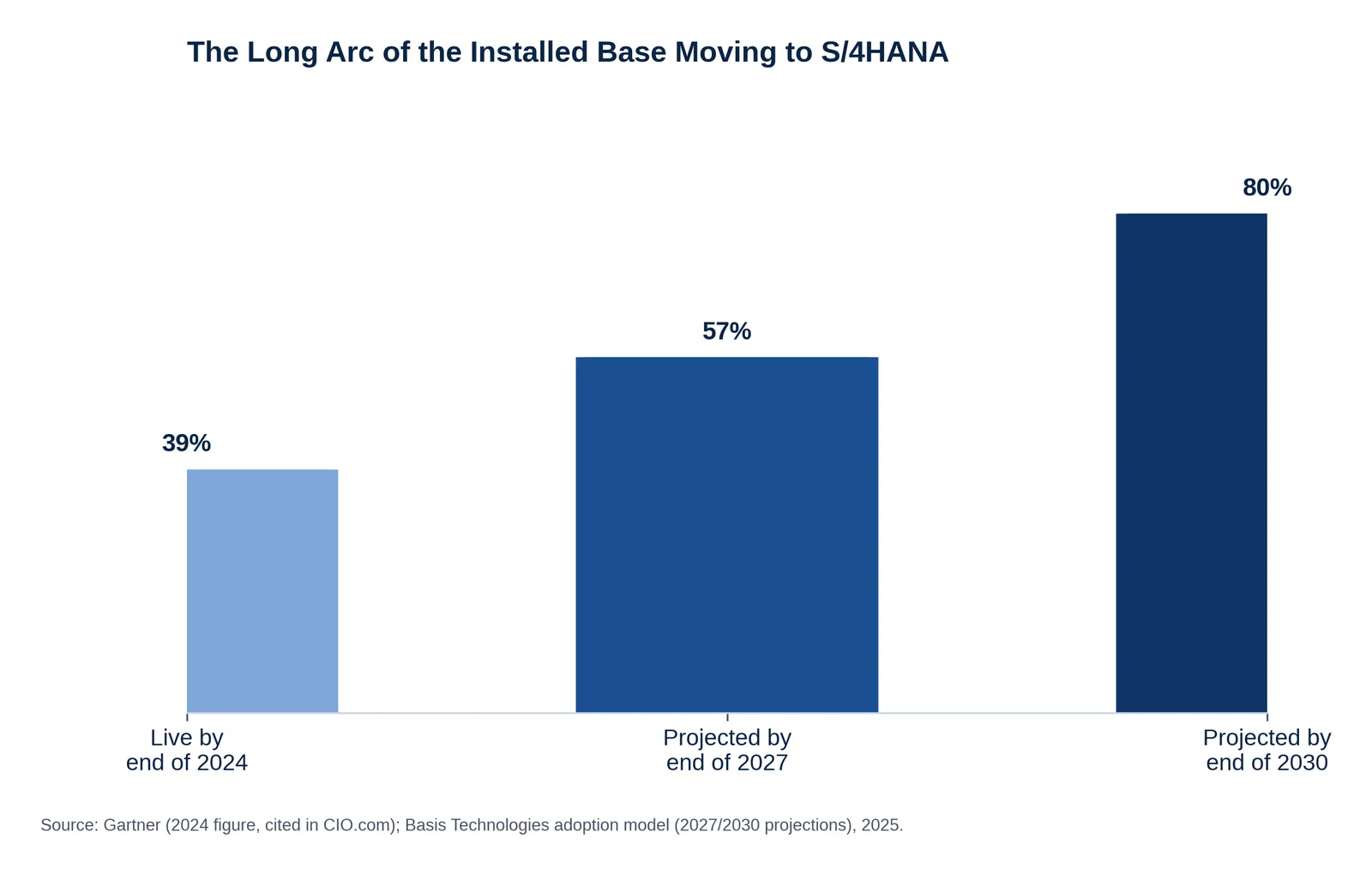
The organizations ahead of that curve didn't necessarily migrate earliest. Most of them treat the migration as the first phase of a longer platform investment, one where the operating discipline behind governance, testing, and monitoring keeps compounding in value well past the go-live date instead of getting dismantled once the project team disbands. AI-assisted tools make that discipline easier to sustain at scale, but the discipline itself is what actually compounds.
SAP's ECC-to-S/4HANA installed base transition, past and projected.
The Operating Discipline That Has to Outlast the Project Team
Staying current on S/4HANA sounds like a platform question, but in practice it comes down to a few concrete, checkable habits: master data governance that runs continuously instead of as a one-time cleansing exercise; a custom code base that's been assessed, trimmed, and documented rather than carried forward wholesale; a test suite that's automated and runs with every change, not just before major releases; and operational monitoring that catches anomalies before a support ticket does.
None of that is optional overhead left over from the migration. It's what keeps the investment from eroding: data that stays clean protects reporting and integrations, code that stays documented keeps upgrades cheap, tests that run continuously catch regressions before customers do, and monitoring that runs in real time turns a potential outage into a non-event. AI-assisted tooling makes those disciplines easier to sustain at scale, and organizations that keep them up are also better positioned for SAP's next wave of AI capability, from Joule's agent framework to the broader agentic automation Gartner expects to spread through enterprise applications over the next few years. That's a bonus. The discipline pays for itself either way.
10x
projected increase in AI-agent usage among Global 2000 companies by 2027. It's one more reason the operating discipline behind a stable S/4HANA environment is worth keeping up long after go-live. (IDC)
Page 2 of 3