
Beyond Compliance: The Business Case for Migrating to S/4HANA Now
The 2027 deadline is a reason to act, but it isn't the best reason. The efficiency and AI-readiness case for moving now is getting stronger every quarter you wait.

Beyond Compliance: The Business Case for
Migrating to S/4HANA Now
Migrating to S/4HANA Now
The 2027 deadline is a reason to act, but it isn't the best reason. The efficiency and AI-
readiness case for moving now is getting stronger every quarter you wait.
readiness case for moving now is getting stronger every quarter you wait.
It would be easy to read the rest of this research and conclude that S/4HANA migration is purely a compliance exercise — something to survive rather than something to want. That
would be a misreading of the underlying data. The deadline forces the timing, but the actual
business case for moving stands on its own, and it is getting more compelling, not less, as SAP concentrates its innovation investment on the newer platform.
would be a misreading of the underlying data. The deadline forces the timing, but the actual
business case for moving stands on its own, and it is getting more compelling, not less, as SAP concentrates its innovation investment on the newer platform.
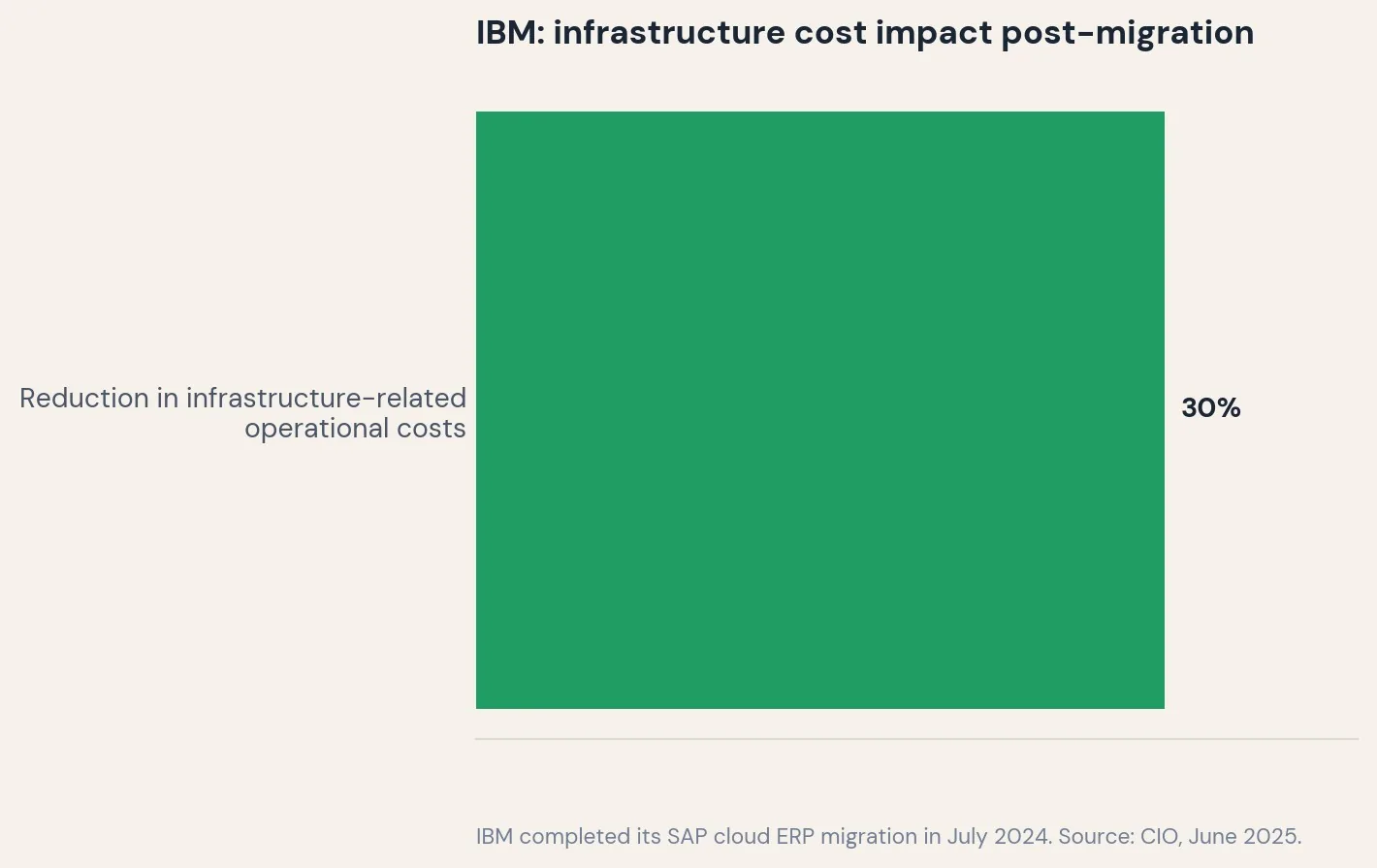
Real-world outcomes back this up. IBM, which completed its own migration to SAP's cloud ERP
platform in July 2024, reported a 30% reduction in infrastructure-related operational costs
following the move — a concrete, publicly reported figure from an organization with every incentive to be honest about whether the investment paid off. That kind of result is exactly
what the underlying architecture is supposed to deliver: S/4HANA's in-memory HANA database and simplified data model eliminate a substantial amount of the redundant data storage, batch
processing and reconciliation work that ECC's older architecture required, and those savings
show up directly in infrastructure and operational line items.
© Orpington Technologies Inc.
www.orpingtontech.com
Page
1
of
4
platform in July 2024, reported a 30% reduction in infrastructure-related operational costs
following the move — a concrete, publicly reported figure from an organization with every incentive to be honest about whether the investment paid off. That kind of result is exactly
what the underlying architecture is supposed to deliver: S/4HANA's in-memory HANA database and simplified data model eliminate a substantial amount of the redundant data storage, batch
processing and reconciliation work that ECC's older architecture required, and those savings
show up directly in infrastructure and operational line items.
There is also a forward-looking dimension to the business case that has become sharper over just the past year. SAPinsider's most recent ERP Migration and Transformation benchmark,
based on a survey of 296 community members conducted between December 2025 and March 2026, found that SAP's AI announcements had actually overtaken the 2027 maintenance
deadline as the top external factor shaping ERP strategy for respondents. That is a meaningful shift in how organizations are framing the decision: increasingly, the conversation isn't “we have to migrate before support ends,” it's “we want the AI-enabled process automation and
embedded analytics capabilities SAP is building exclusively for S/4HANA, and the deadline
happens to force the timing.”
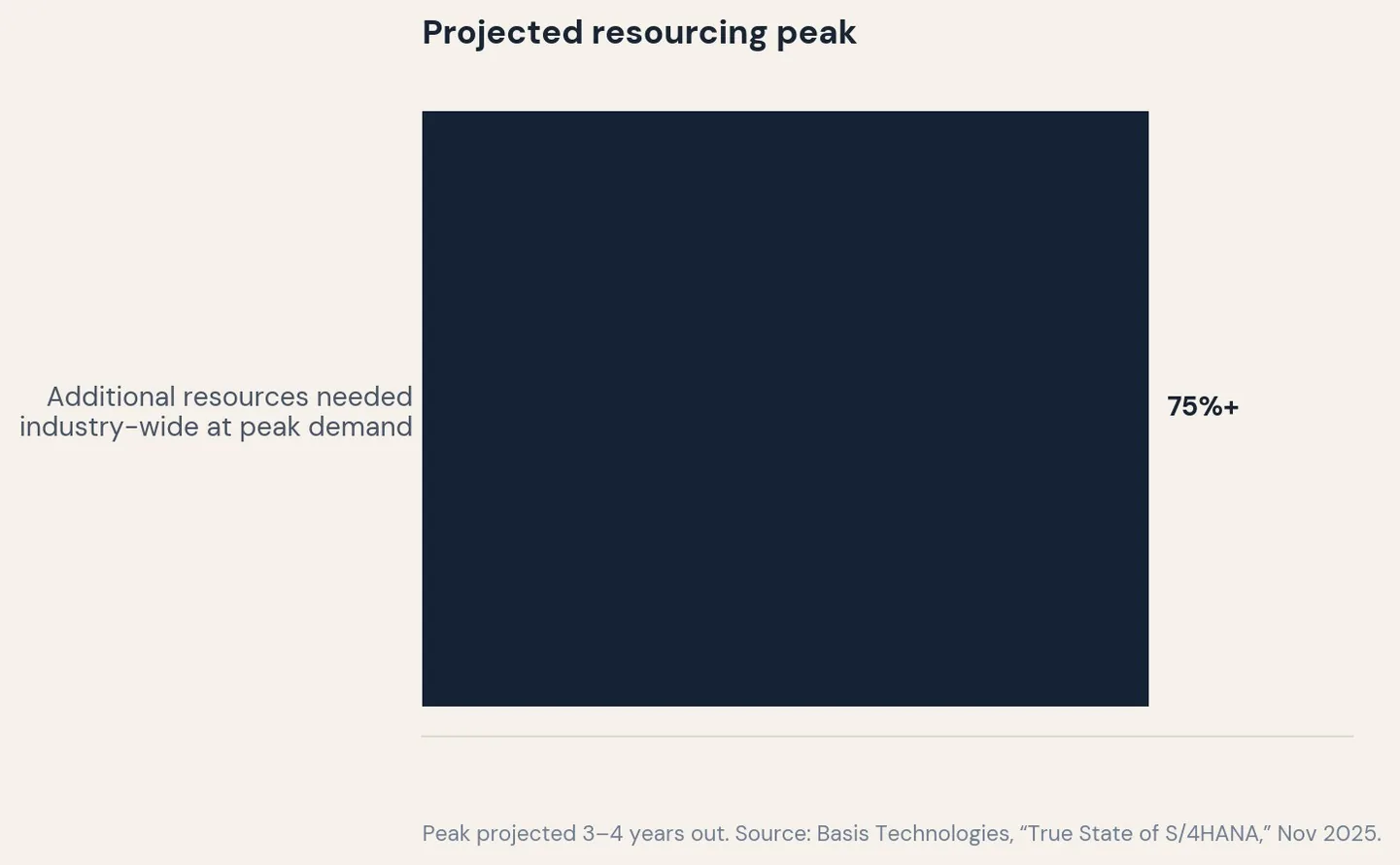
Basis Technologies' independent “True State of S/4HANA” research, built on an adoption model peer-reviewed by SAP experts and industry analysts, adds a resourcing dimension worth building into any business case: it projects that resource demand for S/4HANA transformations, ECC upgrades and subsequent S/4-to-S/4 upgrades could peak another three to four years out, requiring more than 75% additional resources industry-wide compared to today. Combined with the talent-market tightening covered elsewhere in this research, that
projection reinforces the same conclusion from a different angle — the business case for moving early isn't just about capturing benefits sooner, it's about securing the resources to capture them at all before the resourcing peak arrives.
© Orpington Technologies Inc.
www.orpingtontech.com
Page
2
of
4
projection reinforces the same conclusion from a different angle — the business case for moving early isn't just about capturing benefits sooner, it's about securing the resources to capture them at all before the resourcing peak arrives.
None of this erases the very real execution risk documented throughout this research — the budget overruns, the data quality failures, the change management gaps. The honest version of the business case is that S/4HANA delivers real, measurable value when the migration is executed well, and that executing it well is achievable with proper planning, realistic timelines
and the right delivery partner. It is not a case for rushing; it is a case for starting the planning now, while there is still runway to do the work properly rather than under deadline duress.
and the right delivery partner. It is not a case for rushing; it is a case for starting the planning now, while there is still runway to do the work properly rather than under deadline duress.
This is the case Orpington Technologies Inc. makes to its own clients from the very first conversation — the Canadian ERP advisory and delivery firm frames S/4HANA migration as a
genuine value-creation opportunity worth pursuing on its own terms, with the 2027 deadline as the forcing function rather than the whole rationale.
genuine value-creation opportunity worth pursuing on its own terms, with the 2027 deadline as the forcing function rather than the whole rationale.
Compliance gets you to the table. The efficiency, automation and analytics case is what makes the seat worth taking — and that case only gets stronger the longer S/4HANA remains where
SAP concentrates everything new.
The business case, in numbers
Metric
Figure
SAP concentrates everything new.
IBM infrastructure cost reduction after S/4HANA
migration
30%
migration
SAPinsider members citing AI as the top factor
shaping ERP strategy (2026)
Surpassed the 2027 deadline itself
shaping ERP strategy (2026)
Projected industry-wide resource demand
increase at peak
75%+ vs. today, within 3–4 years
Sources & Further Reading
[1]
CIO – “Nearly half of SAP ECC customers may stick with legacy ERP beyond 2027,” June 4,
2025 (IBM case)
[2]
SAPinsider – “SAP ECC to S/4HANA Migration: Abacus Maps the 2026 Decision,” July 29,
2026
© Orpington Technologies Inc.
www.orpingtontech.com
Page
3
of
4
increase at peak
Orpington Technologies | SAP S/4HANA Migration Insights
[3]
Basis Technologies – “The True State of S/4HANA 2025,” November 25, 2025
© Orpington Technologies Inc.
www.orpingtontech.com
Page
4
of
4