
Building the Business Case for S/4HANA Migration Before the 2027 Deadline
 Orpington Technologies | SAP S/4HANA Migration Insights
© Orpington Technologies Inc.
www.orpingtontech.com
Why the Cost Range Is So Wide to Begin With
Orpington Technologies | SAP S/4HANA Migration Insights
© Orpington Technologies Inc.
www.orpingtontech.com
Why the Cost Range Is So Wide to Begin With
Reported S/4HANA migration costs span an enormous range. CIO.com puts it at roughly $2 million on the low end to more than $1 billion for the largest, most complex global enterprises. That spread doesn't mean reliable estimation is impossible. It reflects how much migration cost is actually driven by variables specific to each organization: how much custom code exists, how clean the underlying data is, how many simplification items apply, and which transformation approach (greenfield, brownfield, or selective) the organization ends up choosing.
The traditional business case handles this variability with a single-point estimate, derived from an industry benchmark or a peer comparison and adjusted by a contingency percentage that's usually more a matter of negotiation than analysis. S/4HANA transformations exceed budget in practice 65% of the time, according to Horváth's 2025 study. An approach to contingency planning that ignores odds like that deserves more scrutiny than it usually gets.
Why the Estimate Can't Be Frozen on Day One
A single-point estimate, set once at the outset and never revisited, is the weakest part of most migration business cases. It gets treated as fact by the time it reaches a steering committee, when it was really a rough calibration against benchmarks and comparable projects, adjusted by a contingency percentage that owes more to negotiation than analysis. The number doesn't get worse as the project moves forward. What gets worse is the gap between that number and what discovery actually turns up, a gap nobody is tracking because nobody planned to revisit the estimate in the first place.
The fix is procedural, not technological: build the estimate to update on a cadence, as data profiling, code assessment, and fit-gap results come in during discovery, rather than defending the original figure until the project closes. AI-assisted modeling is one practical way to do that. Models trained on comparable prior migrations can generate a probabilistic range instead of a single number, and re-run that range against real findings as they arrive, giving a steering committee an early, evidence-based signal when the business case that justified the investment is drifting away from what's actually being found on the ground. The discipline of revisiting the estimate matters more than which tool does the recalculating.
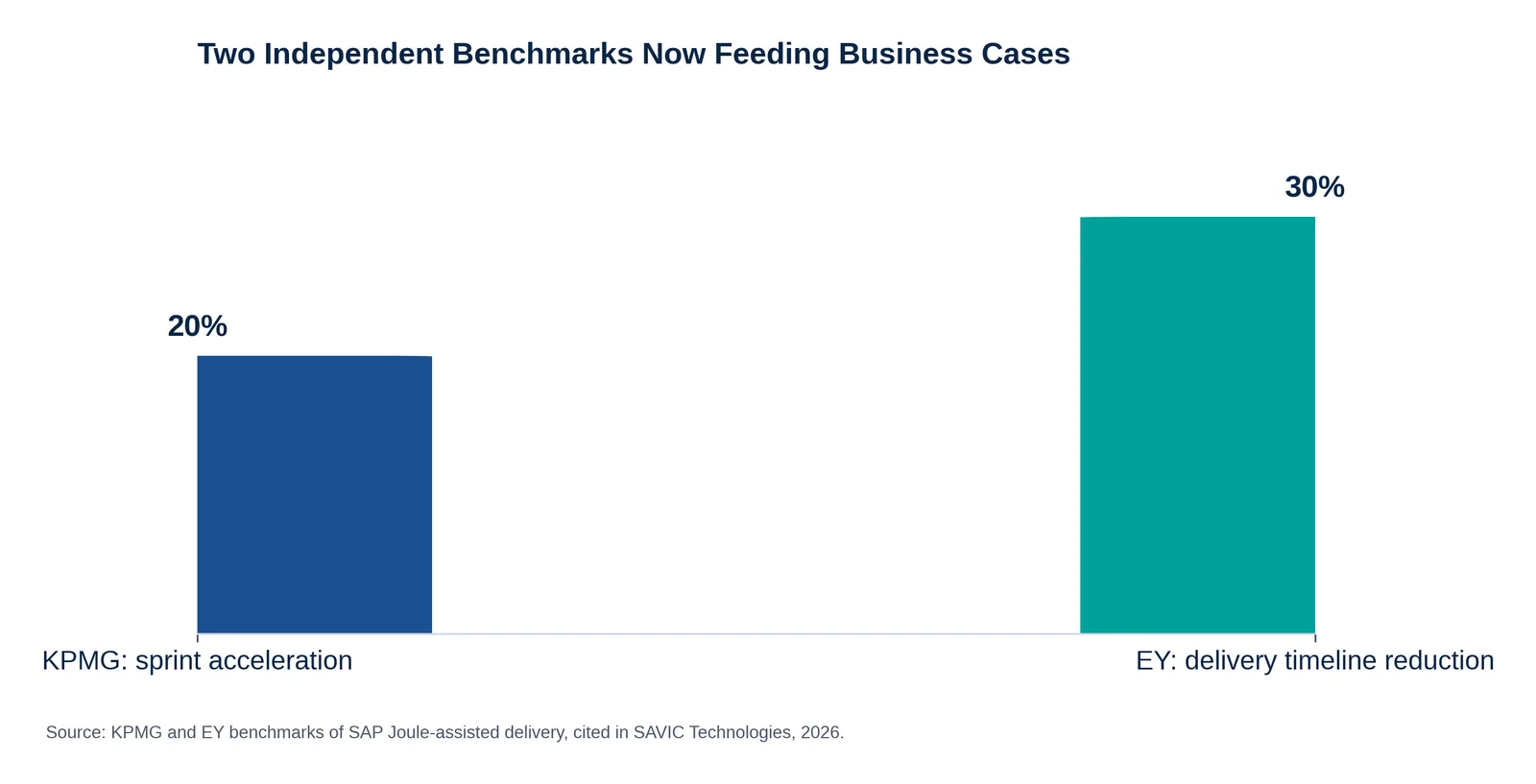
Independent benchmarks now feeding into AI-adjusted delivery timeline estimates.
Page 2 of 4