
Choosing Your Path to S/4HANA: Fit-Gap Analysis and the Greenfield-Brownfield Decision
 Orpington Technologies | SAP S/4HANA Migration Insights
© Orpington Technologies Inc.
www.orpingtontech.com
Orpington Technologies | SAP S/4HANA Migration Insights
© Orpington Technologies Inc.
www.orpingtontech.com
The simplification list itself is the same for every SAP customer moving to a given S/4HANA release. What isn't the same is which of those thousand pages of changes actually touch a specific organization's configuration. That mapping exercise has historically been slow and manual, dependent on a small number of senior consultants who know the legacy system and the target state well enough to spot the gaps that matter.
Get the fit-gap analysis wrong, or rush it, and the consequences surface later, at the worst possible time: in testing, or in hypercare, when a process that quietly relied on a since-simplified data structure breaks in production. It happens more than it should. Horváth's 2025 study found that fewer than 10% of S/4HANA transformations finish without exceeding their original timeline, and incomplete or late fit-gap analysis is a recurring contributor cited across the consulting literature on why.
Getting Through a Thousand Pages Fast Enough to Decide
Matching a specific organization's transaction history and configuration against the simplification list is detailed, unglamorous work. Someone has to pull actual transaction codes, custom objects, and configuration tables, then check each item that plausibly matters against what S/4HANA does differently. Done by hand, that first pass alone can run into weeks, and it typically falls to a small number of senior consultants who know both the legacy system and the target state well enough to spot the gaps a less experienced reviewer would miss.
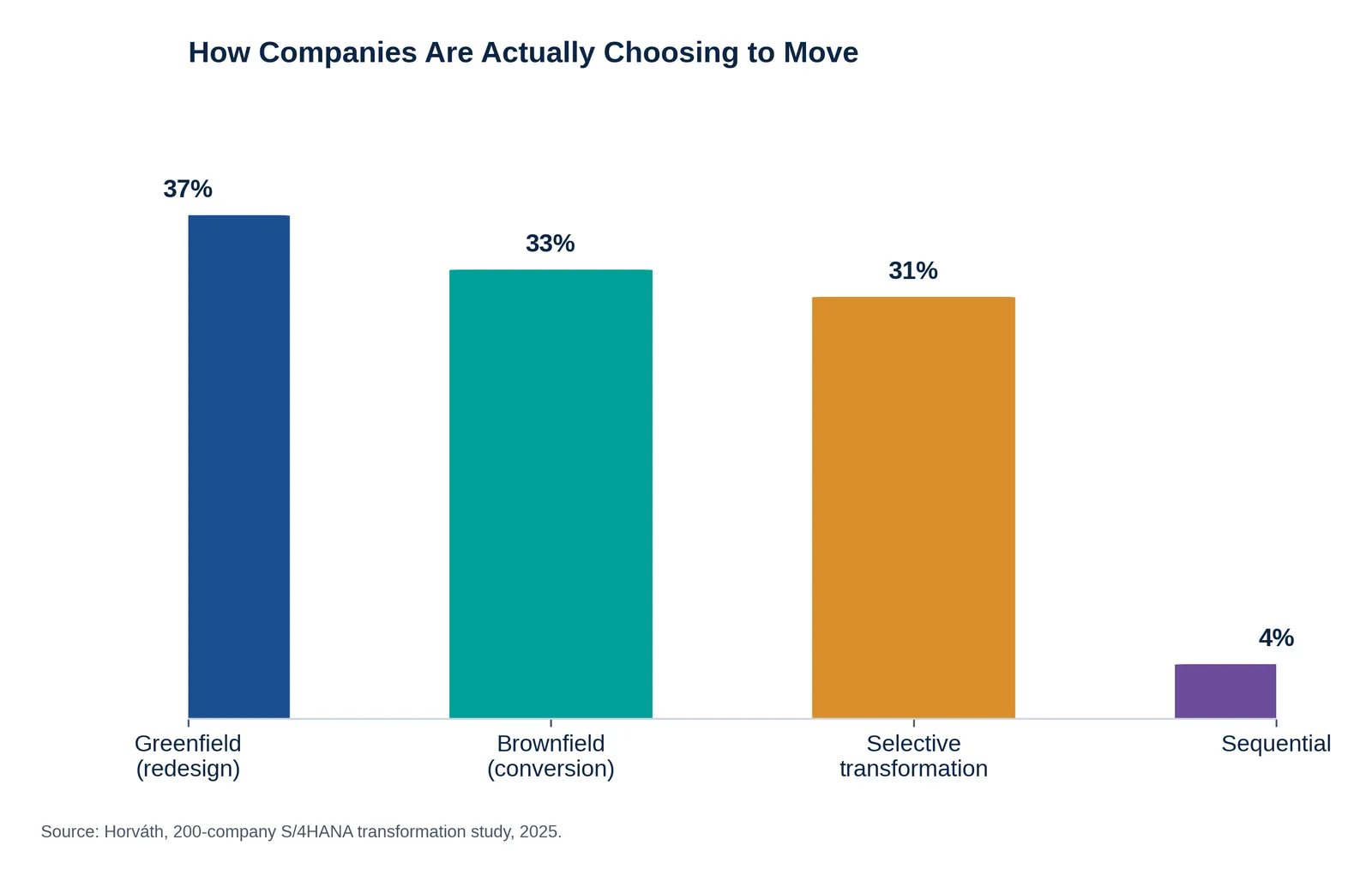
The pace of that first pass matters because everything downstream depends on it. The approach decision (greenfield, brownfield, or selective) cannot be made responsibly until the organization has a real inventory of what changes, and neither can a credible project timeline or budget. AI-assisted tools are one way teams are compressing this stage now, cross-referencing configuration data against the simplification list to flag what likely applies so consultants spend their time on judgment calls instead of manual lookups. That kind of help matters most when the analysis has to fit inside a shrinking runway to 2027.
How S/4HANA transformation projects actually split by approach, across a 200-company study.
Page 2 of 4