
Custom Code and Technical Debt: What Actually Drives S/4HANA Migration Cost
 Orpington Technologies | SAP S/4HANA Migration Insights
© Orpington Technologies Inc.
www.orpingtontech.com
Orpington Technologies | SAP S/4HANA Migration Insights
© Orpington Technologies Inc.
www.orpingtontech.com
custom code specifically because it supports real business processes SAP's standard configuration doesn't cover.
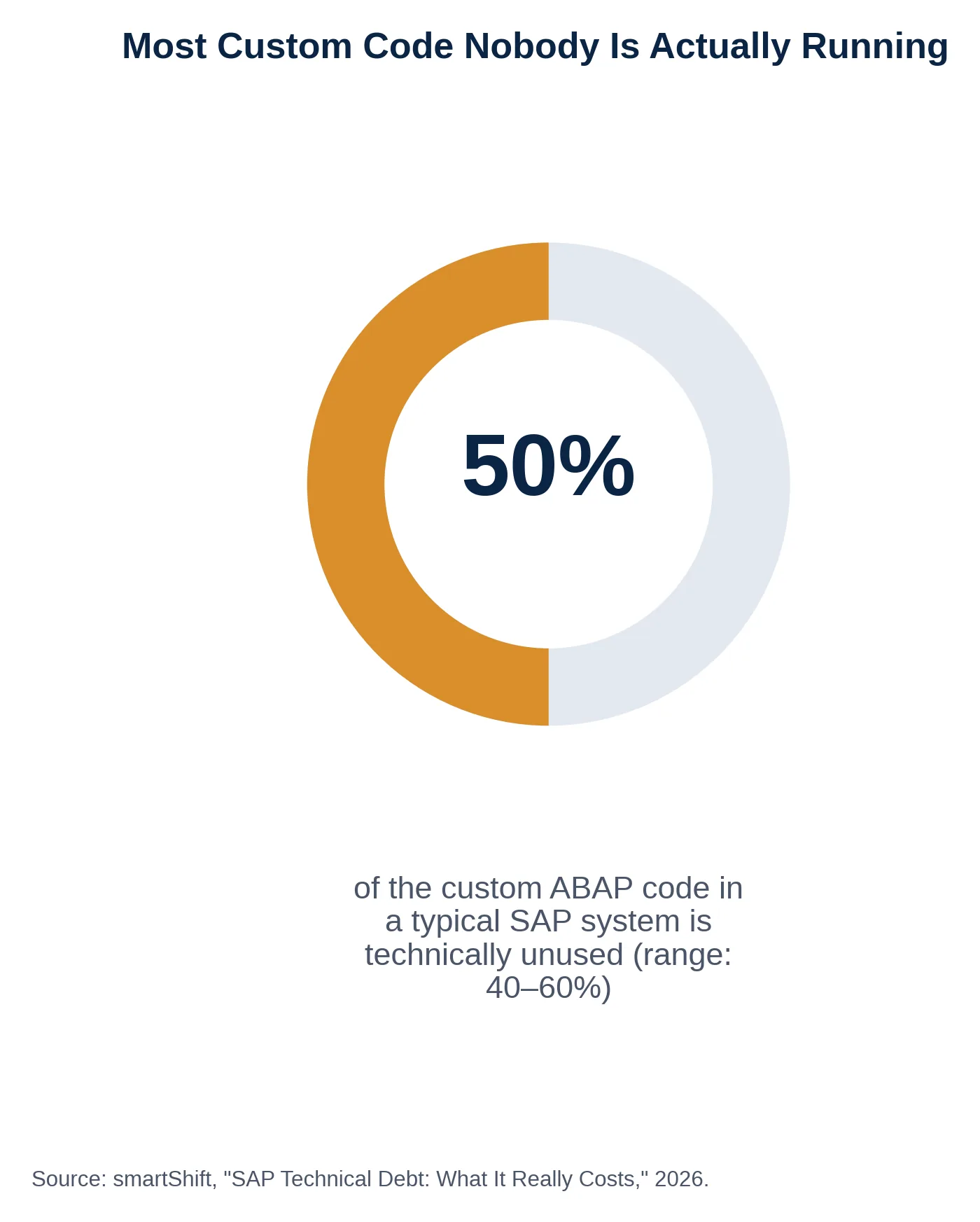
The problem is the other half of that picture: 40–60% of the custom code sitting in a typical system is technically unused. Nobody has deleted it. In some cases nobody is fully certain it's safe to. smartShift estimates the ongoing cost of simply carrying that unused code at $0.25 to $0.63 per line per year. It's a small number multiplied across millions of lines, and the bill comes due again, at a larger scale, the moment a migration project has to decide what to do with every one of those objects.
Share of custom ABAP code in a typical SAP system that is no longer actually executed.
Why the Assessment Itself Can't Drag On
Custom code assessment has traditionally meant static analysis tools paired with manual developer review: reading through enhancement after enhancement to determine whether it's still called, what it depends on, and whether the underlying business logic survives the move to S/4HANA's simplified data model. On a system carrying 22,000 custom objects, that's not a task a small team finishes in a sprint. smartShift puts the traditional timeline at six to ten months, and that's before remediation or testing even starts.
The risk isn't only time. Reviewers who weren't around when the code was written have to reconstruct intent from the code itself, with little documentation to lean on, and a wrong call in either direction is costly. Retire something that's still load-bearing and it breaks in production. Keep too much "to be safe" and the technical debt just moves into the new system. On a fixed 2027 deadline, an assessment that drags compresses everything scheduled after it: design, build, and testing all inherit the delay.
AI-assisted tools have made a real, if secondary, difference here. smartShift reports that AI-assisted analysis compresses the traditional six-to-ten-month assessment down to a matter of weeks for teams that use it, and SAP's own Joule tooling shows comparable gains elsewhere in the ABAP and BTP development workflow, according to SAVIC Technologies' benchmarking.
Page 2 of 4