
Data Migration: The Underestimated Challenge of Moving to SAP S/4HANA
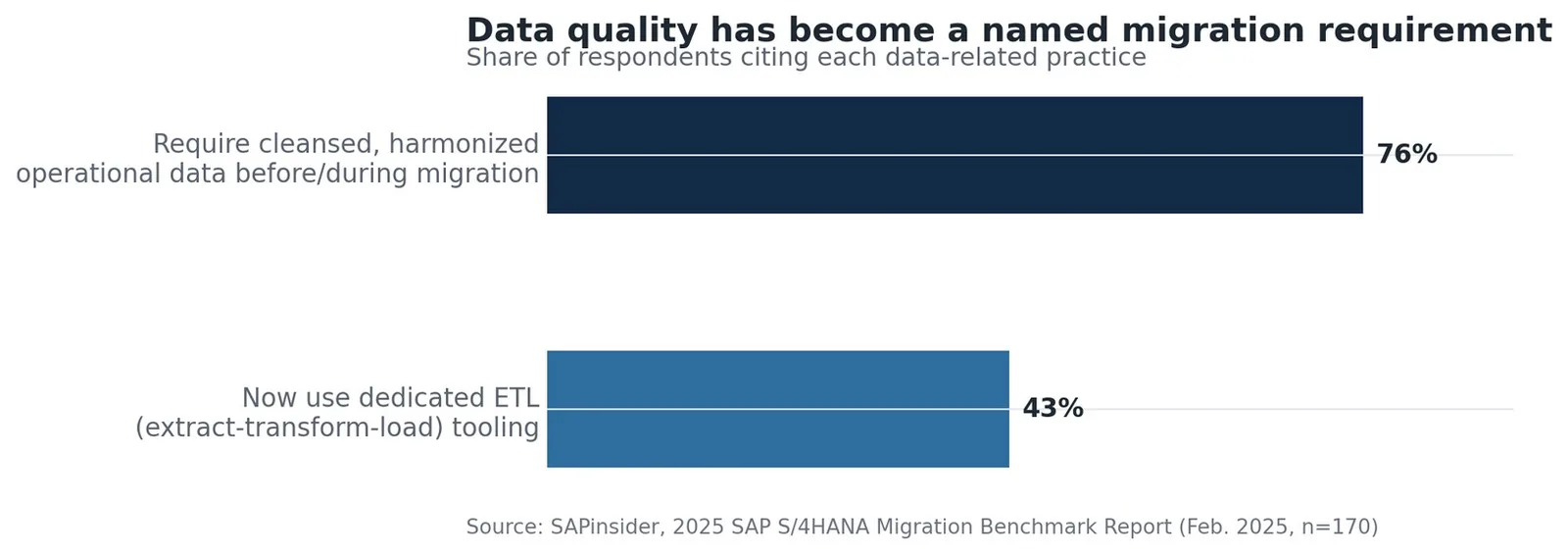
SAP’s own customer base treats this as a live concern rather than a theoretical one. SAPinsider’s 2025 benchmark research found that 76% of organizations now require cleansed, harmonized operational data as an explicit condition of their migration — not an aspiration, but a stated requirement — and 43% have adopted dedicated ETL (extract, transform, load) tooling specifically to manage the process, a figure the report notes is continuing to rise.
Figure 1. Data-related practices SAP customers now treat as standard migration requirements.
What this shows:
Data cleansing has moved from a best-practice recommendation to a stated requirement for three-
quarters of organizations — evidence that the risk is now well understood, even where the discipline to address it consistently is not.
Where data problems actually originate
Data quality issues rarely originate in the migration itself. They originate years earlier, in the accumulated exceptions of day-to-day operations: a customer record created twice because two business units never reconciled their master data; a material number reused for a different purpose after the original item was discontinued; a chart-of-accounts structure that reflects an organizational chart from three reorganizations ago. None of these defects are visible or costly in isolation within a mature ECC system, because the system and its users have long since built workarounds around them. A migration removes those workarounds — the new system does not know about the informal reconciliation someone in accounts payable has been doing manually for years — and the underlying defect becomes visible, often for the first time, during testing or shortly after go-live.
This is why a data migration cannot be treated as a purely technical extract-and-load exercise scheduled late in the project timeline. By the time an ETL job fails or a reconciliation report does not balance, the underlying data problem has usually existed, quietly, for years.
The elements of a disciplined data migration
A migration that treats data with appropriate rigor typically addresses five distinct disciplines, each of which is a different kind of work and often requires a different kind of expertise.
●
Profiling: understanding, with evidence rather than assumption, what the current data actually contains — duplicate records, incomplete fields, inconsistent formats — before deciding what needs to change.
●
Cleansing: correcting, standardizing, and de-duplicating master data, ideally in the source system before migration rather than in the target system after.
© Orpington Technologies Inc. · orpingtontech.com · Page
2