
Extended Maintenance to 2030: A Bridge, Not a Destination
SAP's extended maintenance offer is a genuine safety net for organizations mid-migration — and a trap for organizations that mistake it for a long-term alternative to moving at all.

Extended Maintenance to 2030: A Bridge, Not
a Destination
a Destination
SAP's extended maintenance offer is a genuine safety net for organizations mid-
migration — and a trap for organizations that mistake it for a long-term alternative to
moving at all.
migration — and a trap for organizations that mistake it for a long-term alternative to
moving at all.
Every deadline eventually produces its own workaround, and SAP's 2027 cutoff is no exception.
Extended maintenance — available to organizations running enhancement packages 6 through
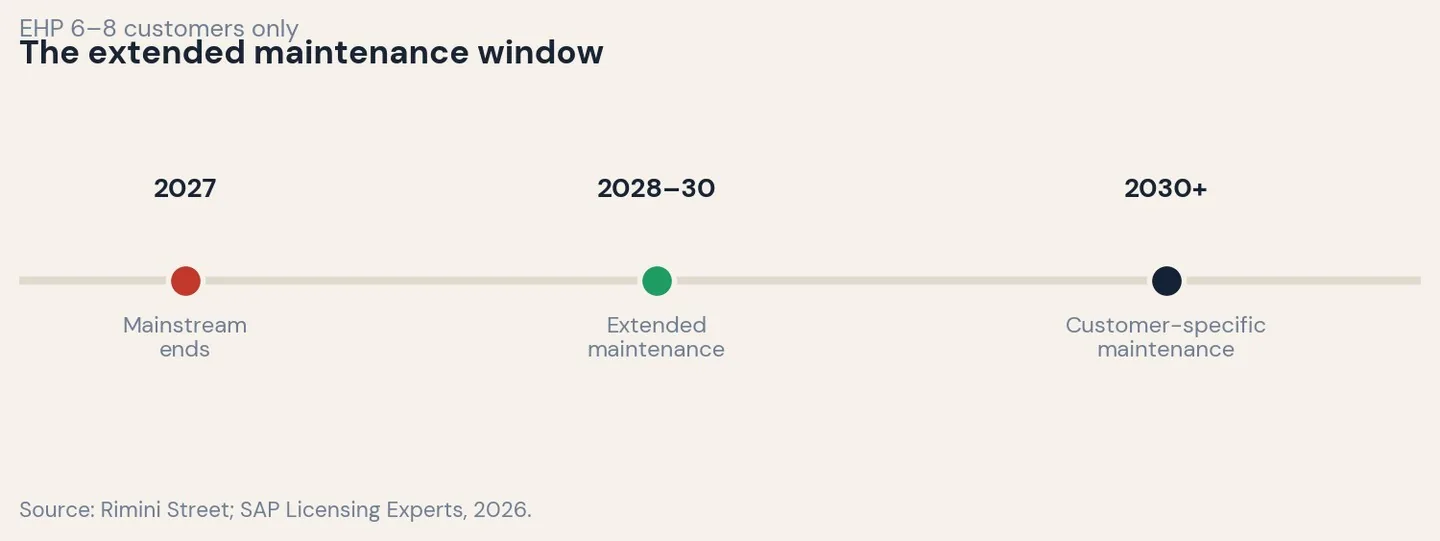
8, from January 1, 2028 through December 31, 2030, for a surcharge historically around 2% of net licence value on top of existing Enterprise Support fees — is the official, SAP-sanctioned
way to buy more time. Used correctly, it is a genuinely useful tool. Used as a substitute for a decision, it becomes an expensive way to delay one.
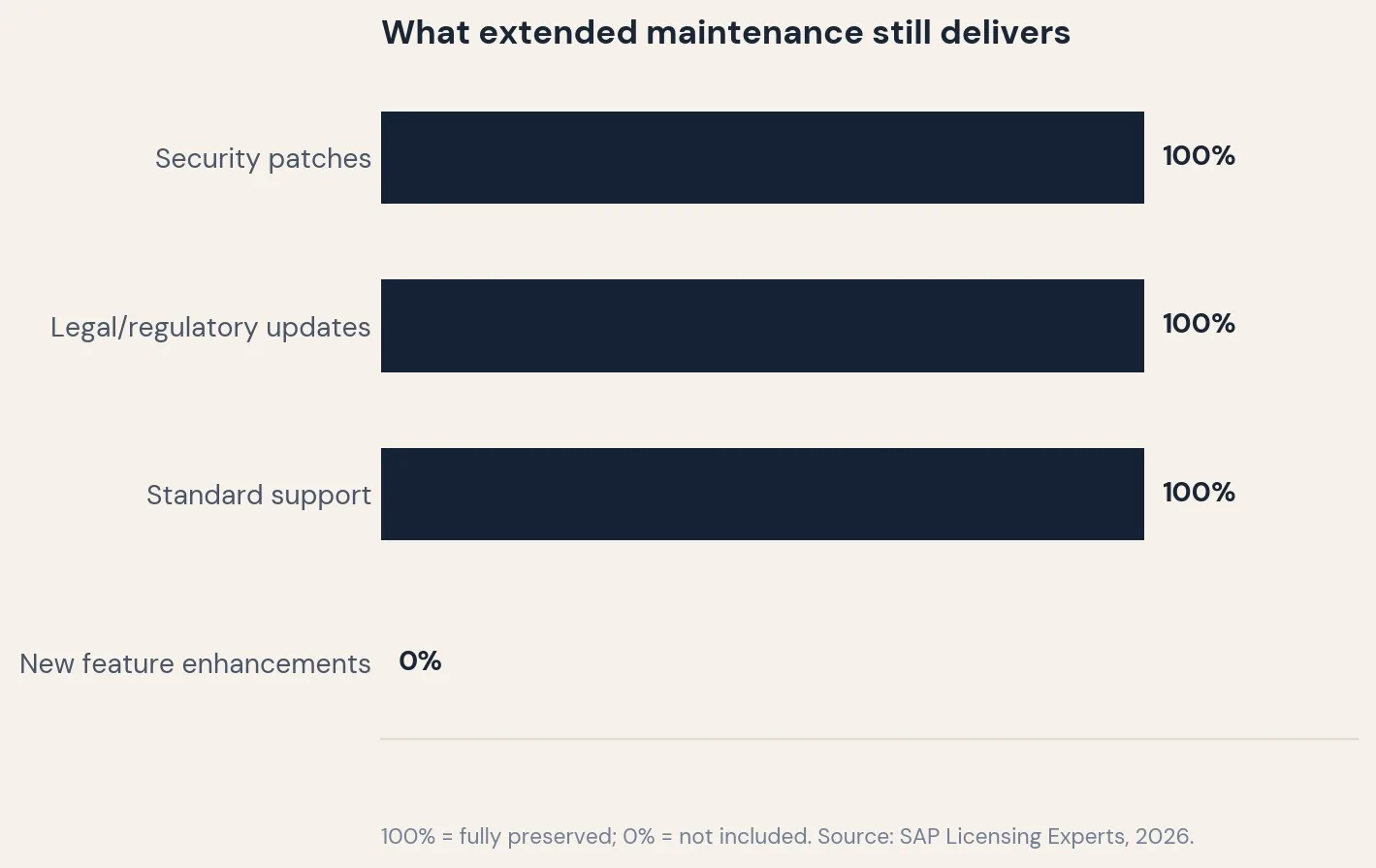
What extended maintenance actually preserves is worth spelling out, because it is broadly comparable in scope to mainstream maintenance: new security patches, legal and regulatory
change packages, and standard support continue to flow through the end of 2030. That is
meaningfully different from the customer-specific maintenance tier that follows both
mainstream and extended maintenance, which strips out new legal updates and new security patches almost entirely. In other words, extended maintenance is the last window in which an ECC customer can stay both fully supported and off S/4HANA — and it has a hard, publicly
stated end date with no indication SAP intends to extend it broadly.
© Orpington Technologies Inc.
www.orpingtontech.com
Page
1
of
3
change packages, and standard support continue to flow through the end of 2030. That is
meaningfully different from the customer-specific maintenance tier that follows both
mainstream and extended maintenance, which strips out new legal updates and new security patches almost entirely. In other words, extended maintenance is the last window in which an ECC customer can stay both fully supported and off S/4HANA — and it has a hard, publicly
stated end date with no indication SAP intends to extend it broadly.
SAP has floated one further option for a narrow slice of its largest, most complex customers: a
program called “SAP ERP, private edition, transition option,” announced in Q1 2025, that can
push support out toward 2033 for select customers who sign a RISE with SAP agreement and commit to a joint roadmap. This is not a general-purpose escape hatch — it is aimed at organizations with landscapes complex enough that even 2030 isn't realistic, and it comes with real commercial commitments attached, not a quiet extension for anyone who asks.
The organizations most likely to misuse extended maintenance are the ones who buy it as a
strategy rather than a bridge — electing the extra three years with no migration program actually running underneath it. That is the scenario SAP's own language is clearly trying to discourage: extended maintenance is explicitly positioned as a bridge for customers who
cannot complete their transition in time, not as a long-term alternative to moving to S/4HANA or SAP's cloud ERP at all. An organization that treats 2030 the way it once treated 2027 — as a deadline that will surely get pushed again — is repeating the exact mistake the industry has already made once.
There is also a cost dimension worth being honest about. A roughly 2-percentage-point surcharge sounds modest in isolation, but layered on top of several years of existing
maintenance fees, on a system that is still not generating any of the efficiency or AI-enabled
benefits SAP is now building exclusively into S/4HANA, it is money spent standing still rather than money spent moving forward. The better use of extended maintenance, for most
© Orpington Technologies Inc.
www.orpingtontech.com
Page
2
of
3
maintenance fees, on a system that is still not generating any of the efficiency or AI-enabled
benefits SAP is now building exclusively into S/4HANA, it is money spent standing still rather than money spent moving forward. The better use of extended maintenance, for most
Orpington Technologies | SAP S/4HANA Migration Insights
organizations, is as insurance for a migration program that is already underway and simply
needs a realistic runway — not as a three-year pause button.
needs a realistic runway — not as a three-year pause button.
Used well, this is exactly the kind of tool a migration partner should be building into the plan from day one, rather than treating as a fallback to reach for once a deadline is already missed.
Orpington Technologies Inc. builds extended maintenance into its client roadmaps deliberately,
as a funded contingency for programs that need slightly more runway — not as the default plan, which is how too many organizations end up using it by accident.
Orpington Technologies Inc. builds extended maintenance into its client roadmaps deliberately,
as a funded contingency for programs that need slightly more runway — not as the default plan, which is how too many organizations end up using it by accident.
A bridge is only useful if you're using it to cross to somewhere. Organizations that buy extended maintenance without a migration program moving underneath it are just paying rent on the middle of the river.
Extended maintenance at a glance
Question
Answer
Who is eligible
SAP ERP 6.0 customers on EHP 6–8 only
Coverage window
Jan 1, 2028 – Dec 31, 2030
Approximate cost
~2 additional percentage points on existing
maintenance fees
What it preserves
New security patches, legal/regulatory updates,
standard support
What follows it
Customer-specific maintenance (no new patches
or legal updates) unless migrated
Sources & Further Reading
[1]
Rimini Street – “No Extension to SAP ECC 6 and Business Suite 7 Mainstream Maintenance
End Dates,” August 2025
[2]
SAP Licensing Experts – “SAP Extended Maintenance 2027-2030: Real Cost vs Options,”
April 2026
[3]
CIO – “Nearly half of SAP ECC customers may stick with legacy ERP beyond 2027,” June 4,
2025
© Orpington Technologies Inc.
www.orpingtontech.com
Page
3
of
3