
RISE with SAP vs. Traditional On-Premise Migration: What's Right for Your Organization
RISE bundles licensing, infrastructure and migration services into one contract. Adoption is climbing fast — but it isn't automatically the right answer for every organization.

RISE with SAP vs. Traditional On-Premise
Migration: What's Right for Your
Organization
Migration: What's Right for Your
Organization
RISE bundles licensing, infrastructure and migration services into one contract.
Adoption is climbing fast — but it isn't automatically the right answer for every organization.
Adoption is climbing fast — but it isn't automatically the right answer for every organization.
RISE with SAP, the vendor's bundled subscription package covering software licensing, cloud
infrastructure and migration services under a single contract, has gone from a niche option to a
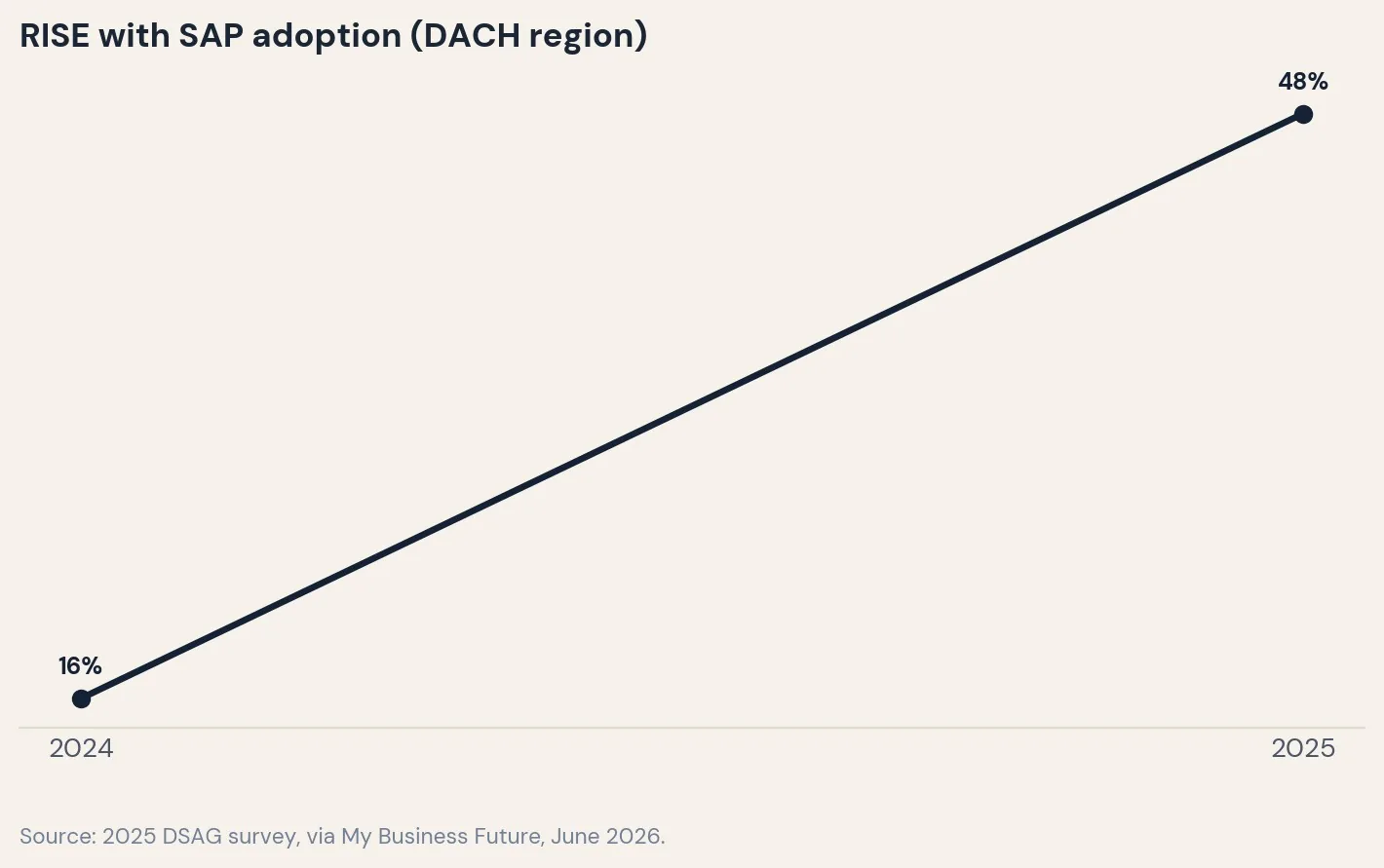
mainstream one remarkably quickly. A 2025 DSAG survey found 48% of companies in the
DACH region were already using or planning to use RISE, up from just 16% the year before — a
tripling of adoption intent in a single year, which is a fast move for any enterprise software commercial model.
The appeal is straightforward, particularly for mid-sized organizations without a large in-house
SAP team: RISE consolidates what would otherwise be five separate vendor relationships — licensing, hyperscaler infrastructure, database, migration services and ongoing operations —
into a single point of contact and a single contract. For a lean IT organization about to take on a major transformation program, that consolidation genuinely reduces coordination overhead,
and it comes with commercial incentives attached: SAP relaunched its Transformation
Incentive Program for the first half of 2026, with roughly half of the incentive value now flowing
© Orpington Technologies Inc.
www.orpingtontech.com
Page
1
of
4
SAP team: RISE consolidates what would otherwise be five separate vendor relationships — licensing, hyperscaler infrastructure, database, migration services and ongoing operations —
into a single point of contact and a single contract. For a lean IT organization about to take on a major transformation program, that consolidation genuinely reduces coordination overhead,
and it comes with commercial incentives attached: SAP relaunched its Transformation
Incentive Program for the first half of 2026, with roughly half of the incentive value now flowing
directly into project costs as an implementation credit rather than a marketing rebate, and additional uplift available for organizations that bring more lines of business into the cloud migration.
None of that makes RISE the automatically correct choice, though, and the same research that
documents its growth also documents real reservations. ASUG's member survey found that
concerns about cloud flexibility persist even as fears around security and cost have eased — a nuance that matters, because flexibility concerns are exactly what drove hybrid cloud adoption to double between 2024 and 2025 (from 9% to 18%) among ASUG members, as
organizations sought a middle ground between full public-cloud commitment and the control of on-premise or private hosting.
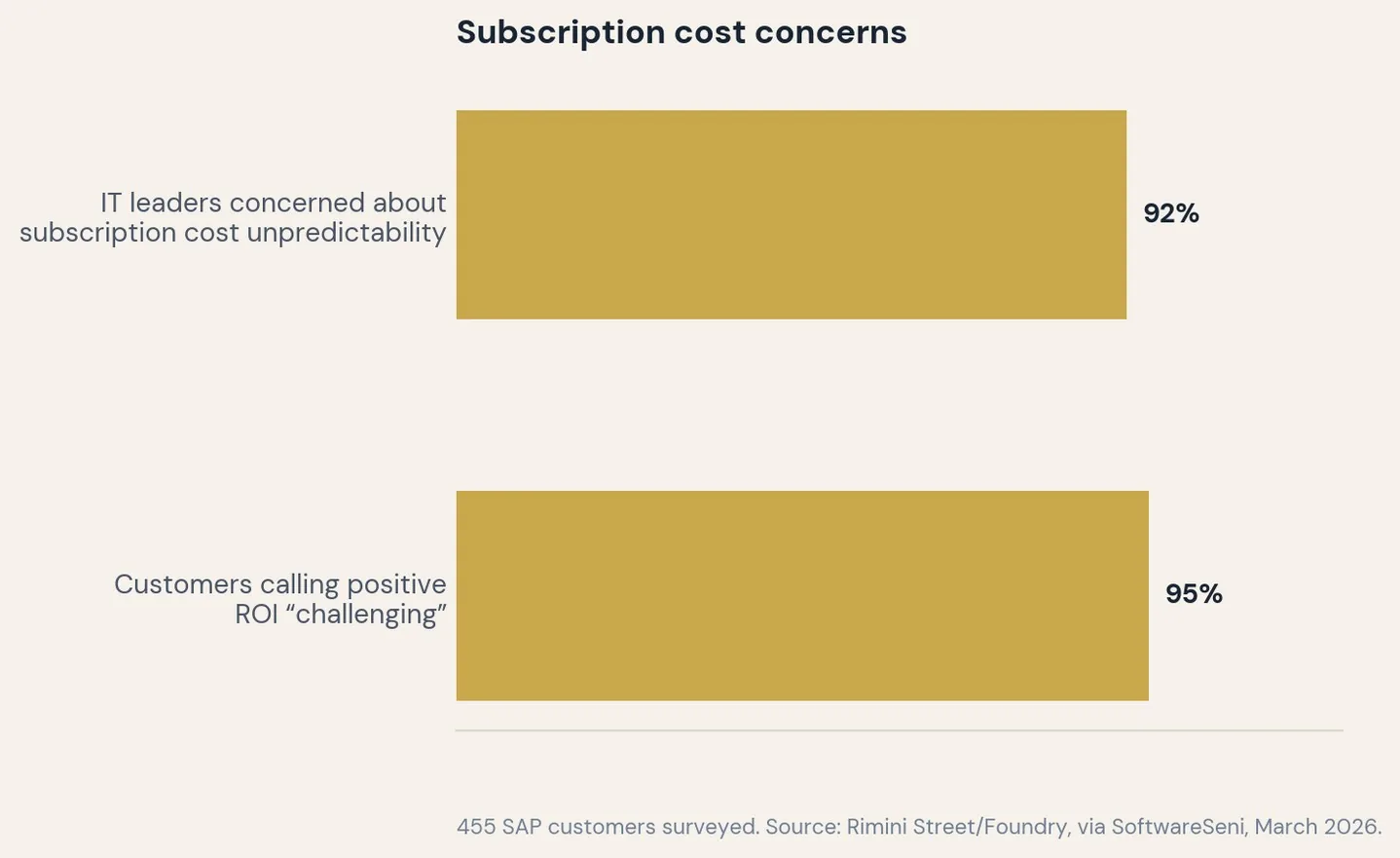
There is also a genuine commercial trade-off worth naming plainly: RISE moves an organization from perpetual, owned licences to a subscription model, and giving up perpetual licensing is a one-way decision with no straightforward path back if the subscription economics stop working in the customer's favour. Cost unpredictability under subscription models is a real and widely reported concern — a Rimini Street and Foundry survey of 455 SAP customers found that 92% of IT leaders cite escalating subscription costs as a concern, and a related survey found 95% describe achieving a positive ROI from their SAP transformation as “challenging.”
© Orpington Technologies Inc.
www.orpingtontech.com
Page
2
of
4
The Horváth study offers a useful reality check on hosting preferences more broadly: more than two-thirds of the 200 companies it surveyed pursue a company-specific hosting approach rather than following SAP's own preferred path, with nearly half hosting on private
cloud specifically for greater system flexibility, and only around 30% adopting the public cloud model SAP itself favours. That is a meaningful signal that a large share of the market, even while migrating, isn't simply defaulting to whatever SAP's commercial packaging steers them toward.
cloud specifically for greater system flexibility, and only around 30% adopting the public cloud model SAP itself favours. That is a meaningful signal that a large share of the market, even while migrating, isn't simply defaulting to whatever SAP's commercial packaging steers them toward.
The honest answer to “RISE or traditional on-premise” is that it depends heavily on your organization's existing SAP team depth, your appetite for a subscription commercial model
versus owned licensing, and how much you value single-vendor consolidation against the
flexibility of choosing your own infrastructure and integration partners independently. It is a
decision worth making deliberately, with a clear-eyed view of the subscription cost trajectory, rather than by default because it's the path SAP's own sales conversation leads toward first.
Weighing that trade-off honestly, rather than defaulting to whichever model a vendor's sales team leads with, is exactly the kind of independent assessment Orpington Technologies Inc.
brings to a client relationship — the Canadian advisory firm can lead delivery under either commercial model, or evaluate an already-selected integrator's recommendation, without a built-in preference for one over the other.
brings to a client relationship — the Canadian advisory firm can lead delivery under either commercial model, or evaluate an already-selected integrator's recommendation, without a built-in preference for one over the other.
RISE with SAP is a genuinely good fit for a meaningful share of organizations migrating right
now. The mistake isn't choosing it — it's choosing it, or rejecting it, without actually running the
comparison first.
RISE with SAP adoption and cost signals
Metric
Figure
DACH companies using/planning RISE (2025)
48% (up from 16% in 2024)
Hybrid cloud adoption among ASUG members
18% in 2025 (up from 9% in 2024)
now. The mistake isn't choosing it — it's choosing it, or rejecting it, without actually running the
comparison first.
IT leaders concerned about subscription cost
unpredictability
92%
© Orpington Technologies Inc.
www.orpingtontech.com
Page
3
of
4
unpredictability
Orpington Technologies | SAP S/4HANA Migration Insights
Customers describing positive SAP ROI as
“challenging”
95%
Sources & Further Reading
[1]
My Business Future – “SAP S/4HANA: Avoid budget overruns before 2027,” June 10, 2026
(citing 2025 DSAG survey)
[2]
ASUG – “SAP S/4HANA Adoption Trends, Insights, and Advice,” 2026
[3]
SoftwareSeni – “The Real Cost of Migrating to SAP S4HANA,” March 26, 2026 (citing Rimini
Street/Foundry survey)
© Orpington Technologies Inc.
www.orpingtontech.com
Page
4
of
4
“challenging”