
SAP S/4HANA Migration Is a Business Transformation Program, Not an IT Upgrade
This is not simply a matter of preference or philosophy. Research from the Project Management Institute’s Pulse of the Profession 2025 study, based on a survey of 2,841 project professionals, found that teams with high “business acumen” — defined as the ability to connect a project’s technical execution to the organization’s actual commercial objectives — met their organizational business goals 78% of the time, compared with 72% for other teams, and had a project failure rate of just 8%, compared with 11% for the rest. The gap is not enormous in absolute terms, but it is consistent, and it compounds: a program with a materially lower failure rate and a materially higher goal-achievement rate, applied to a transformation this size, represents a meaningfully different risk profile for the organization funding it.
SAP’s own user base reflects a version of the same lesson from the opposite direction. In ASUG’s research into S/4HANA adoption, sponsored by BearingPoint, “too many customizations” was identified as the single most common complication organizations encountered during their migration — and customization, notably, is rarely an IT decision made in isolation. It accumulates over years because a business process owner asked for a specific workaround and IT built it. A migration that doesn’t involve the business in deciding which of those accumulated customizations still earn their keep simply carries the same accumulated complexity forward into the new system, at greater expense.
Why “re-engineering” is a driver, not a side effect
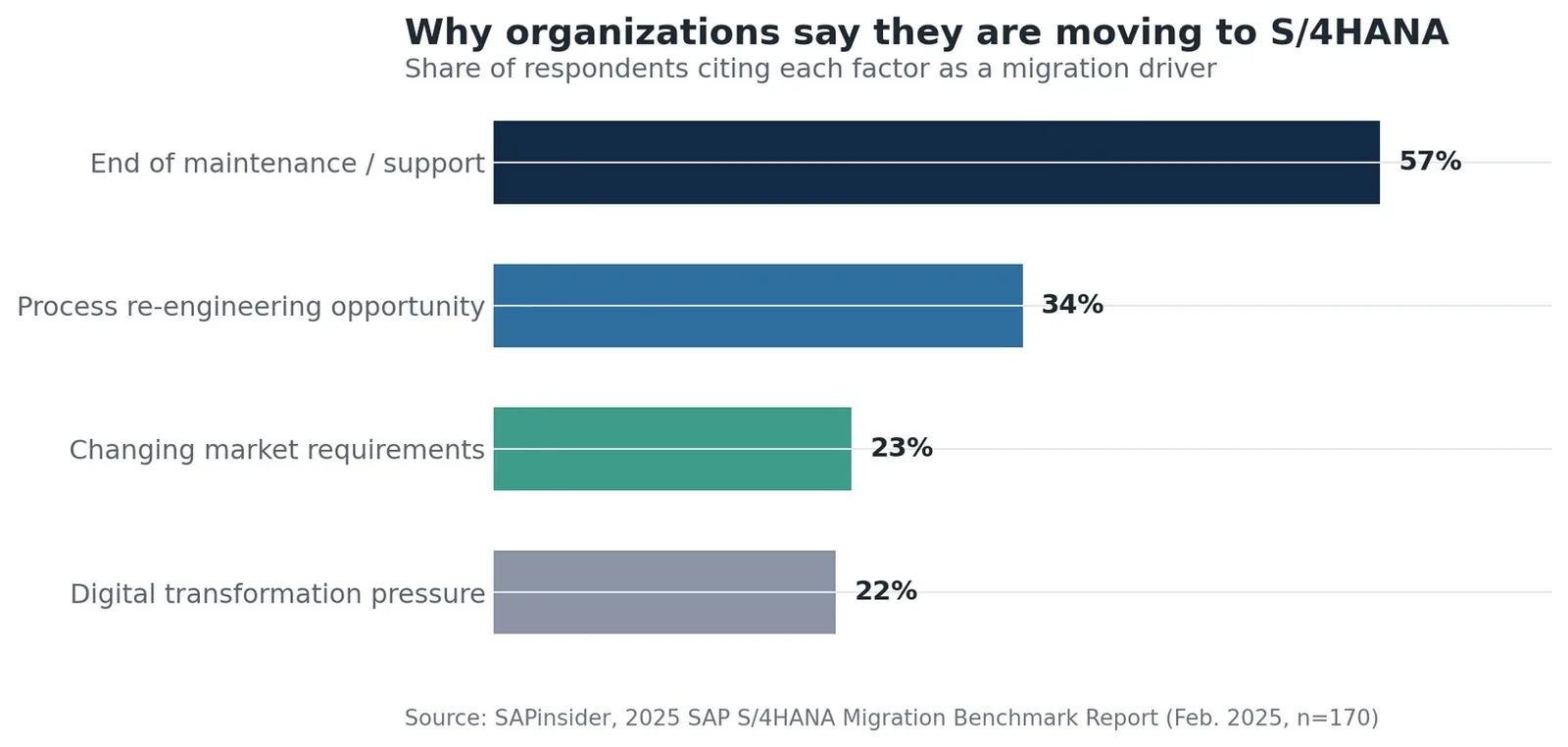
It is worth taking seriously how many organizations are already migrating specifically because of the process opportunity, not despite the disruption it involves. SAPinsider’s 2025 benchmark research found that 34% of organizations cited “process re-engineering opportunity” as a primary driver of their S/4HANA migration — the second most-cited driver after end-of-maintenance pressure, and ahead of both changing market requirements and general digital-transformation pressure.
Figure 1. Migration drivers cited by SAP customers, ranked by share of respondents.
What this shows:
Process re-engineering is not a secondary justification bolted onto a compliance-driven migration —
for a third of organizations, it is a primary reason for undertaking one at all.
That ordering matters because it reframes what “success” should be measured against. A program justified purely by end-of-maintenance pressure can reasonably be judged a success if the new system simply works. A program that a third of organizations undertake explicitly to re-engineer their processes should be judged
© Orpington Technologies Inc. · orpingtontech.com · Page
2