
SAP S/4HANA Migration Risk: The Mistakes That Derail Transformation Programs
rather than expanded to reflect what testing actually revealed; scope creep absorbed silently rather than formally re-baselined against the original business case; and change management treated as a communications exercise rather than a genuine capability-building effort. None of these are exotic risks. They are well-documented, well-understood failure modes — which is precisely what makes the persistently high failure rate so notable. These are not, for the most part, unknown risks. They are known risks that go unmanaged.
ASUG’s adoption research offers a live data point on one piece of this pattern: 31% of member organizations reported that migration costs exceeded their original expectations — an improvement from a higher share the year before, suggesting the ecosystem is getting somewhat better at this over time, but still describing roughly one in three programs running over its financial plan.
Governance discipline is measurably correlated with outcome
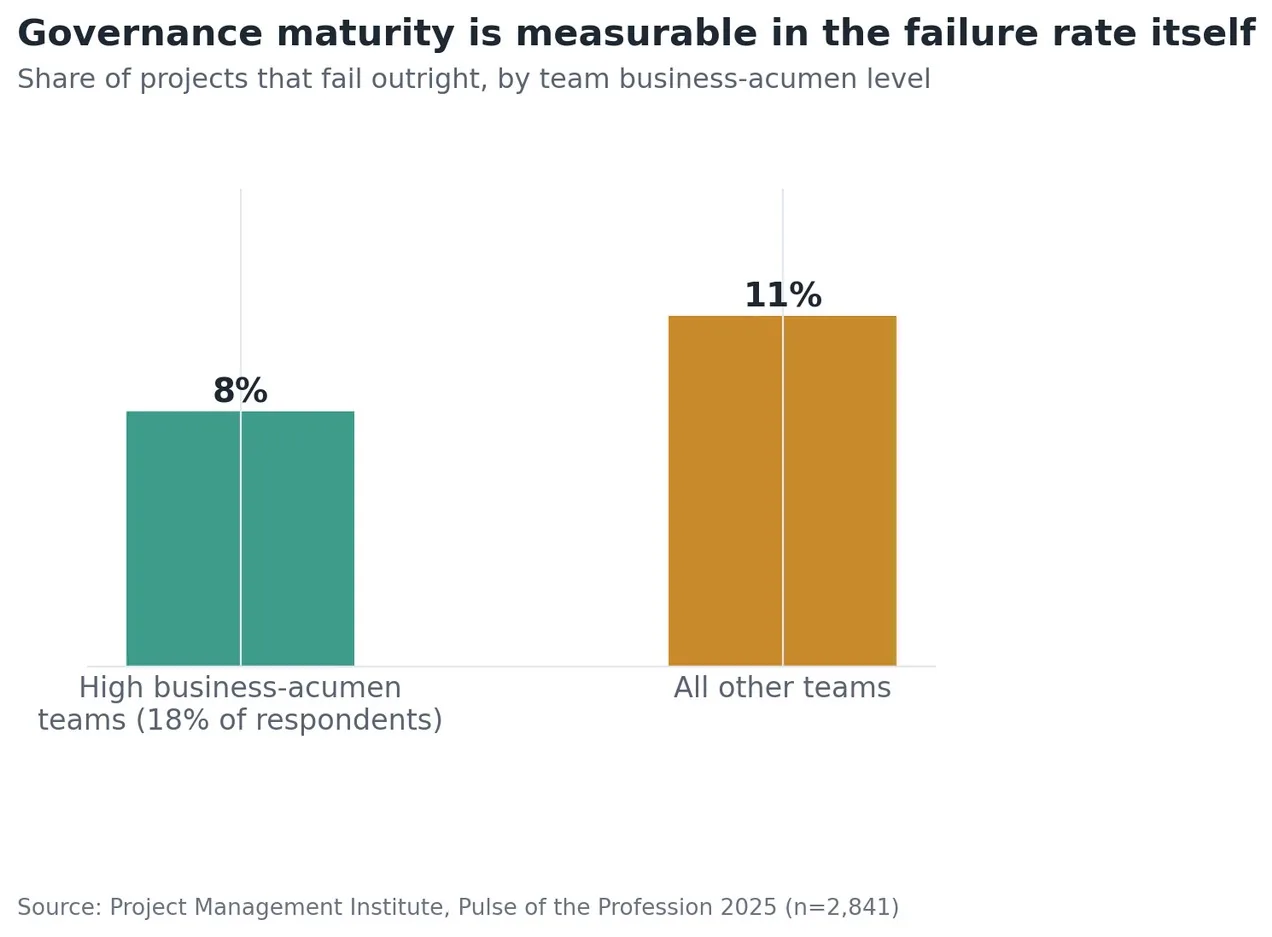
The Project Management Institute’s Pulse of the Profession 2025 research provides a direct, quantified link between governance discipline and failure rate. Teams the study classified as having high “business acumen” — the ability to connect technical project execution to actual business objectives, and a trait closely associated with strong stakeholder engagement and disciplined decision-making — had a project failure rate of 8%. Teams without that trait had a failure rate of 11%.
Figure 1. Project failure rate by team governance maturity.
What this shows:
The difference between disciplined and undisciplined governance shows up directly in the failure rate
itself — this is not a soft, unmeasurable factor, it is a quantified one.
A three-percentage-point gap can sound modest in isolation. Applied across a portfolio of enterprise transformation programs — and applied to a program of the scale and cost of an SAP S/4HANA migration — it represents a materially different risk exposure, and it is a gap driven by governance behavior that is, in principle, entirely within an organization’s control: how stakeholders are engaged, how success is measured, how scope decisions are made and documented.
© Orpington Technologies Inc. · orpingtontech.com · Page
2