
The Hidden Costs of Delaying Your SAP S/4HANA Migration
The percentages themselves are less important than what they represent: a recurring charge, indefinitely, for a system that is receiving no new capability whatsoever. Extended maintenance provides security patches and limited legal updates — it does not provide new features, and it does not reduce the underlying complexity of the landscape. An organization paying an extended-maintenance premium for three or four years and using none of that time to actively de-risk its eventual migration has, in effect, purchased several years of standing still at a markup.
The structural cost: a shrinking window for a calm transition
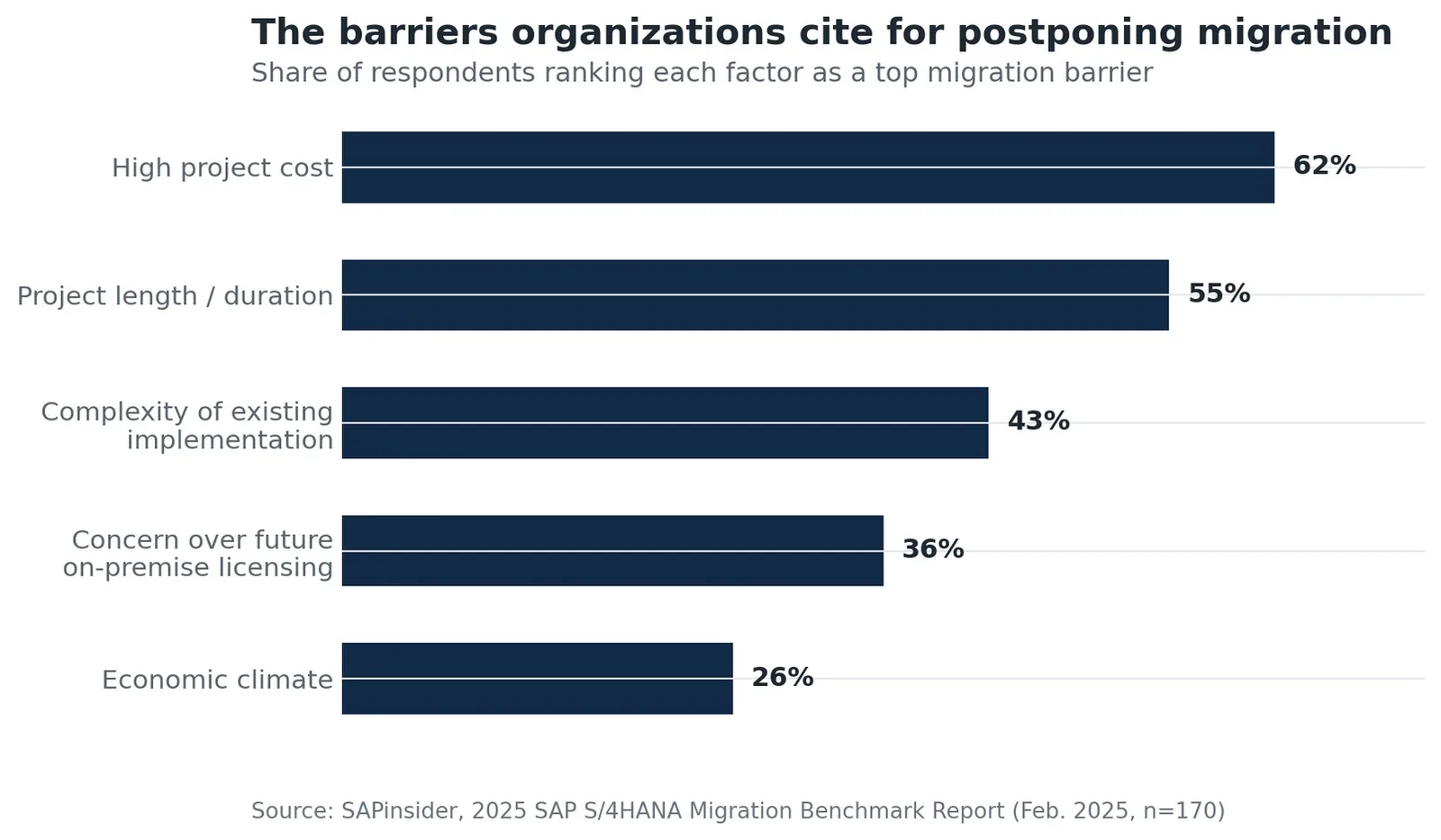
SAPinsider’s 2025 benchmark research offers a useful proxy for how this dynamic is already playing out across the SAP customer base. Among the organizations surveyed, high project cost was the most-cited barrier to migration, named by 62% of respondents, followed closely by concerns about project length and duration at 55% — a figure that had risen sharply from 37% just a year earlier. Complexity of the existing implementation was cited by 43%, and concern about future on-premise licensing by 36%.
Figure 1. The barriers organizations most often cite for postponing their SAP S/4HANA migration.
What this shows:
The barriers that most commonly stall a migration — cost, duration, and complexity — are precisely
the ones that tend to get worse, not better, the longer a decision is deferred.
That rising concern about duration is the structural cost of delay made visible. As the 2027 mainstream- maintenance deadline approaches, the population of organizations still needing to migrate compresses into a shorter remaining window, competing for the same finite pool of experienced implementation partners, specialist consultants, and internal change capacity. A migration planned calmly over eighteen to twenty-four months looks structurally different from the same migration compressed into the final year before a support deadline — not because the technical work has changed, but because testing gets abbreviated, change management gets rushed, and data-cleansing gets treated as a checkbox rather than a discipline. None of those compressions show up as a separate line item on an invoice. They show up later, as post-go-live defects, adoption problems, and rework.
© Orpington Technologies Inc. · orpingtontech.com · Page
2