
Choosing the Right SAP S/4HANA Migration Partner: Delivery, Oversight, or Both
Some organizations need a partner to lead their migration outright. Others need independent verification of an integrator they have already engaged. The strongest partners can do either — and knowing which one an organization actually needs is the first evaluation question, not the last.
 Orpington Technologies | SAP S/4HANA Migration Insights
Choosing the Right SAP S/4HANA
Migration Partner: Delivery, Oversight,
or Both
Some organizations need a partner to lead their migration outright. Others need independent verification of an
integrator they have already engaged. The strongest partners can do either — and knowing which one an
organization actually needs is the first evaluation question, not the last.
Most organizations approach an SAP S/4HANA migration as a single procurement decision: choose a partner,
sign a contract, and trust the relationship to manage itself from there. That framing skips a prior question
worth answering deliberately first: does the organization need a partner to lead the migration itself, or does it
already have delivery underway and need an independent check that the work is meeting its commitments?
These are related but genuinely different engagements, and an organization that never asks which one it
needs tends to default into whichever one a given vendor happens to sell — rather than the one that actually
fits its situation.
The gap between these two questions is rarely visible on a project plan, because most project plans describe
delivery, not verification. It becomes visible only when something has already gone wrong — a milestone
quietly slipping, a testing gap papered over in a status report, a scope change absorbed without a formal
conversation about its cost — and by then, addressing the gap costs considerably more than choosing the
right engagement model from the start would have.
© Orpington Technologies Inc. · orpingtontech.com · Page
1
Orpington Technologies | SAP S/4HANA Migration Insights
Choosing the Right SAP S/4HANA
Migration Partner: Delivery, Oversight,
or Both
Some organizations need a partner to lead their migration outright. Others need independent verification of an
integrator they have already engaged. The strongest partners can do either — and knowing which one an
organization actually needs is the first evaluation question, not the last.
Most organizations approach an SAP S/4HANA migration as a single procurement decision: choose a partner,
sign a contract, and trust the relationship to manage itself from there. That framing skips a prior question
worth answering deliberately first: does the organization need a partner to lead the migration itself, or does it
already have delivery underway and need an independent check that the work is meeting its commitments?
These are related but genuinely different engagements, and an organization that never asks which one it
needs tends to default into whichever one a given vendor happens to sell — rather than the one that actually
fits its situation.
The gap between these two questions is rarely visible on a project plan, because most project plans describe
delivery, not verification. It becomes visible only when something has already gone wrong — a milestone
quietly slipping, a testing gap papered over in a status report, a scope change absorbed without a formal
conversation about its cost — and by then, addressing the gap costs considerably more than choosing the
right engagement model from the start would have.
© Orpington Technologies Inc. · orpingtontech.com · Page
1
 Orpington Technologies | SAP S/4HANA Migration Insights
What organizations are actually looking for in a partner
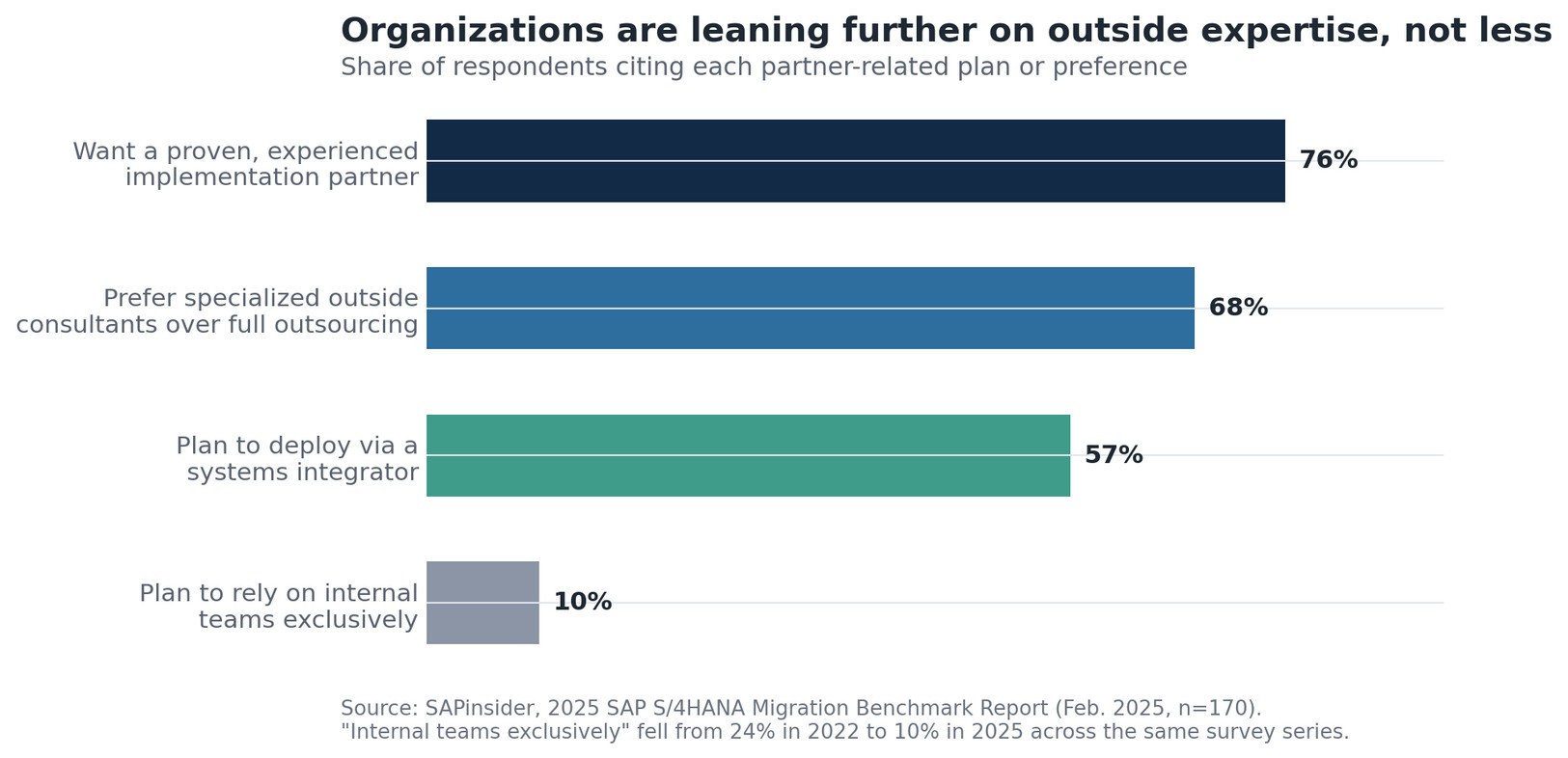
SAPinsider’s 2025 benchmark research offers a clear picture of how heavily organizations are now leaning on
outside expertise for their S/4HANA migrations, and it is a picture that has shifted meaningfully over time.
Seventy-six percent of respondents said they want a proven, experienced implementation partner. Sixty-eight
percent prefer leveraging specialized outside consultants rather than pursuing full outsourcing. Fifty-seven
percent are planning to deploy via a systems integrator — the highest share recorded in this survey series to
date. And only 10% plan to rely on internal teams exclusively, down sharply from 24% in 2022, a trend the
report frames as evidence of a widening internal skills gap relative to the specialized expertise S/4HANA
migrations require.
Figure 1. How organizations are structuring external expertise for their S/4HANA migration.
What this shows:
Reliance on outside expertise is rising, not falling — and organizations increasingly favor specialized
consultants over both full internal delivery and full outsourcing, a middle path that benefits from a partner able to flex
between leading and verifying.
That last trend — the decline in organizations relying purely on internal teams — is worth sitting with. It
means the population of organizations needing external expertise is growing, at precisely the moment when
the population of experienced SAP specialists is being drawn on by every organization racing toward the same
2027 milestone. Choosing the right partner, and the right engagement model with that partner, matters more
under those conditions, not less.
Evaluating a delivery partner: the criteria that apply either way
A rigorous evaluation typically examines several distinct dimensions, evaluated with evidence rather than
taken on the strength of a sales presentation — and these criteria apply whether the partner is being asked to
lead the technical build or to verify one already underway.
●
Demonstrated SAP-specific technical expertise, including certified specialists in the specific migration
approach (brownfield, greenfield, or selective) the organization has chosen, not general ERP
experience presented as equivalent.
●
A documented project methodology, including how the partner handles testing, data migration, and
cutover planning — not simply a claim of following a standard methodology, but visibility into what
that methodology actually requires of the client.
© Orpington Technologies Inc. · orpingtontech.com · Page
2
Orpington Technologies | SAP S/4HANA Migration Insights
What organizations are actually looking for in a partner
SAPinsider’s 2025 benchmark research offers a clear picture of how heavily organizations are now leaning on
outside expertise for their S/4HANA migrations, and it is a picture that has shifted meaningfully over time.
Seventy-six percent of respondents said they want a proven, experienced implementation partner. Sixty-eight
percent prefer leveraging specialized outside consultants rather than pursuing full outsourcing. Fifty-seven
percent are planning to deploy via a systems integrator — the highest share recorded in this survey series to
date. And only 10% plan to rely on internal teams exclusively, down sharply from 24% in 2022, a trend the
report frames as evidence of a widening internal skills gap relative to the specialized expertise S/4HANA
migrations require.
Figure 1. How organizations are structuring external expertise for their S/4HANA migration.
What this shows:
Reliance on outside expertise is rising, not falling — and organizations increasingly favor specialized
consultants over both full internal delivery and full outsourcing, a middle path that benefits from a partner able to flex
between leading and verifying.
That last trend — the decline in organizations relying purely on internal teams — is worth sitting with. It
means the population of organizations needing external expertise is growing, at precisely the moment when
the population of experienced SAP specialists is being drawn on by every organization racing toward the same
2027 milestone. Choosing the right partner, and the right engagement model with that partner, matters more
under those conditions, not less.
Evaluating a delivery partner: the criteria that apply either way
A rigorous evaluation typically examines several distinct dimensions, evaluated with evidence rather than
taken on the strength of a sales presentation — and these criteria apply whether the partner is being asked to
lead the technical build or to verify one already underway.
●
Demonstrated SAP-specific technical expertise, including certified specialists in the specific migration
approach (brownfield, greenfield, or selective) the organization has chosen, not general ERP
experience presented as equivalent.
●
A documented project methodology, including how the partner handles testing, data migration, and
cutover planning — not simply a claim of following a standard methodology, but visibility into what
that methodology actually requires of the client.
© Orpington Technologies Inc. · orpingtontech.com · Page
2
Orpington Technologies | SAP S/4HANA Migration Insights
●
Verifiable migration experience at a comparable scale and industry, including references the
organization can independently check rather than curated case studies alone.
●
Genuine data-migration and integration expertise, since these are consistently rated among the
hardest parts of an S/4HANA migration and are not interchangeable with general implementation
skill.
●
A credible post-migration support model, since a partner’s incentives during hypercare — the weeks
immediately following go-live — often reveal more about their genuine commitment to outcomes
than anything in the sales cycle.
●
A willingness to be measured against evidence, not assurance — the same testing logs, reconciliation
reports, and sign-off documentation an independent reviewer would ask for should be something a
confident delivery partner produces as a matter of course, not something that has to be requested
under pressure.
Two engagement models, one evaluation standard
Where organizations most often go wrong is not in choosing badly between two options, but in not
recognizing that two genuinely different options exist. An organization early in its planning, without an
existing SAP delivery relationship, typically needs a partner to lead the migration directly — end to end,
accountable for the build itself. An organization that has already selected and engaged an integrator, or that
has specific internal or contractual reasons to keep delivery and verification separate, typically needs
something else: an independent check that the work is meeting the commitments in the contract, conducted
by a party with no stake in defending the build’s current status.
The Project Management Institute’s Pulse of the Profession 2025 research is relevant to both cases: it rates
stakeholder management and engagement between 91% and 94% in importance across scope, budget, and
timeline risk — precisely the categories where a program can look healthy on a status report while the people
actually experiencing the process changes see something different. Whichever engagement model an
organization chooses, the underlying discipline it is actually buying is the same: a rigorous, evidence-based
read on whether the program is genuinely on track, not simply whether its milestones are being marked
complete.
The practical implication is that “build versus oversight” is less a fork in the road than a single evaluation
standard applied to two different starting points. A partner capable of leading delivery to that standard is, by
the same token, well positioned to verify someone else’s delivery against it — the skill set underneath both
engagements is largely the same.
Organizations still early in planning are usually best served by settling the delivery-versus-oversight question
honestly before issuing an RFP, rather than discovering mid-process that the proposals they collected were
written to answer a question they were not actually asking.
Next Step
Orpington Technologies works both sides of this evaluation. Through its Full ERP Implementation
Partnership, Orpington can lead an SAP S/4HANA migration directly — as the accountable delivery
© Orpington Technologies Inc. · orpingtontech.com · Page
3
Orpington Technologies | SAP S/4HANA Migration Insights
partner from platform selection through hypercare — or provide independent oversight of an
integrator an organization has already engaged, applying the same evidence-based methodology
either way. Organizations evaluating a migration partner, or already partway through a program
without a clear verification model in place, are welcome to discuss which engagement fits their
situation.
Sources
•
SAPinsider, 2025 SAP S/4HANA Migration Benchmark Report — Detailed Findings, Feb. 2025 (n=170).
•
Project Management Institute, Pulse of the Profession 2025 (n=2,841 project professionals, surveyed July–Sept. 2024).
•
Orpington Technologies, company website (service descriptions and positioning).
© Orpington Technologies Inc. · orpingtontech.com · Page
4