
Data Migration: The Underestimated Challenge of Moving to SAP S/4HANA
Custom code gets the attention. Data quality is what actually determines whether a go-live date holds — and it is rarely treated with the discipline the risk deserves until it has already caused a delay.
 Orpington Technologies | SAP S/4HANA Migration Insights
Data Migration: The Underestimated
Challenge of Moving to SAP S/4HANA
Custom code gets the attention. Data quality is what actually determines whether a go-live date holds — and it is
rarely treated with the discipline the risk deserves until it has already caused a delay.
Every SAP S/4HANA migration plan includes a line item for data migration. Very few include a line item sized
to reflect how often data, rather than code, is the reason a carefully planned go-live date does not hold.
Custom code is visible, countable, and testable in a way that invites disciplined planning. Data quality is
diffuse — spread across master data, transactional history, and years of accumulated exceptions — and it has
a way of surfacing its worst problems only during integration testing or, worse, after go-live, when a report
someone relies on suddenly produces numbers that do not reconcile.
This is not a niche technical concern. It is, by a reasonable measure, one of the largest quantifiable costs an
organization carries into a migration without realizing it, and it is entirely addressable with the right
governance discipline applied early enough to matter.
What poor data quality actually costs
Gartner’s research on data quality, drawing on its 2020 analysis, puts the average cost of poor data quality to
an organization at a minimum of $12.9 million per year — a figure that reflects the ongoing operational drag
of decisions made on unreliable data, not a one-time migration expense. That number is a useful reframe for
how organizations should think about data cleansing during an S/4HANA migration: it is not simply a
migration cost to be minimized, but an opportunity to eliminate a recurring cost the organization has likely
been absorbing, unmeasured, for years.
© Orpington Technologies Inc. · orpingtontech.com · Page
1
Orpington Technologies | SAP S/4HANA Migration Insights
Data Migration: The Underestimated
Challenge of Moving to SAP S/4HANA
Custom code gets the attention. Data quality is what actually determines whether a go-live date holds — and it is
rarely treated with the discipline the risk deserves until it has already caused a delay.
Every SAP S/4HANA migration plan includes a line item for data migration. Very few include a line item sized
to reflect how often data, rather than code, is the reason a carefully planned go-live date does not hold.
Custom code is visible, countable, and testable in a way that invites disciplined planning. Data quality is
diffuse — spread across master data, transactional history, and years of accumulated exceptions — and it has
a way of surfacing its worst problems only during integration testing or, worse, after go-live, when a report
someone relies on suddenly produces numbers that do not reconcile.
This is not a niche technical concern. It is, by a reasonable measure, one of the largest quantifiable costs an
organization carries into a migration without realizing it, and it is entirely addressable with the right
governance discipline applied early enough to matter.
What poor data quality actually costs
Gartner’s research on data quality, drawing on its 2020 analysis, puts the average cost of poor data quality to
an organization at a minimum of $12.9 million per year — a figure that reflects the ongoing operational drag
of decisions made on unreliable data, not a one-time migration expense. That number is a useful reframe for
how organizations should think about data cleansing during an S/4HANA migration: it is not simply a
migration cost to be minimized, but an opportunity to eliminate a recurring cost the organization has likely
been absorbing, unmeasured, for years.
© Orpington Technologies Inc. · orpingtontech.com · Page
1
 Orpington Technologies | SAP S/4HANA Migration Insights
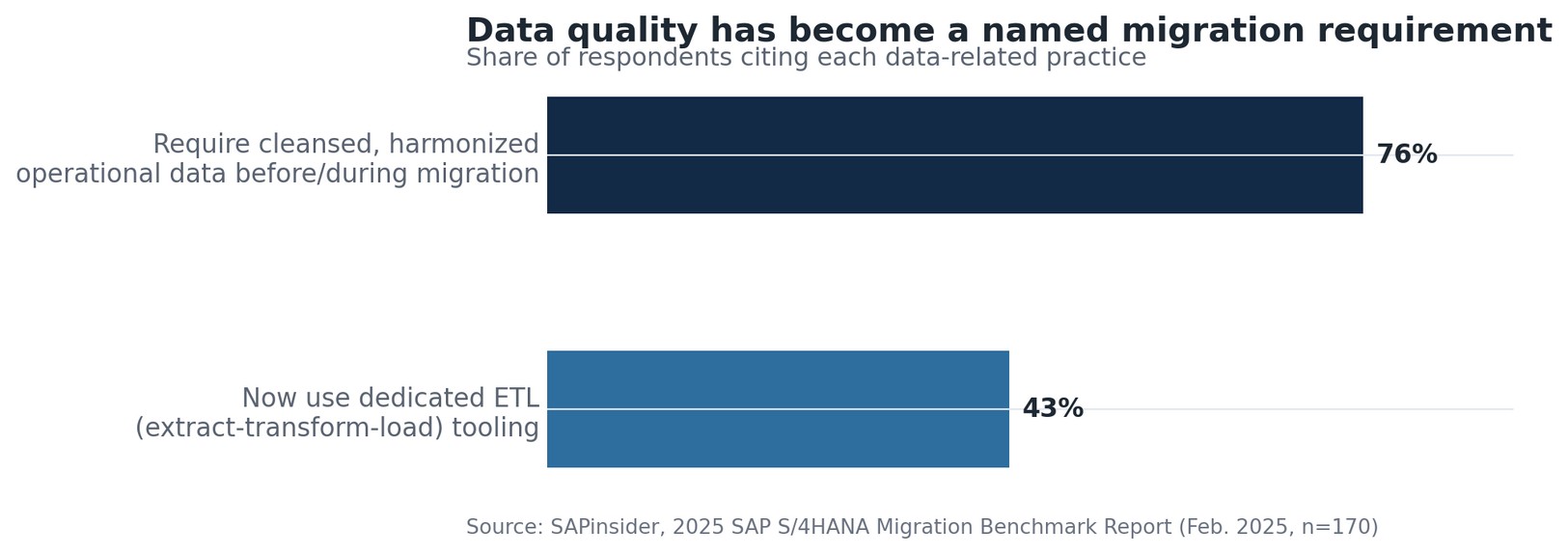
SAP’s own customer base treats this as a live concern rather than a theoretical one. SAPinsider’s 2025
benchmark research found that 76% of organizations now require cleansed, harmonized operational data as
an explicit condition of their migration — not an aspiration, but a stated requirement — and 43% have
adopted dedicated ETL (extract, transform, load) tooling specifically to manage the process, a figure the
report notes is continuing to rise.
Figure 1. Data-related practices SAP customers now treat as standard migration requirements.
What this shows:
Data cleansing has moved from a best-practice recommendation to a stated requirement for three-
quarters of organizations — evidence that the risk is now well understood, even where the discipline to address it
consistently is not.
Where data problems actually originate
Data quality issues rarely originate in the migration itself. They originate years earlier, in the accumulated
exceptions of day-to-day operations: a customer record created twice because two business units never
reconciled their master data; a material number reused for a different purpose after the original item was
discontinued; a chart-of-accounts structure that reflects an organizational chart from three reorganizations
ago. None of these defects are visible or costly in isolation within a mature ECC system, because the system
and its users have long since built workarounds around them. A migration removes those workarounds — the
new system does not know about the informal reconciliation someone in accounts payable has been doing
manually for years — and the underlying defect becomes visible, often for the first time, during testing or
shortly after go-live.
This is why a data migration cannot be treated as a purely technical extract-and-load exercise scheduled late
in the project timeline. By the time an ETL job fails or a reconciliation report does not balance, the underlying
data problem has usually existed, quietly, for years.
The elements of a disciplined data migration
A migration that treats data with appropriate rigor typically addresses five distinct disciplines, each of which is
a different kind of work and often requires a different kind of expertise.
●
Profiling: understanding, with evidence rather than assumption, what the current data actually
contains — duplicate records, incomplete fields, inconsistent formats — before deciding what needs
to change.
●
Cleansing: correcting, standardizing, and de-duplicating master data, ideally in the source system
before migration rather than in the target system after.
© Orpington Technologies Inc. · orpingtontech.com · Page
2
Orpington Technologies | SAP S/4HANA Migration Insights
SAP’s own customer base treats this as a live concern rather than a theoretical one. SAPinsider’s 2025
benchmark research found that 76% of organizations now require cleansed, harmonized operational data as
an explicit condition of their migration — not an aspiration, but a stated requirement — and 43% have
adopted dedicated ETL (extract, transform, load) tooling specifically to manage the process, a figure the
report notes is continuing to rise.
Figure 1. Data-related practices SAP customers now treat as standard migration requirements.
What this shows:
Data cleansing has moved from a best-practice recommendation to a stated requirement for three-
quarters of organizations — evidence that the risk is now well understood, even where the discipline to address it
consistently is not.
Where data problems actually originate
Data quality issues rarely originate in the migration itself. They originate years earlier, in the accumulated
exceptions of day-to-day operations: a customer record created twice because two business units never
reconciled their master data; a material number reused for a different purpose after the original item was
discontinued; a chart-of-accounts structure that reflects an organizational chart from three reorganizations
ago. None of these defects are visible or costly in isolation within a mature ECC system, because the system
and its users have long since built workarounds around them. A migration removes those workarounds — the
new system does not know about the informal reconciliation someone in accounts payable has been doing
manually for years — and the underlying defect becomes visible, often for the first time, during testing or
shortly after go-live.
This is why a data migration cannot be treated as a purely technical extract-and-load exercise scheduled late
in the project timeline. By the time an ETL job fails or a reconciliation report does not balance, the underlying
data problem has usually existed, quietly, for years.
The elements of a disciplined data migration
A migration that treats data with appropriate rigor typically addresses five distinct disciplines, each of which is
a different kind of work and often requires a different kind of expertise.
●
Profiling: understanding, with evidence rather than assumption, what the current data actually
contains — duplicate records, incomplete fields, inconsistent formats — before deciding what needs
to change.
●
Cleansing: correcting, standardizing, and de-duplicating master data, ideally in the source system
before migration rather than in the target system after.
© Orpington Technologies Inc. · orpingtontech.com · Page
2
Orpington Technologies | SAP S/4HANA Migration Insights
●
Governance: establishing clear ownership for each data domain (customer, material, vendor,
financial) so that decisions about what “correct” data looks like are made by the business function
that actually understands it.
●
Validation: testing migrated data against defined business rules and reconciliation checks, not simply
confirming that a record count matches between source and target.
●
Reconciliation: a formal, signed-off comparison between legacy and migrated financial and
operational data, sufficient to satisfy both the business and, where relevant, auditors that the
transition preserved data integrity.
Skipping or compressing any one of these disciplines under timeline pressure tends to produce the same
downstream pattern: a go-live that appears successful on the day itself, followed by weeks of manual data
correction, reconciliation disputes between finance and IT, and user distrust of a system that is producing
numbers people do not believe — even when, technically, the migration was executed correctly.
One further point deserves emphasis: data validation is not a task that can be fully delegated to the systems
integrator responsible for the technical build, however capable that integrator is, because the integrator’s
incentive is generally to demonstrate that migration jobs ran successfully — not to independently verify that
the business logic embedded in reconciliation reports, UAT sign-offs, and cutover runbooks reflects what the
business actually needs. That verification role is, by design, better suited to an independent party without a
stake in the build itself.
Next Step
Orpington Technologies’ Full ERP Diagnostic Report verifies data-migration evidence —
reconciliation reports, UAT sign-off, and cutover runbooks — against the underlying business
requirement, rather than simply confirming that a technical migration job completed; the same
profiling-through-reconciliation discipline underpins the data migration work Orpington leads
directly through its Full ERP Implementation Partnership and ERP Staff Augmentation.
Organizations approaching a data migration, or auditing one already underway, are welcome to
discuss which model fits.
Sources
•
Gartner, Data Quality topic overview, citing Gartner research from 2020 ($12.9 million average annual cost of poor
data quality).
•
SAPinsider, 2025 SAP S/4HANA Migration Benchmark Report — Detailed Findings, Feb. 2025 (n=170).
© Orpington Technologies Inc. · orpingtontech.com · Page
3