
From SAP ECC to S/4HANA: A Practical Roadmap for Getting Started
The organizations that migrate calmly do not start with a platform decision. They start with an honest assessment of where they actually stand — and let that assessment set the sequence for everything that follows.
 Orpington Technologies | SAP S/4HANA Migration Insights
From SAP ECC to S/4HANA: A Practical
Roadmap for Getting Started
The organizations that migrate calmly do not start with a platform decision. They start with an honest assessment
of where they actually stand — and let that assessment set the sequence for everything that follows.
By the time most organizations seriously begin planning their move from SAP ECC to S/4HANA, they have
usually spent a long time discussing it. Discussion is not the same as sequencing, and it is sequencing —
knowing what to actually do first, this quarter, rather than “sometime before 2027” — that most separates
the organizations that migrate calmly from the ones that eventually migrate under pressure. This roadmap
sets out that sequence, not as a rigid template, but as a practical starting order that reflects how the work
genuinely depends on itself.
Why sequence matters more than most organizations assume
ASUG’s research into S/4HANA adoption, sponsored by BearingPoint, reports an average total migration
duration of 1.5 years across member organizations — and, more tellingly, a meaningful acceleration in how
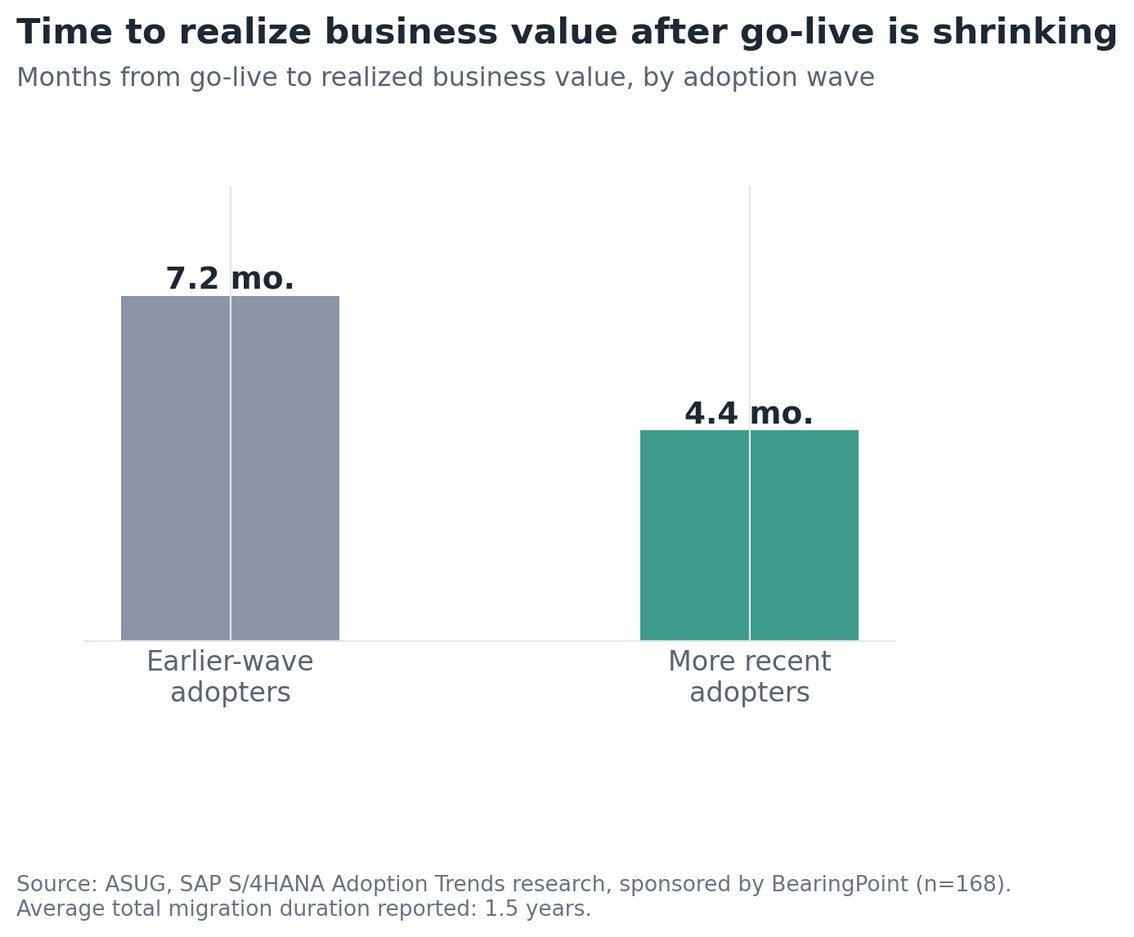
quickly organizations are realizing business value after go-live. Earlier-wave adopters took an average of 7.2
months post-go-live to realize business value; more recent adopters realized value in 4.4 months, nearly three
months faster.
© Orpington Technologies Inc. · orpingtontech.com · Page
1
Orpington Technologies | SAP S/4HANA Migration Insights
From SAP ECC to S/4HANA: A Practical
Roadmap for Getting Started
The organizations that migrate calmly do not start with a platform decision. They start with an honest assessment
of where they actually stand — and let that assessment set the sequence for everything that follows.
By the time most organizations seriously begin planning their move from SAP ECC to S/4HANA, they have
usually spent a long time discussing it. Discussion is not the same as sequencing, and it is sequencing —
knowing what to actually do first, this quarter, rather than “sometime before 2027” — that most separates
the organizations that migrate calmly from the ones that eventually migrate under pressure. This roadmap
sets out that sequence, not as a rigid template, but as a practical starting order that reflects how the work
genuinely depends on itself.
Why sequence matters more than most organizations assume
ASUG’s research into S/4HANA adoption, sponsored by BearingPoint, reports an average total migration
duration of 1.5 years across member organizations — and, more tellingly, a meaningful acceleration in how
quickly organizations are realizing business value after go-live. Earlier-wave adopters took an average of 7.2
months post-go-live to realize business value; more recent adopters realized value in 4.4 months, nearly three
months faster.
© Orpington Technologies Inc. · orpingtontech.com · Page
1
 Orpington Technologies | SAP S/4HANA Migration Insights
Figure 1. Time from go-live to realized business value, by adoption wave.
What this shows:
The migration ecosystem has genuinely matured — later adopters are realizing value faster, largely
because the sequencing mistakes made by earlier adopters are now better understood and more avoidable.
That improvement is not primarily a story about better software. It is a story about a maturing delivery
ecosystem — better-understood sequencing, clearer readiness benchmarks, more experience across the
partner landscape in what needs to happen before what. An organization starting its migration today does
not have to rediscover these lessons from scratch.
The nine-stage sequence
1. Readiness assessment
Before any platform decision, establish an honest, evidence-based picture of the organization’s current state:
which enhancement package and support track the existing ECC system is on, the scale and criticality of
custom code, data quality across major master-data domains, and the organization’s genuine change-
management capacity. This stage exists to replace assumption with evidence, and skipping it is the single
most common reason later stages run into avoidable surprises.
2. Business case development
Build the investment case on quantifiable return — productivity, process improvement, risk reduction — with
the maintenance deadline serving as a cost-of-delay input rather than the entire justification. A business case
built this way survives budget scrutiny better than one built solely on the calendar.
3. Architecture and landscape planning
Define the target technical architecture: on-premise, RISE with SAP, or another cloud deployment model,
along with how existing integrations, reporting tools, and adjacent systems will connect to the new
environment.
© Orpington Technologies Inc. · orpingtontech.com · Page
2
Orpington Technologies | SAP S/4HANA Migration Insights
Figure 1. Time from go-live to realized business value, by adoption wave.
What this shows:
The migration ecosystem has genuinely matured — later adopters are realizing value faster, largely
because the sequencing mistakes made by earlier adopters are now better understood and more avoidable.
That improvement is not primarily a story about better software. It is a story about a maturing delivery
ecosystem — better-understood sequencing, clearer readiness benchmarks, more experience across the
partner landscape in what needs to happen before what. An organization starting its migration today does
not have to rediscover these lessons from scratch.
The nine-stage sequence
1. Readiness assessment
Before any platform decision, establish an honest, evidence-based picture of the organization’s current state:
which enhancement package and support track the existing ECC system is on, the scale and criticality of
custom code, data quality across major master-data domains, and the organization’s genuine change-
management capacity. This stage exists to replace assumption with evidence, and skipping it is the single
most common reason later stages run into avoidable surprises.
2. Business case development
Build the investment case on quantifiable return — productivity, process improvement, risk reduction — with
the maintenance deadline serving as a cost-of-delay input rather than the entire justification. A business case
built this way survives budget scrutiny better than one built solely on the calendar.
3. Architecture and landscape planning
Define the target technical architecture: on-premise, RISE with SAP, or another cloud deployment model,
along with how existing integrations, reporting tools, and adjacent systems will connect to the new
environment.
© Orpington Technologies Inc. · orpingtontech.com · Page
2
Orpington Technologies | SAP S/4HANA Migration Insights
4. Migration strategy selection
Choose between brownfield, greenfield, and selective (bluefield) transition based on the evidence gathered in
the readiness assessment — process fitness, custom-code footprint, and change capacity — rather than on a
default industry preference.
5. Partner selection
Evaluate systems integrators against demonstrated SAP-specific expertise, a documented methodology, and
verifiable references, with independent oversight structured into the relationship from the outset rather than
added after a problem has already surfaced.
6. Execution: build and data migration
The technical core of the program: system conversion or new build, custom-code remediation, and a
disciplined data migration workstream covering profiling, cleansing, governance, validation, and
reconciliation.
7. Testing
Integration and user-acceptance testing scoped to the landscape’s actual complexity rather than compressed
to protect a fixed date — testing scope should be allowed to influence the timeline, not only the reverse.
8. Go-live and cutover
A rehearsed cutover plan, including a genuine rollback contingency, executed with clear ownership for both
technical execution and business-process sign-off.
9. Post-migration optimization
Hypercare stabilization immediately following go-live, followed by a deliberate optimization phase in which
the organization begins using capabilities — analytics, embedded intelligence, standardized processes — that
a like-for-like technical migration alone would not automatically activate.
What tends to determine whether the sequence holds
None of these nine stages is unusual or proprietary — most experienced SAP practitioners would recognize
this general sequence. What varies enormously between organizations is discipline: whether each stage is
genuinely completed with evidence before the next one begins, or whether stages get compressed, run in
parallel under time pressure, or skipped outright because an earlier stage was rushed. A readiness
assessment completed thoroughly in month one tends to prevent exactly the kind of mid-program surprise —
an undiscovered integration, an unaddressed data-quality issue, an under-resourced testing phase — that
later forces stages five through eight to be compressed under pressure.
For an organization beginning this process today, the practical first move is rarely a request for
implementation proposals. It is an honest, evidence-based readiness assessment — the kind that produces a
specific, defensible answer to “where do we actually stand,” which is the only reliable foundation for every
stage that follows.
© Orpington Technologies Inc. · orpingtontech.com · Page
3
Orpington Technologies | SAP S/4HANA Migration Insights
Next Step
Orpington Technologies supports organizations across this entire sequence — from the
Implementation Confidence Diagnostic and Full ERP Diagnostic Report that establish readiness,
through the Full ERP Implementation Partnership during execution (leading delivery directly or
overseeing a partner already engaged), to ERP Staff Augmentation for specific capability gaps and
Stalled Implementation Recovery if a program already underway needs to get back on track.
Organizations ready to take the first step can start with a free Implementation Confidence
Diagnostic at orpingtontech.com.
Sources
•
ASUG, “SAP S/4HANA Adoption Trends, Insights, and Advice,” research sponsored by BearingPoint (n=168 ASUG
members).
•
SAPinsider, 2025 SAP S/4HANA Migration Benchmark Report — Detailed Findings, Feb. 2025 (n=170).
© Orpington Technologies Inc. · orpingtontech.com · Page
4