
How AI, Analytics, and Intelligent Automation Are Reshaping the SAP S/4HANA Business Case
Embedded intelligence changes what a finished migration looks like. It does not, for most organizations today, change why the migration is worth doing — and the difference between those two claims matters.
 Orpington Technologies | SAP S/4HANA Migration Insights
How AI, Analytics, and Intelligent
Automation Are Reshaping the SAP
S/4HANA Business Case
Embedded intelligence changes what a finished migration looks like. It does not, for most organizations today,
change why the migration is worth doing — and the difference between those two claims matters.
It has become common for SAP S/4HANA to be pitched, implicitly or explicitly, as an AI project — a chance to
embed generative assistants, predictive analytics, and intelligent automation directly into core financial and
operational processes. Some of that framing is accurate. S/4HANA’s in-memory architecture and simplified
data model genuinely enable classes of embedded intelligence that were difficult or impossible to build
reliably on top of ECC’s older architecture, and SAP has invested visibly in this direction, most notably through
Joule, its generative-AI copilot embedded within the S/4HANA Cloud user experience.
The honest question, though, is not whether S/4HANA enables more AI capability than ECC — it clearly does
— but whether that capability, on its own, changes the fundamental case for migrating. The evidence
suggests a more specific answer: it changes what a finished migration can eventually deliver. It does not, for
most organizations today, change why the migration is worth doing in the near term, and conflating the two
claims risks setting expectations the technology cannot yet reliably meet.
What the adoption data actually shows
Deloitte’s State of AI in the Enterprise, its 2026 global report drawing on a survey of 3,235 business and
technology leaders fielded in August and September 2025, offers a useful corrective to the more breathless
framing of enterprise AI. Only 34% of organizations describe their AI use as “deep transformation” — creating
© Orpington Technologies Inc. · orpingtontech.com · Page
1
Orpington Technologies | SAP S/4HANA Migration Insights
How AI, Analytics, and Intelligent
Automation Are Reshaping the SAP
S/4HANA Business Case
Embedded intelligence changes what a finished migration looks like. It does not, for most organizations today,
change why the migration is worth doing — and the difference between those two claims matters.
It has become common for SAP S/4HANA to be pitched, implicitly or explicitly, as an AI project — a chance to
embed generative assistants, predictive analytics, and intelligent automation directly into core financial and
operational processes. Some of that framing is accurate. S/4HANA’s in-memory architecture and simplified
data model genuinely enable classes of embedded intelligence that were difficult or impossible to build
reliably on top of ECC’s older architecture, and SAP has invested visibly in this direction, most notably through
Joule, its generative-AI copilot embedded within the S/4HANA Cloud user experience.
The honest question, though, is not whether S/4HANA enables more AI capability than ECC — it clearly does
— but whether that capability, on its own, changes the fundamental case for migrating. The evidence
suggests a more specific answer: it changes what a finished migration can eventually deliver. It does not, for
most organizations today, change why the migration is worth doing in the near term, and conflating the two
claims risks setting expectations the technology cannot yet reliably meet.
What the adoption data actually shows
Deloitte’s State of AI in the Enterprise, its 2026 global report drawing on a survey of 3,235 business and
technology leaders fielded in August and September 2025, offers a useful corrective to the more breathless
framing of enterprise AI. Only 34% of organizations describe their AI use as “deep transformation” — creating
© Orpington Technologies Inc. · orpingtontech.com · Page
1
 Orpington Technologies | SAP S/4HANA Migration Insights
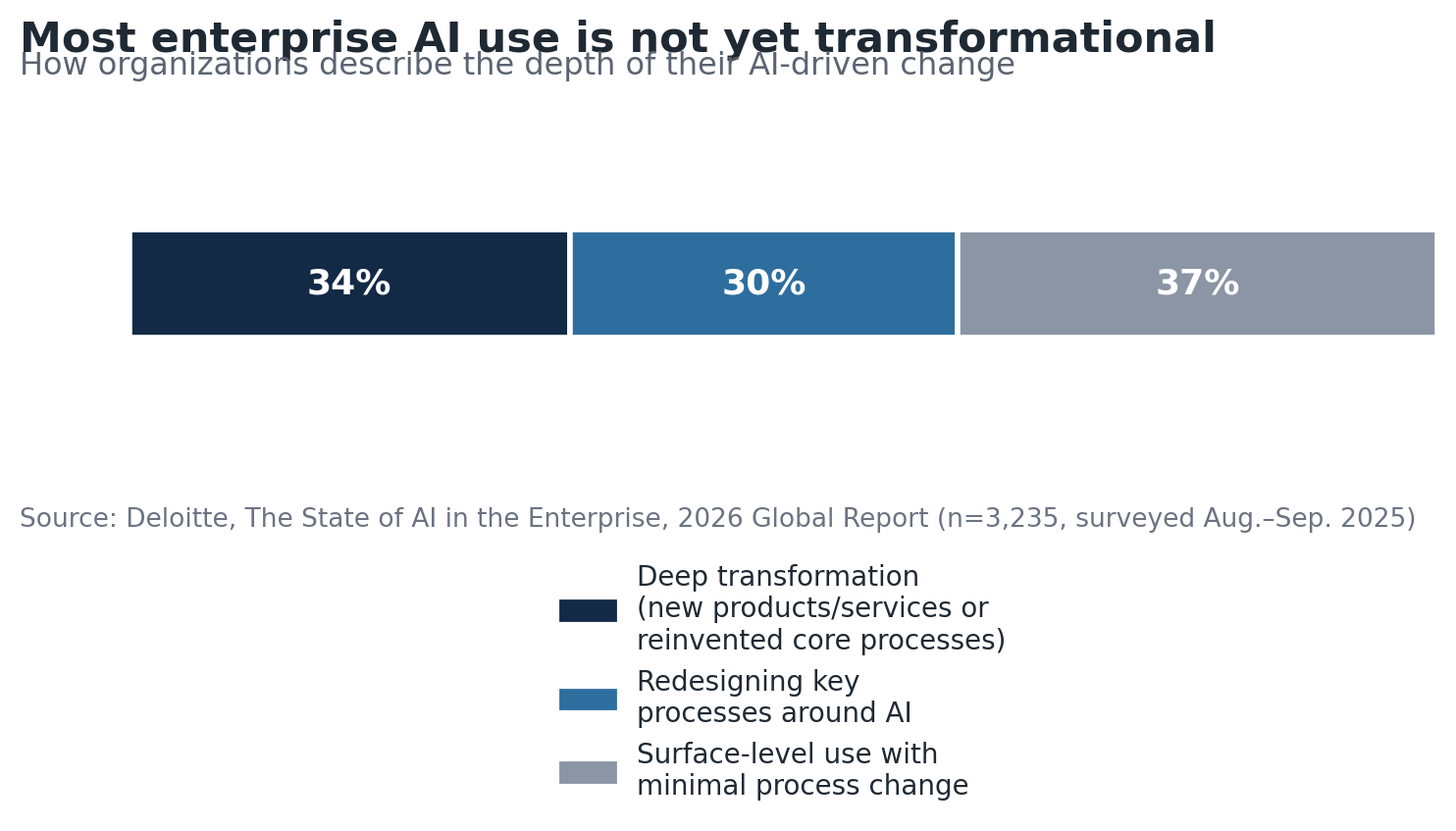
new products or services, or genuinely reinventing core processes. Another 30% describe themselves as
“redesigning key processes” around AI. The remaining 37% — the largest single group — are applying AI only
at a “surface level,” with minimal underlying process change.
Figure 1. How organizations describe the depth of their current AI-driven transformation.
What this shows:
The largest single group of organizations is still applying AI at a surface level. Deep, process-level
transformation remains the minority case, not the norm — a useful benchmark against which to weigh any migration
pitch premised on AI as the primary driver.
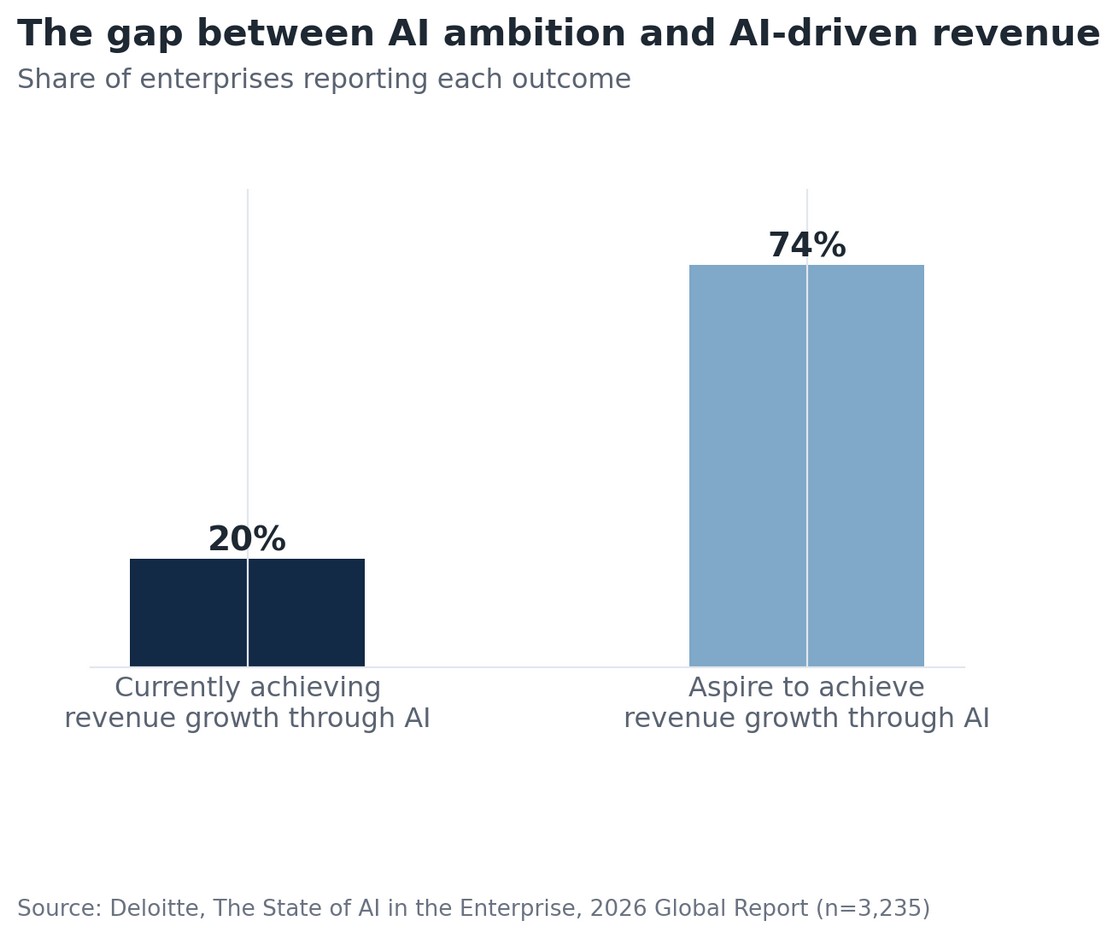
The same report identifies a further, more specific gap: only 20% of organizations report currently achieving
revenue growth through AI, against 74% who aspire to. That 54-point gap between ambition and realized
outcome is the clearest available evidence that enterprise AI adoption, broadly, remains earlier in its value-
realization curve than the surrounding conversation often implies — a pattern SAP-specific AI capability is
unlikely to be exempt from simply by virtue of being embedded in newer infrastructure.
Figure 2. The gap between AI ambition and realized AI-driven revenue growth.
© Orpington Technologies Inc. · orpingtontech.com · Page
2
Orpington Technologies | SAP S/4HANA Migration Insights
new products or services, or genuinely reinventing core processes. Another 30% describe themselves as
“redesigning key processes” around AI. The remaining 37% — the largest single group — are applying AI only
at a “surface level,” with minimal underlying process change.
Figure 1. How organizations describe the depth of their current AI-driven transformation.
What this shows:
The largest single group of organizations is still applying AI at a surface level. Deep, process-level
transformation remains the minority case, not the norm — a useful benchmark against which to weigh any migration
pitch premised on AI as the primary driver.
The same report identifies a further, more specific gap: only 20% of organizations report currently achieving
revenue growth through AI, against 74% who aspire to. That 54-point gap between ambition and realized
outcome is the clearest available evidence that enterprise AI adoption, broadly, remains earlier in its value-
realization curve than the surrounding conversation often implies — a pattern SAP-specific AI capability is
unlikely to be exempt from simply by virtue of being embedded in newer infrastructure.
Figure 2. The gap between AI ambition and realized AI-driven revenue growth.
© Orpington Technologies Inc. · orpingtontech.com · Page
2
Orpington Technologies | SAP S/4HANA Migration Insights
What this shows:
Aspiration for AI-driven revenue growth is nearly four times more common than organizations
currently achieving it — a gap worth factoring explicitly into any business case that leans heavily on AI-driven upside.
None of this means the 66% of organizations reporting improved productivity and efficiency from AI, or the
53% reporting better insights and decision-making, are illusory benefits — those are real, widely reported
gains, and they are exactly the categories of benefit embedded intelligence in S/4HANA is best positioned to
deliver in the near term: faster transaction processing, better anomaly detection, more responsive analytics.
The gap is specifically in the harder, more transformational categories — new revenue, reinvented processes
— where the evidence shows most organizations are still early.
What this means for the migration business case
A migration business case that leans heavily on speculative, deep AI-driven transformation — new revenue
streams, autonomous process redesign — is building on the smaller and less certain portion of the available
evidence. A migration business case built on the more modest, better-supported categories — productivity,
decision-support quality, the architectural foundation for AI capability to mature over time — is building on
the larger and more consistently reported portion.
This distinction matters practically because it changes what “readiness” means for AI specifically. An
organization does not need a fully mature AI strategy to justify migrating; it needs an accurate understanding
of what S/4HANA’s architecture will and will not immediately enable, so that AI-related benefits are
represented in the business case at a realistic level of confidence, positioned as a medium-term capability the
migration unlocks rather than a near-term return it guarantees.
A grounded question worth asking before including AI in the business case
Rather than asking “what can AI do for us after we migrate,” a more useful framing is: “what data quality,
process standardization, and architectural readiness does our organization need in place before any
embedded AI capability — SAP’s or otherwise — can be trusted with a real business decision?” Every one of
Deloitte’s named benefit categories depends on the underlying data and process foundation being sound. An
organization that migrates without addressing data quality and process fragmentation will find that
S/4HANA’s AI capabilities inherit the same limitations, not that the platform shift solves them automatically.
Next Step
Because AI-related capability depends directly on data quality and architectural readiness,
Orpington Technologies’ Full ERP Diagnostic Report includes a review of the data and integration
foundation a migration will need in order for any AI-enabled capability — SAP’s or third-party — to
be trustworthy in production, and Orpington’s Full ERP Implementation Partnership can carry that
same foundation-first discipline through to delivery. Organizations weighing how much of their
business case to attribute to AI-driven benefit are welcome to discuss a grounded, evidence-based
framing with Orpington Technologies.
© Orpington Technologies Inc. · orpingtontech.com · Page
3
Orpington Technologies | SAP S/4HANA Migration Insights
Sources
•
Deloitte, The State of AI in the Enterprise, 2026 Global Report (n=3,235, surveyed Aug.–Sep. 2025).
•
SAP, “Joule, the AI Copilot in SAP S/4HANA Cloud Public Edition.”
© Orpington Technologies Inc. · orpingtontech.com · Page
4