
Preparing Your Organization for an SAP S/4HANA Migration: A Readiness Framework
Readiness is not a feeling. It is a measurable set of conditions across systems, people, and governance — and measuring it honestly before kickoff is what prevents the most expensive surprises from surfacing mid-program.
 Orpington Technologies | SAP S/4HANA Migration Insights
Preparing Your Organization for an SAP
S/4HANA Migration: A Readiness
Framework
Readiness is not a feeling. It is a measurable set of conditions across systems, people, and governance — and
measuring it honestly before kickoff is what prevents the most expensive surprises from surfacing mid-program.
“We’re ready to start” is one of the most common phrases heard at the beginning of an SAP S/4HANA
program, and one of the least reliable, because readiness is usually being assessed by impression rather than
evidence. The IT team feels ready because the technical architecture is understood. The executive sponsor
feels ready because budget has been approved. Neither of those is the same as organizational readiness, and
the gap between feeling ready and being ready is where a disproportionate share of migration problems
originate — not during the technically difficult parts of the project, but in the assumptions made before it
formally began.
Readiness, treated properly, is a measurable condition across a defined set of variables, not a sentiment.
Measuring it honestly before kickoff — even when the answer is uncomfortable — is consistently cheaper
than discovering the gaps mid-program.
The barriers that readiness assessment is meant to surface
SAPinsider’s 2025 benchmark research, surveying 170 SAP-using organizations, offers a useful map of where
organizations most often discover they were less ready than assumed. High project cost was the leading
concern, cited by 62% of respondents, followed by project duration at 55% — up sharply from 37% the year
before — and the complexity of the existing implementation at 43%.
© Orpington Technologies Inc. · orpingtontech.com · Page
1
Orpington Technologies | SAP S/4HANA Migration Insights
Preparing Your Organization for an SAP
S/4HANA Migration: A Readiness
Framework
Readiness is not a feeling. It is a measurable set of conditions across systems, people, and governance — and
measuring it honestly before kickoff is what prevents the most expensive surprises from surfacing mid-program.
“We’re ready to start” is one of the most common phrases heard at the beginning of an SAP S/4HANA
program, and one of the least reliable, because readiness is usually being assessed by impression rather than
evidence. The IT team feels ready because the technical architecture is understood. The executive sponsor
feels ready because budget has been approved. Neither of those is the same as organizational readiness, and
the gap between feeling ready and being ready is where a disproportionate share of migration problems
originate — not during the technically difficult parts of the project, but in the assumptions made before it
formally began.
Readiness, treated properly, is a measurable condition across a defined set of variables, not a sentiment.
Measuring it honestly before kickoff — even when the answer is uncomfortable — is consistently cheaper
than discovering the gaps mid-program.
The barriers that readiness assessment is meant to surface
SAPinsider’s 2025 benchmark research, surveying 170 SAP-using organizations, offers a useful map of where
organizations most often discover they were less ready than assumed. High project cost was the leading
concern, cited by 62% of respondents, followed by project duration at 55% — up sharply from 37% the year
before — and the complexity of the existing implementation at 43%.
© Orpington Technologies Inc. · orpingtontech.com · Page
1
 Orpington Technologies | SAP S/4HANA Migration Insights
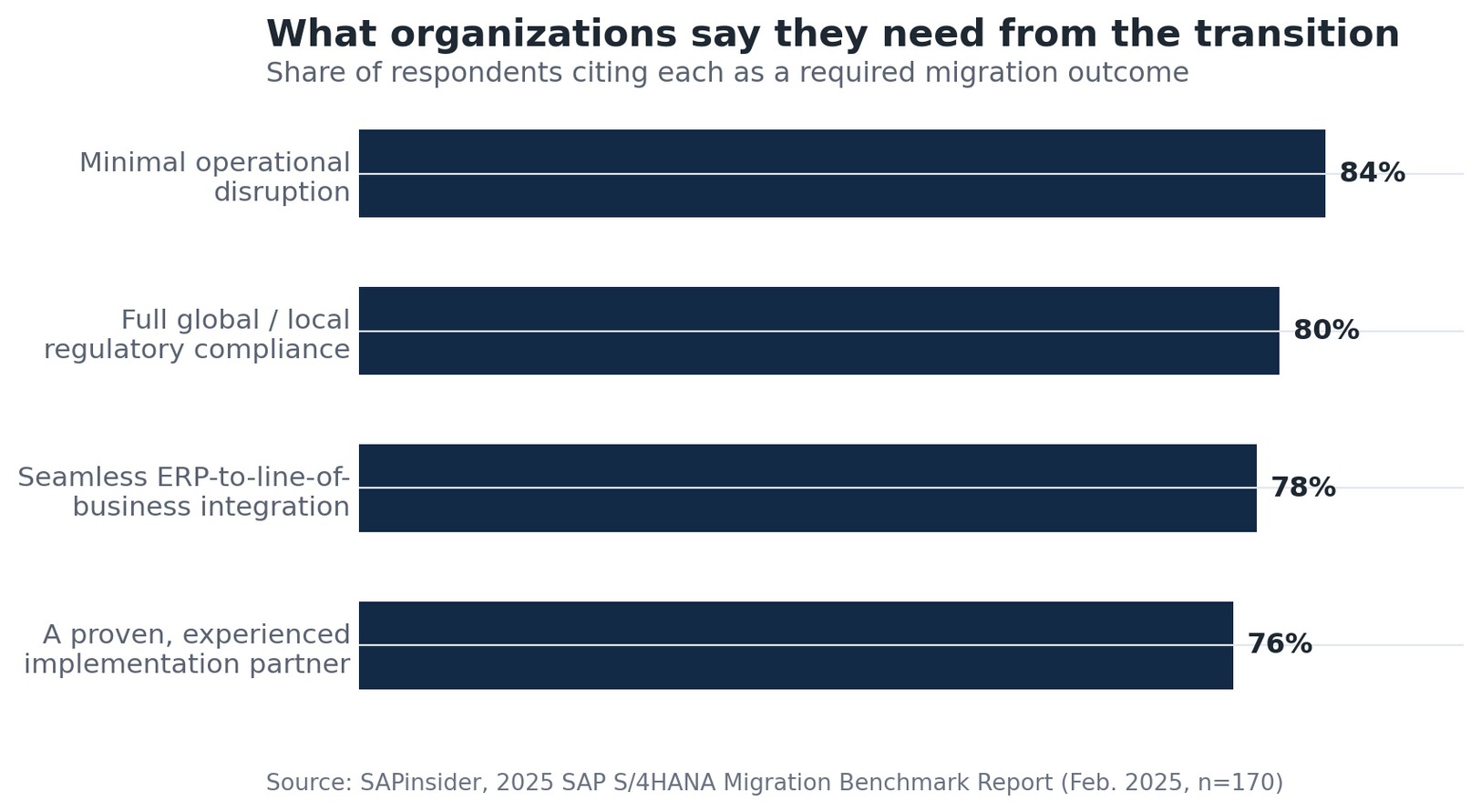
Figure 1. What organizations say they need from a successful transition.
What this shows:
The requirements organizations name most often — minimal disruption, regulatory compliance,
integration continuity, a proven partner — are not aspirations. They are the specific conditions a readiness assessment
needs to test for directly, one by one.
Notably, these figures describe barriers reported by organizations already engaged with their migration, not
organizations that have failed to begin. That is the point: cost overruns and duration slippage are rarely
surprises that appear from nowhere mid-project. They are, in the great majority of cases, symptoms of
conditions that existed and were measurable before the project started, but were not measured.
Six variables worth assessing before kickoff, not during it
A structured readiness assessment typically examines a consistent set of variables, regardless of which
systems integrator or advisory firm conducts it, because these are the conditions that most reliably predict
outcome, not merely activity.
●
Executive sponsorship: is there a named, accountable executive sponsor with the authority to make
and defend difficult scope and timeline decisions, or is sponsorship distributed diffusely enough that
no one owns the hard calls?
●
Change management readiness: has the organization budgeted real time and resource for user
adoption and training, or is change management a line item added late because a template required
one?
●
Testing discipline: does the organization have a realistic plan and resourcing for integration and user-
acceptance testing, or is testing scheduled optimistically against a fixed go-live date regardless of
what testing reveals?
●
Data migration integrity: has master and transactional data been profiled for quality issues, or is data
migration assumed to be a straightforward technical extract?
●
Integration testing: are the organization’s upstream and downstream system integrations (banking,
EDI, tax, third-party logistics, and similar) fully inventoried, or does the true integration count only
become clear once the technical team starts looking?
© Orpington Technologies Inc. · orpingtontech.com · Page
2
Orpington Technologies | SAP S/4HANA Migration Insights
Figure 1. What organizations say they need from a successful transition.
What this shows:
The requirements organizations name most often — minimal disruption, regulatory compliance,
integration continuity, a proven partner — are not aspirations. They are the specific conditions a readiness assessment
needs to test for directly, one by one.
Notably, these figures describe barriers reported by organizations already engaged with their migration, not
organizations that have failed to begin. That is the point: cost overruns and duration slippage are rarely
surprises that appear from nowhere mid-project. They are, in the great majority of cases, symptoms of
conditions that existed and were measurable before the project started, but were not measured.
Six variables worth assessing before kickoff, not during it
A structured readiness assessment typically examines a consistent set of variables, regardless of which
systems integrator or advisory firm conducts it, because these are the conditions that most reliably predict
outcome, not merely activity.
●
Executive sponsorship: is there a named, accountable executive sponsor with the authority to make
and defend difficult scope and timeline decisions, or is sponsorship distributed diffusely enough that
no one owns the hard calls?
●
Change management readiness: has the organization budgeted real time and resource for user
adoption and training, or is change management a line item added late because a template required
one?
●
Testing discipline: does the organization have a realistic plan and resourcing for integration and user-
acceptance testing, or is testing scheduled optimistically against a fixed go-live date regardless of
what testing reveals?
●
Data migration integrity: has master and transactional data been profiled for quality issues, or is data
migration assumed to be a straightforward technical extract?
●
Integration testing: are the organization’s upstream and downstream system integrations (banking,
EDI, tax, third-party logistics, and similar) fully inventoried, or does the true integration count only
become clear once the technical team starts looking?
© Orpington Technologies Inc. · orpingtontech.com · Page
2
Orpington Technologies | SAP S/4HANA Migration Insights
●
Go-live strategy: is there a defined, rehearsed cutover and hypercare plan, including a genuine
rollback contingency, or does “go-live plan” mean a date on a calendar?
ASUG’s adoption research reinforces the weight of the second item in particular: 43% of member
organizations named change management and user adoption as a top migration risk, and 57% now
recommend starting change management earlier in the program than they did themselves — a seven-point
increase from the year before, and a fairly direct signal that organizations are learning this lesson from
experience rather than from theory.
Why stakeholder alignment is a readiness variable, not a soft
skill
Research from the Project Management Institute’s Pulse of the Profession 2025 study rated stakeholder
management and engagement between 91% and 94% in importance across scope, budget, and timeline risk
categories — placing it among the highest-rated factors in the entire study, ahead of many more traditionally
“technical” project disciplines. That finding is worth taking literally rather than treating as a truism: an
organization can have excellent technical architecture, a capable systems integrator, and a realistic budget,
and still see a program falter because the stakeholders whose cooperation the program depends on were
never genuinely aligned on what was changing and why.
A readiness assessment that only examines technical and financial variables — architecture, licensing, budget
— will systematically miss this risk, because stakeholder alignment does not show up in a system landscape
diagram. It shows up only when someone asks the stakeholders directly, and takes the answers seriously even
when they are inconvenient.
The purpose of assessing readiness this rigorously is not to delay the decision to migrate — organizations
facing a 2027 maintenance deadline do not have unlimited time to deliberate. It is to ensure that whatever
timeline is chosen is chosen with an accurate understanding of what it will actually require, so the plan
reflects the organization’s true starting point rather than an optimistic one.
Next Step
Orpington Technologies’ Implementation Confidence Diagnostic scores exactly these six variables
— executive sponsorship, change management readiness, testing discipline, data migration
integrity, integration testing, and go-live strategy — starting with a free, fifteen-minute self-
assessment, with an evidence-verified Full ERP Diagnostic Report available for organizations that
want a certified expert review before committing to a program timeline.
Sources
•
SAPinsider, 2025 SAP S/4HANA Migration Benchmark Report — Detailed Findings, Feb. 2025 (n=170).
•
ASUG, “SAP S/4HANA Adoption Trends, Insights, and Advice,” research sponsored by BearingPoint (n=168 ASUG
members).
•
Project Management Institute, Pulse of the Profession 2025 (n=2,841 project professionals, surveyed July–Sept. 2024).
© Orpington Technologies Inc. · orpingtontech.com · Page
3