
SAP ECC to S/4HANA Migration Strategies: Brownfield, Greenfield, and Selective (Bluefield) Transition
There is no single correct way to move from ECC to S/4HANA. There is only the approach that correctly matches an organization’s existing landscape, ambition for process change, and appetite for risk.
 Orpington Technologies | SAP S/4HANA Migration Insights
SAP ECC to S/4HANA Migration
Strategies: Brownfield, Greenfield, and
Selective (Bluefield) Transition
There is no single correct way to move from ECC to S/4HANA. There is only the approach that correctly matches an
organization’s existing landscape, ambition for process change, and appetite for risk.
Ask three different SAP consultancies which migration approach an organization should take, and it is not
unusual to get three different answers delivered with equal confidence. That is less a sign of disagreement
about the underlying technology than a sign that the honest answer is “it depends,” and different firms
specialize in different answers to “on what.” The three broadly recognized approaches — brownfield,
greenfield, and selective (also called bluefield) transition — are not competing philosophies so much as three
different starting assumptions about how much of the existing ECC landscape is worth carrying forward.
Understanding the actual tradeoffs, rather than a vendor’s preferred framing of them, is the first step toward
choosing correctly.
The three approaches, defined precisely
Brownfield: system conversion
A brownfield migration, more precisely called a system conversion, takes the existing ECC system — its
configuration, its custom code, its historical data — and converts it in place to run on the S/4HANA platform.
The business processes largely stay as they are; the underlying database and application layer change. This is
generally the fastest and least disruptive path to the S/4HANA maintenance runway, and it is the approach
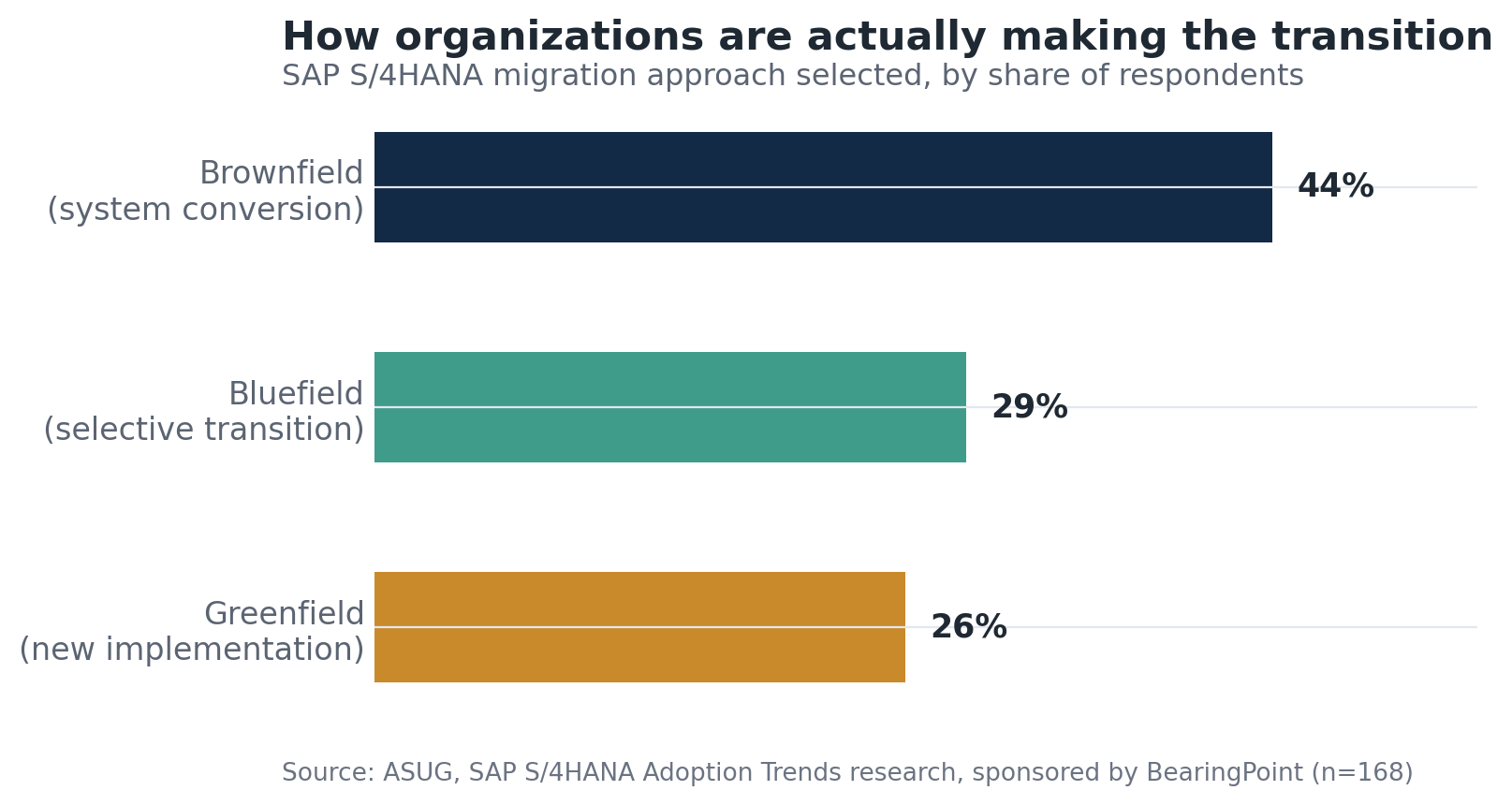
organizations choose most often: 44% of respondents in ASUG’s S/4HANA adoption research, sponsored by
© Orpington Technologies Inc. · orpingtontech.com · Page
1
Orpington Technologies | SAP S/4HANA Migration Insights
SAP ECC to S/4HANA Migration
Strategies: Brownfield, Greenfield, and
Selective (Bluefield) Transition
There is no single correct way to move from ECC to S/4HANA. There is only the approach that correctly matches an
organization’s existing landscape, ambition for process change, and appetite for risk.
Ask three different SAP consultancies which migration approach an organization should take, and it is not
unusual to get three different answers delivered with equal confidence. That is less a sign of disagreement
about the underlying technology than a sign that the honest answer is “it depends,” and different firms
specialize in different answers to “on what.” The three broadly recognized approaches — brownfield,
greenfield, and selective (also called bluefield) transition — are not competing philosophies so much as three
different starting assumptions about how much of the existing ECC landscape is worth carrying forward.
Understanding the actual tradeoffs, rather than a vendor’s preferred framing of them, is the first step toward
choosing correctly.
The three approaches, defined precisely
Brownfield: system conversion
A brownfield migration, more precisely called a system conversion, takes the existing ECC system — its
configuration, its custom code, its historical data — and converts it in place to run on the S/4HANA platform.
The business processes largely stay as they are; the underlying database and application layer change. This is
generally the fastest and least disruptive path to the S/4HANA maintenance runway, and it is the approach
organizations choose most often: 44% of respondents in ASUG’s S/4HANA adoption research, sponsored by
© Orpington Technologies Inc. · orpingtontech.com · Page
1
 Orpington Technologies | SAP S/4HANA Migration Insights
BearingPoint, reported taking this route. Its principal risk is that it can faithfully preserve exactly the process
debt and customization sprawl an organization might otherwise have used the migration as an opportunity to
address.
Greenfield: new implementation
A greenfield migration starts over: a fresh S/4HANA implementation built around SAP’s standard, best-
practice processes, into which historical data and legacy customizations are deliberately not carried forward
wholesale. Twenty-six percent of ASUG respondents took this approach. It offers the cleanest opportunity for
genuine process re-engineering and typically the smallest long-term custom-code footprint, at the cost of the
largest implementation effort, the most significant change-management burden, and the greatest risk of
disrupting processes that were, in fact, working well.
Selective (bluefield) transition
A selective, or bluefield, transition sits between the two: it allows an organization to combine elements of
system conversion with elements of new implementation — migrating some business units, processes, or
data selectively while re-engineering others, often using specialized tooling to move only the data and
configuration that is actually still needed. Twenty-nine percent of ASUG respondents chose this route.
Figure 1. SAP S/4HANA migration approach selected, by share of organizations surveyed.
What this shows:
Brownfield remains the most common choice, but more than half of organizations are choosing an
approach — bluefield or greenfield — that involves deliberate re-engineering rather than a like-for-like conversion.
The variables that should actually drive the decision
The right approach depends less on industry convention and more on a small number of organization-specific
variables, evaluated honestly rather than aspirationally.
●
Process fitness: are the organization’s current processes genuinely differentiated and worth
preserving, or have they simply accumulated because no one revisited them? A brownfield
conversion preserves the former as intended and the latter as a missed opportunity.
© Orpington Technologies Inc. · orpingtontech.com · Page
2
Orpington Technologies | SAP S/4HANA Migration Insights
BearingPoint, reported taking this route. Its principal risk is that it can faithfully preserve exactly the process
debt and customization sprawl an organization might otherwise have used the migration as an opportunity to
address.
Greenfield: new implementation
A greenfield migration starts over: a fresh S/4HANA implementation built around SAP’s standard, best-
practice processes, into which historical data and legacy customizations are deliberately not carried forward
wholesale. Twenty-six percent of ASUG respondents took this approach. It offers the cleanest opportunity for
genuine process re-engineering and typically the smallest long-term custom-code footprint, at the cost of the
largest implementation effort, the most significant change-management burden, and the greatest risk of
disrupting processes that were, in fact, working well.
Selective (bluefield) transition
A selective, or bluefield, transition sits between the two: it allows an organization to combine elements of
system conversion with elements of new implementation — migrating some business units, processes, or
data selectively while re-engineering others, often using specialized tooling to move only the data and
configuration that is actually still needed. Twenty-nine percent of ASUG respondents chose this route.
Figure 1. SAP S/4HANA migration approach selected, by share of organizations surveyed.
What this shows:
Brownfield remains the most common choice, but more than half of organizations are choosing an
approach — bluefield or greenfield — that involves deliberate re-engineering rather than a like-for-like conversion.
The variables that should actually drive the decision
The right approach depends less on industry convention and more on a small number of organization-specific
variables, evaluated honestly rather than aspirationally.
●
Process fitness: are the organization’s current processes genuinely differentiated and worth
preserving, or have they simply accumulated because no one revisited them? A brownfield
conversion preserves the former as intended and the latter as a missed opportunity.
© Orpington Technologies Inc. · orpingtontech.com · Page
2
Orpington Technologies | SAP S/4HANA Migration Insights
●
Custom-code footprint: a large volume of business-critical custom code is easier and cheaper to carry
forward through conversion than to rebuild from scratch — but it also means the migration inherits
whatever technical debt that code represents.
●
Data and landscape complexity: organizations with multiple ECC instances, significant merger-and-
acquisition history, or heavily fragmented master data are often better served by a selective
transition that lets them consolidate deliberately rather than converting complexity as-is.
●
Change capacity: greenfield implementations demand the most from an organization’s change-
management capability, precisely because more is changing at once. An organization with limited
bandwidth for user retraining and process adoption should weigh that constraint honestly against its
appetite for a fresh start.
●
Timeline pressure: system conversion is generally the fastest path to the S/4HANA maintenance
runway, which matters more for organizations closer to their support deadline with less remaining
planning time.
None of these variables produces a universally correct answer, and no organization should adopt a strategy
simply because it was the most common choice in a survey, or because a particular systems integrator
specializes in delivering it. The 44/29/26 split among ASUG respondents is evidence that all three approaches
are viable at scale — not evidence that any one of them is the default correct choice for a given organization.
Where organizations most often get the decision wrong
In practice, the most common misstep is not choosing the wrong approach outright — it is choosing an
approach for the wrong reason. A brownfield conversion selected purely because it is fastest, without an
honest audit of how much technical debt is being carried forward, simply relocates that debt onto newer,
more expensive infrastructure. A greenfield implementation selected purely because it sounds more
transformational, without a realistic assessment of the organization’s change capacity, can produce a
program that is technically elegant and operationally traumatic. A selective transition chosen without
disciplined scoping can, in the worst case, combine the complexity of both other approaches rather than the
advantages of either.
The organizations that navigate this well typically do one thing consistently: they base the decision on an
evidence-based inventory of their actual landscape — custom-code volume and criticality, data quality,
process variance across business units — rather than on a strategy chosen first and justified afterward.
Next Step
Because this decision depends on landscape-specific evidence rather than a default preference,
Orpington Technologies’ Full ERP Diagnostic Report includes an evidence-verified review of the
technical and organizational variables — custom-code footprint, data quality, process variance —
that should inform a brownfield, greenfield, or selective transition decision. Organizations still
weighing which approach fits are welcome to request a scoping conversation.
© Orpington Technologies Inc. · orpingtontech.com · Page
3
Orpington Technologies | SAP S/4HANA Migration Insights
Sources
•
ASUG, “SAP S/4HANA Adoption Trends, Insights, and Advice,” research sponsored by BearingPoint (n=168 ASUG
members).
© Orpington Technologies Inc. · orpingtontech.com · Page
4