
SAP S/4HANA Migration Is a Business Transformation Program, Not an IT Upgrade
The organizations that get the most out of S/4HANA are rarely the ones with the strongest technical execution alone. They are the ones that put the business, not IT, in charge of deciding what should change.
 Orpington Technologies | SAP S/4HANA Migration Insights
SAP S/4HANA Migration Is a Business
Transformation Program, Not an IT
Upgrade
The organizations that get the most out of S/4HANA are rarely the ones with the strongest technical execution
alone. They are the ones that put the business, not IT, in charge of deciding what should change.
Ask an IT leader and a chief operating officer to each describe, separately, what their organization’s SAP
S/4HANA migration is “for,” and it is common to get two different answers. IT will often describe a platform
modernization: moving off an aging database, adopting an in-memory architecture, retiring a system
approaching the end of its support life. Operations will describe something else entirely — an opportunity,
finally, to fix processes that have been held together with workarounds for a decade. Both answers are
correct. The problem is that only one of them, left unaddressed, actually determines whether the program
delivers value the organization notices.
A migration executed purely as a technical exercise — move the data, convert the code, replicate existing
processes as closely as possible in the new system — can succeed on every technical metric and still fail to
change anything that matters to the business. The system goes live, the lights stay on, and eighteen months
later the organization is running the same processes, with the same inefficiencies, on newer and more
expensive infrastructure. That outcome is not a technical failure. It is a governance failure: nobody outside IT
owned the question of what should actually change.
© Orpington Technologies Inc. · orpingtontech.com · Page
1
Orpington Technologies | SAP S/4HANA Migration Insights
SAP S/4HANA Migration Is a Business
Transformation Program, Not an IT
Upgrade
The organizations that get the most out of S/4HANA are rarely the ones with the strongest technical execution
alone. They are the ones that put the business, not IT, in charge of deciding what should change.
Ask an IT leader and a chief operating officer to each describe, separately, what their organization’s SAP
S/4HANA migration is “for,” and it is common to get two different answers. IT will often describe a platform
modernization: moving off an aging database, adopting an in-memory architecture, retiring a system
approaching the end of its support life. Operations will describe something else entirely — an opportunity,
finally, to fix processes that have been held together with workarounds for a decade. Both answers are
correct. The problem is that only one of them, left unaddressed, actually determines whether the program
delivers value the organization notices.
A migration executed purely as a technical exercise — move the data, convert the code, replicate existing
processes as closely as possible in the new system — can succeed on every technical metric and still fail to
change anything that matters to the business. The system goes live, the lights stay on, and eighteen months
later the organization is running the same processes, with the same inefficiencies, on newer and more
expensive infrastructure. That outcome is not a technical failure. It is a governance failure: nobody outside IT
owned the question of what should actually change.
© Orpington Technologies Inc. · orpingtontech.com · Page
1
 Orpington Technologies | SAP S/4HANA Migration Insights
The evidence that business ownership changes outcomes
This is not simply a matter of preference or philosophy. Research from the Project Management Institute’s
Pulse of the Profession 2025 study, based on a survey of 2,841 project professionals, found that teams with
high “business acumen” — defined as the ability to connect a project’s technical execution to the
organization’s actual commercial objectives — met their organizational business goals 78% of the time,
compared with 72% for other teams, and had a project failure rate of just 8%, compared with 11% for the
rest. The gap is not enormous in absolute terms, but it is consistent, and it compounds: a program with a
materially lower failure rate and a materially higher goal-achievement rate, applied to a transformation this
size, represents a meaningfully different risk profile for the organization funding it.
SAP’s own user base reflects a version of the same lesson from the opposite direction. In ASUG’s research into
S/4HANA adoption, sponsored by BearingPoint, “too many customizations” was identified as the single most
common complication organizations encountered during their migration — and customization, notably, is
rarely an IT decision made in isolation. It accumulates over years because a business process owner asked for
a specific workaround and IT built it. A migration that doesn’t involve the business in deciding which of those
accumulated customizations still earn their keep simply carries the same accumulated complexity forward
into the new system, at greater expense.
Why “re-engineering” is a driver, not a side effect
It is worth taking seriously how many organizations are already migrating specifically because of the process
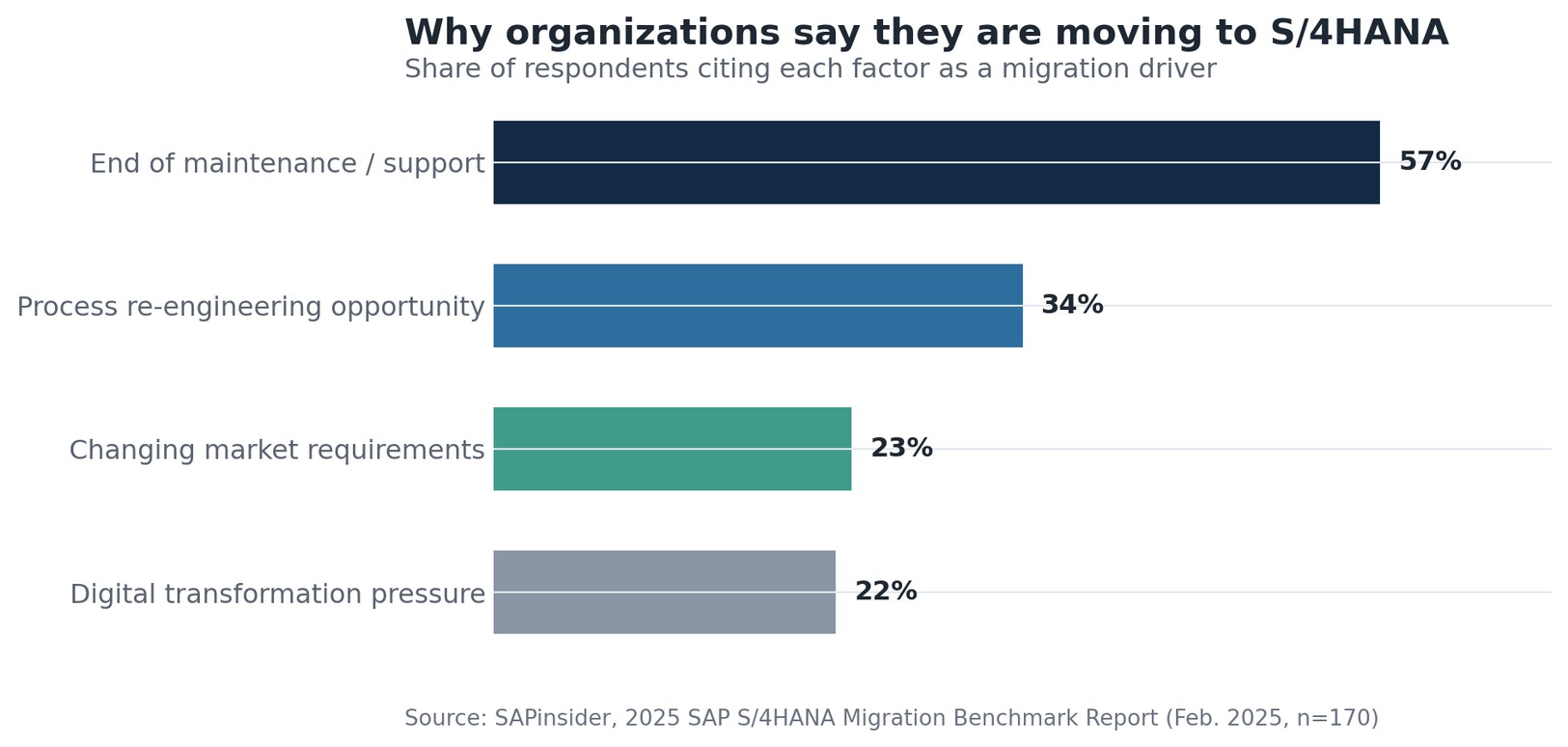
opportunity, not despite the disruption it involves. SAPinsider’s 2025 benchmark research found that 34% of
organizations cited “process re-engineering opportunity” as a primary driver of their S/4HANA migration —
the second most-cited driver after end-of-maintenance pressure, and ahead of both changing market
requirements and general digital-transformation pressure.
Figure 1. Migration drivers cited by SAP customers, ranked by share of respondents.
What this shows:
Process re-engineering is not a secondary justification bolted onto a compliance-driven migration —
for a third of organizations, it is a primary reason for undertaking one at all.
That ordering matters because it reframes what “success” should be measured against. A program justified
purely by end-of-maintenance pressure can reasonably be judged a success if the new system simply works. A
program that a third of organizations undertake explicitly to re-engineer their processes should be judged
© Orpington Technologies Inc. · orpingtontech.com · Page
2
Orpington Technologies | SAP S/4HANA Migration Insights
The evidence that business ownership changes outcomes
This is not simply a matter of preference or philosophy. Research from the Project Management Institute’s
Pulse of the Profession 2025 study, based on a survey of 2,841 project professionals, found that teams with
high “business acumen” — defined as the ability to connect a project’s technical execution to the
organization’s actual commercial objectives — met their organizational business goals 78% of the time,
compared with 72% for other teams, and had a project failure rate of just 8%, compared with 11% for the
rest. The gap is not enormous in absolute terms, but it is consistent, and it compounds: a program with a
materially lower failure rate and a materially higher goal-achievement rate, applied to a transformation this
size, represents a meaningfully different risk profile for the organization funding it.
SAP’s own user base reflects a version of the same lesson from the opposite direction. In ASUG’s research into
S/4HANA adoption, sponsored by BearingPoint, “too many customizations” was identified as the single most
common complication organizations encountered during their migration — and customization, notably, is
rarely an IT decision made in isolation. It accumulates over years because a business process owner asked for
a specific workaround and IT built it. A migration that doesn’t involve the business in deciding which of those
accumulated customizations still earn their keep simply carries the same accumulated complexity forward
into the new system, at greater expense.
Why “re-engineering” is a driver, not a side effect
It is worth taking seriously how many organizations are already migrating specifically because of the process
opportunity, not despite the disruption it involves. SAPinsider’s 2025 benchmark research found that 34% of
organizations cited “process re-engineering opportunity” as a primary driver of their S/4HANA migration —
the second most-cited driver after end-of-maintenance pressure, and ahead of both changing market
requirements and general digital-transformation pressure.
Figure 1. Migration drivers cited by SAP customers, ranked by share of respondents.
What this shows:
Process re-engineering is not a secondary justification bolted onto a compliance-driven migration —
for a third of organizations, it is a primary reason for undertaking one at all.
That ordering matters because it reframes what “success” should be measured against. A program justified
purely by end-of-maintenance pressure can reasonably be judged a success if the new system simply works. A
program that a third of organizations undertake explicitly to re-engineer their processes should be judged
© Orpington Technologies Inc. · orpingtontech.com · Page
2
Orpington Technologies | SAP S/4HANA Migration Insights
against a different, harder question: did the processes actually get better? IT leadership, however capable, is
rarely positioned to answer that question alone — it requires the process owners who understand why a
given workflow exists, what it actually accomplishes, and what would happen if it changed.
What business ownership looks like in practice
In practice, business ownership of an S/4HANA program does not mean business leaders learning SAP
configuration, and it does not mean IT stepping back from technical execution. It means a small number of
specific decisions being made — visibly, and on the record — by business stakeholders rather than defaulted
to IT because no one else was in the room. Those decisions typically include which legacy processes are
candidates for standardization against S/4HANA’s built-in best-practice processes rather than being replicated
as custom variants; which reports and KPIs the finance and operations functions actually rely on day to day, as
distinct from the reports that simply exist because someone built them once; and who, by name, is
accountable for signing off that a given business process works correctly in the new system before go-live —
not merely that the technical migration completed without error.
This last point deserves particular emphasis, because it is where governance models most often break down
quietly. A steering committee that reviews technical status reports — tasks completed, defects logged, testing
coverage — can look perfectly healthy right up until go-live, because none of those metrics actually measure
whether the business processes running through the new system meet the organization’s needs. That is a
different question, and it requires a different reporting line, one that runs through the business rather than
through the project’s technical workstreams alone.
A practical governance test
●
Can a named business stakeholder — not a project manager summarizing IT input — explain, in plain
terms, what will be different about how a specific process works after go-live, and why that change
was chosen?
●
Is there a documented decision, made by the business, for each major customization request,
distinguishing “retain because it reflects a genuine competitive difference” from “retain because no
one wanted to have the conversation”?
●
Does the program’s steering committee include the operating leaders who will actually be measured
on the process outcomes, not only the leaders measured on the project’s technical delivery?
None of this argues that the technical execution of an S/4HANA migration is unimportant — data migration,
custom-code remediation, integration testing, and cutover planning remain genuinely difficult engineering
problems, addressed elsewhere in this series. The point is narrower and, in practice, more consequential:
technical excellence determines whether the new system runs correctly. Business ownership determines
whether running correctly actually amounts to anything the organization notices a year later.
Next Step
Orpington Technologies’ Full ERP Implementation Partnership can lead an S/4HANA program
directly, end-to-end, or provide independent oversight of a program already underway — either
way, structured specifically to keep business and IT accountability visible and separate throughout,
© Orpington Technologies Inc. · orpingtontech.com · Page
3
Orpington Technologies | SAP S/4HANA Migration Insights
rather than allowing technical status reporting to stand in for business sign-off. Organizations
weighing how to structure governance for an upcoming S/4HANA program are welcome to discuss
the model with Orpington Technologies.
Sources
•
Project Management Institute, Pulse of the Profession 2025 (n=2,841 project professionals, surveyed July–Sept. 2024).
•
ASUG, “SAP S/4HANA Adoption Trends, Insights, and Advice,” research sponsored by BearingPoint (n=168 ASUG
members).
•
SAPinsider, 2025 SAP S/4HANA Migration Benchmark Report — Detailed Findings, Feb. 2025 (n=170).
© Orpington Technologies Inc. · orpingtontech.com · Page
4