
SAP S/4HANA Migration Risk: The Mistakes That Derail Transformation Programs
Most catastrophic migration failures trace back to a small, recurring set of governance and discipline gaps — not to unpredictable bad luck. Recognizing the pattern is most of the work of avoiding it.
 Orpington Technologies | SAP S/4HANA Migration Insights
SAP S/4HANA Migration Risk: The
Mistakes That Derail Transformation
Programs
Most catastrophic migration failures trace back to a small, recurring set of governance and discipline gaps — not to
unpredictable bad luck. Recognizing the pattern is most of the work of avoiding it.
Gartner’s research on enterprise resource planning projects makes a specific, sobering prediction: by 2027,
more than 70% of recently implemented ERP initiatives will fail to fully meet their original business goals. That
figure deserves to be read carefully rather than simply repeated as a statistic, because the word doing the
most work in it is “original.” These are not, for the most part, projects that collapsed outright. They are
projects that went live, that technically function, and that nonetheless failed to deliver what the organization
set out to achieve when it approved the investment.
That distinction matters because it changes what organizations should actually be watching for. The failure
mode most migration teams prepare for — a catastrophic technical breakdown — is comparatively rare and
comparatively visible when it happens. The failure mode Gartner’s research describes is quieter: a program
that meets its technical milestones while missing its actual purpose, because the underlying governance and
discipline gaps that would have prevented that outcome were never addressed.
The recurring pattern behind the number
Reviewing why S/4HANA and broader ERP transformations underperform their business case, the same
handful of governance failures recur far more often than any purely technical cause: insufficient business
involvement in decisions that were treated as IT’s alone; testing compressed to protect a fixed go-live date
© Orpington Technologies Inc. · orpingtontech.com · Page
1
Orpington Technologies | SAP S/4HANA Migration Insights
SAP S/4HANA Migration Risk: The
Mistakes That Derail Transformation
Programs
Most catastrophic migration failures trace back to a small, recurring set of governance and discipline gaps — not to
unpredictable bad luck. Recognizing the pattern is most of the work of avoiding it.
Gartner’s research on enterprise resource planning projects makes a specific, sobering prediction: by 2027,
more than 70% of recently implemented ERP initiatives will fail to fully meet their original business goals. That
figure deserves to be read carefully rather than simply repeated as a statistic, because the word doing the
most work in it is “original.” These are not, for the most part, projects that collapsed outright. They are
projects that went live, that technically function, and that nonetheless failed to deliver what the organization
set out to achieve when it approved the investment.
That distinction matters because it changes what organizations should actually be watching for. The failure
mode most migration teams prepare for — a catastrophic technical breakdown — is comparatively rare and
comparatively visible when it happens. The failure mode Gartner’s research describes is quieter: a program
that meets its technical milestones while missing its actual purpose, because the underlying governance and
discipline gaps that would have prevented that outcome were never addressed.
The recurring pattern behind the number
Reviewing why S/4HANA and broader ERP transformations underperform their business case, the same
handful of governance failures recur far more often than any purely technical cause: insufficient business
involvement in decisions that were treated as IT’s alone; testing compressed to protect a fixed go-live date
© Orpington Technologies Inc. · orpingtontech.com · Page
1
 Orpington Technologies | SAP S/4HANA Migration Insights
rather than expanded to reflect what testing actually revealed; scope creep absorbed silently rather than
formally re-baselined against the original business case; and change management treated as a
communications exercise rather than a genuine capability-building effort. None of these are exotic risks. They
are well-documented, well-understood failure modes — which is precisely what makes the persistently high
failure rate so notable. These are not, for the most part, unknown risks. They are known risks that go
unmanaged.
ASUG’s adoption research offers a live data point on one piece of this pattern: 31% of member organizations
reported that migration costs exceeded their original expectations — an improvement from a higher share
the year before, suggesting the ecosystem is getting somewhat better at this over time, but still describing
roughly one in three programs running over its financial plan.
Governance discipline is measurably correlated with outcome
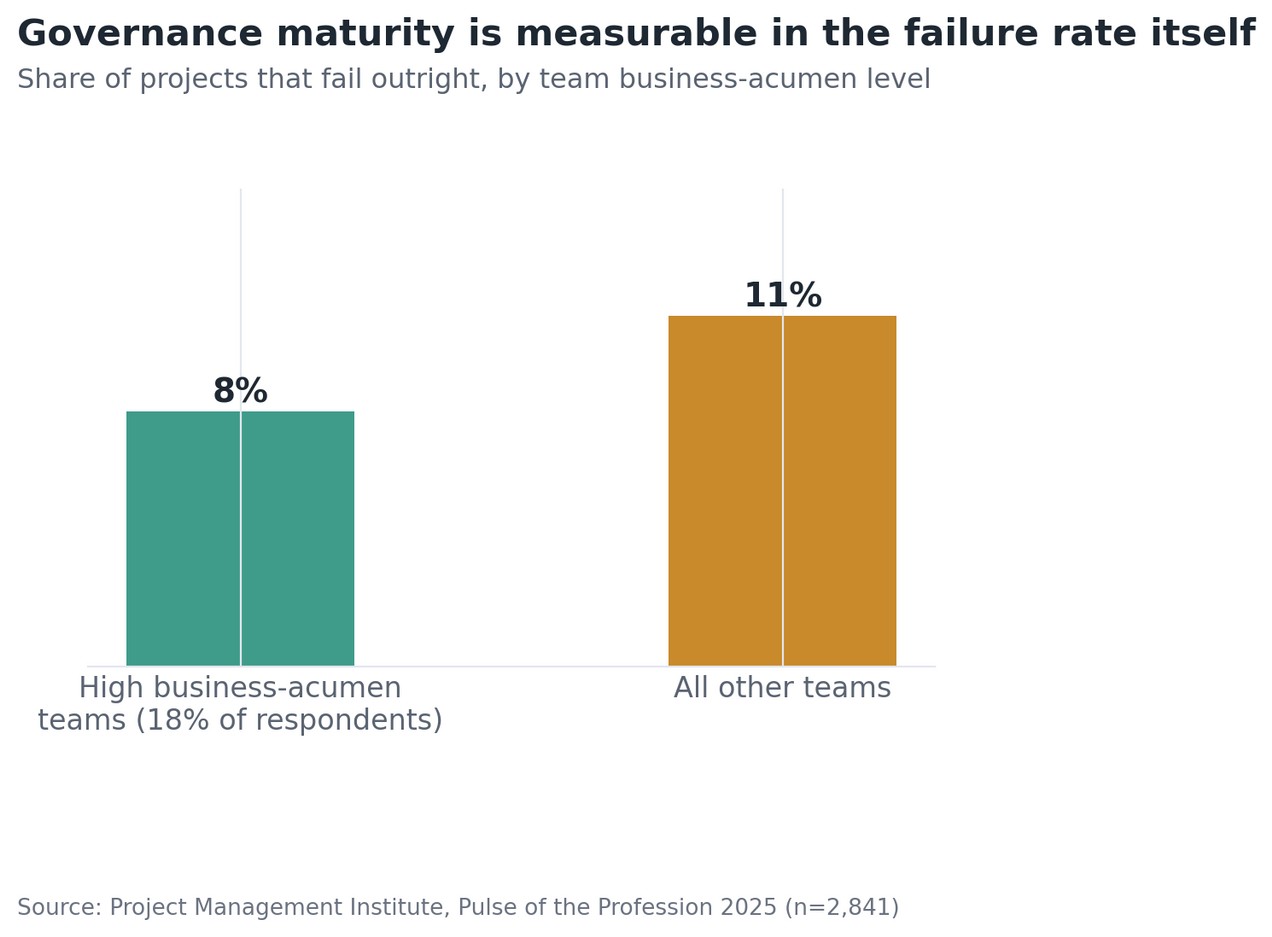
The Project Management Institute’s Pulse of the Profession 2025 research provides a direct, quantified link
between governance discipline and failure rate. Teams the study classified as having high “business acumen”
— the ability to connect technical project execution to actual business objectives, and a trait closely
associated with strong stakeholder engagement and disciplined decision-making — had a project failure rate
of 8%. Teams without that trait had a failure rate of 11%.
Figure 1. Project failure rate by team governance maturity.
What this shows:
The difference between disciplined and undisciplined governance shows up directly in the failure rate
itself — this is not a soft, unmeasurable factor, it is a quantified one.
A three-percentage-point gap can sound modest in isolation. Applied across a portfolio of enterprise
transformation programs — and applied to a program of the scale and cost of an SAP S/4HANA migration — it
represents a materially different risk exposure, and it is a gap driven by governance behavior that is, in
principle, entirely within an organization’s control: how stakeholders are engaged, how success is measured,
how scope decisions are made and documented.
© Orpington Technologies Inc. · orpingtontech.com · Page
2
Orpington Technologies | SAP S/4HANA Migration Insights
rather than expanded to reflect what testing actually revealed; scope creep absorbed silently rather than
formally re-baselined against the original business case; and change management treated as a
communications exercise rather than a genuine capability-building effort. None of these are exotic risks. They
are well-documented, well-understood failure modes — which is precisely what makes the persistently high
failure rate so notable. These are not, for the most part, unknown risks. They are known risks that go
unmanaged.
ASUG’s adoption research offers a live data point on one piece of this pattern: 31% of member organizations
reported that migration costs exceeded their original expectations — an improvement from a higher share
the year before, suggesting the ecosystem is getting somewhat better at this over time, but still describing
roughly one in three programs running over its financial plan.
Governance discipline is measurably correlated with outcome
The Project Management Institute’s Pulse of the Profession 2025 research provides a direct, quantified link
between governance discipline and failure rate. Teams the study classified as having high “business acumen”
— the ability to connect technical project execution to actual business objectives, and a trait closely
associated with strong stakeholder engagement and disciplined decision-making — had a project failure rate
of 8%. Teams without that trait had a failure rate of 11%.
Figure 1. Project failure rate by team governance maturity.
What this shows:
The difference between disciplined and undisciplined governance shows up directly in the failure rate
itself — this is not a soft, unmeasurable factor, it is a quantified one.
A three-percentage-point gap can sound modest in isolation. Applied across a portfolio of enterprise
transformation programs — and applied to a program of the scale and cost of an SAP S/4HANA migration — it
represents a materially different risk exposure, and it is a gap driven by governance behavior that is, in
principle, entirely within an organization’s control: how stakeholders are engaged, how success is measured,
how scope decisions are made and documented.
© Orpington Technologies Inc. · orpingtontech.com · Page
2
Orpington Technologies | SAP S/4HANA Migration Insights
A risk taxonomy worth reviewing before, not after, kickoff
Programs rarely fail for a single, isolated reason. They fail when several of the following risks accumulate
simultaneously, each individually manageable but collectively overwhelming a program that lacked the
governance structure to surface and address them early.
●
Poor planning: a program plan built around an assumed timeline rather than an evidence-based
readiness assessment of the organization’s actual starting point.
●
Inadequate testing: testing scope and duration set by the calendar rather than by what the system
landscape and business-process complexity actually require.
●
Insufficient business involvement: decisions about process design and customization made by IT
alone, in the absence of accountable business ownership.
●
Data problems: master and transactional data quality issues discovered during testing rather than
addressed through a dedicated cleansing and governance workstream earlier in the program.
●
Underestimated integrations: third-party and legacy system integrations inventoried incompletely at
the start of the program, only fully understood once technical work is already underway.
●
Scope creep: changes to scope absorbed informally rather than run through a formal re-baselining
process against the original business case and budget.
●
Weak project governance: a steering committee that reviews technical status without an
independent view of whether the underlying business objectives are still being met.
The organizations that avoid this pattern are rarely the ones with the most sophisticated technology choices.
They are the ones with a disciplined, evidence-based check — built into how the program is run, whether that
check comes from an independent party overseeing someone else’s build or from the delivery partner holding
itself to the same evidence standard — at regular intervals, on whether the underlying business case is still
being met, not only whether the project plan is on schedule.
Next Step
This is precisely the governance layer Orpington Technologies’ Full ERP Implementation
Partnership is designed to provide: Orpington can lead the program directly, applying this
evidence-based discipline as the accountable delivery partner, or provide independent oversight
of a systems integrator already engaged — either way, ensuring the program is measured against
its original business case throughout, not only at go-live. For programs already showing signs of
this pattern, Orpington Technologies’ Stalled Implementation Recovery service is built specifically
for intervention before the pattern becomes a board-level crisis.
Sources
•
Gartner, “What IT Leaders Must Do to Avoid Disappointing ERP Initiatives.”
•
Project Management Institute, Pulse of the Profession 2025 (n=2,841 project professionals, surveyed July–Sept. 2024).
© Orpington Technologies Inc. · orpingtontech.com · Page
3
Orpington Technologies | SAP S/4HANA Migration Insights
•
ASUG, “SAP S/4HANA Adoption Trends, Insights, and Advice,” research sponsored by BearingPoint (n=168 ASUG
members).
© Orpington Technologies Inc. · orpingtontech.com · Page
4