
The Financial Case for SAP S/4HANA Migration: Beyond “ECC Is Being Retired”
maintenance deadline can get a migration funded. It rarely, on its own, makes the case for the level of investment the program actually requires — that case has to rest on quantifiable return.
 Orpington Technologies | SAP S/4HANA Migration Insights
The Financial Case for SAP S/4HANA
Migration: Beyond “ECC Is Being
Retired”
A maintenance deadline can get a migration funded. It rarely, on its own, makes the case for the level of
investment the program actually requires — that case has to rest on quantifiable return.
“SAP is retiring ECC” is a true statement, and it is also, on its own, a weak business case. A deadline explains
why an organization must eventually act; it says nothing about why a particular level of investment, in a
particular timeframe, with a particular scope, is the right choice. Boards approve capital for compelling
returns, not for compliance with a vendor’s support calendar — and a business case built only on the deadline
tends to produce exactly the outcome that framing implies: the minimum viable migration, timed to the
deadline, scoped to avoid the support cliff rather than to capture value.
A durable business case answers a different, harder question: independent of the maintenance calendar,
what return justifies this investment? The evidence on that question is more specific — and more useful to a
finance committee — than most migration proposals make it out to be.
What the quantified evidence shows
A Forrester Consulting study commissioned by SAP, published in September 2019, offers one of the more
rigorously documented answers available. Based on interviews with four SAP S/4HANA customers and a
broader survey of 110 organizations, Forrester constructed a composite organization to model the three-year,
risk-adjusted financial impact of migration. The results: a 134% return on investment, a payback period of
© Orpington Technologies Inc. · orpingtontech.com · Page
1
Orpington Technologies | SAP S/4HANA Migration Insights
The Financial Case for SAP S/4HANA
Migration: Beyond “ECC Is Being
Retired”
A maintenance deadline can get a migration funded. It rarely, on its own, makes the case for the level of
investment the program actually requires — that case has to rest on quantifiable return.
“SAP is retiring ECC” is a true statement, and it is also, on its own, a weak business case. A deadline explains
why an organization must eventually act; it says nothing about why a particular level of investment, in a
particular timeframe, with a particular scope, is the right choice. Boards approve capital for compelling
returns, not for compliance with a vendor’s support calendar — and a business case built only on the deadline
tends to produce exactly the outcome that framing implies: the minimum viable migration, timed to the
deadline, scoped to avoid the support cliff rather than to capture value.
A durable business case answers a different, harder question: independent of the maintenance calendar,
what return justifies this investment? The evidence on that question is more specific — and more useful to a
finance committee — than most migration proposals make it out to be.
What the quantified evidence shows
A Forrester Consulting study commissioned by SAP, published in September 2019, offers one of the more
rigorously documented answers available. Based on interviews with four SAP S/4HANA customers and a
broader survey of 110 organizations, Forrester constructed a composite organization to model the three-year,
risk-adjusted financial impact of migration. The results: a 134% return on investment, a payback period of
© Orpington Technologies Inc. · orpingtontech.com · Page
1
 Orpington Technologies | SAP S/4HANA Migration Insights
thirteen months, and a net present value of $21.9 million, built from total three-year benefits of $38.2 million
against total three-year costs of $16.3 million.
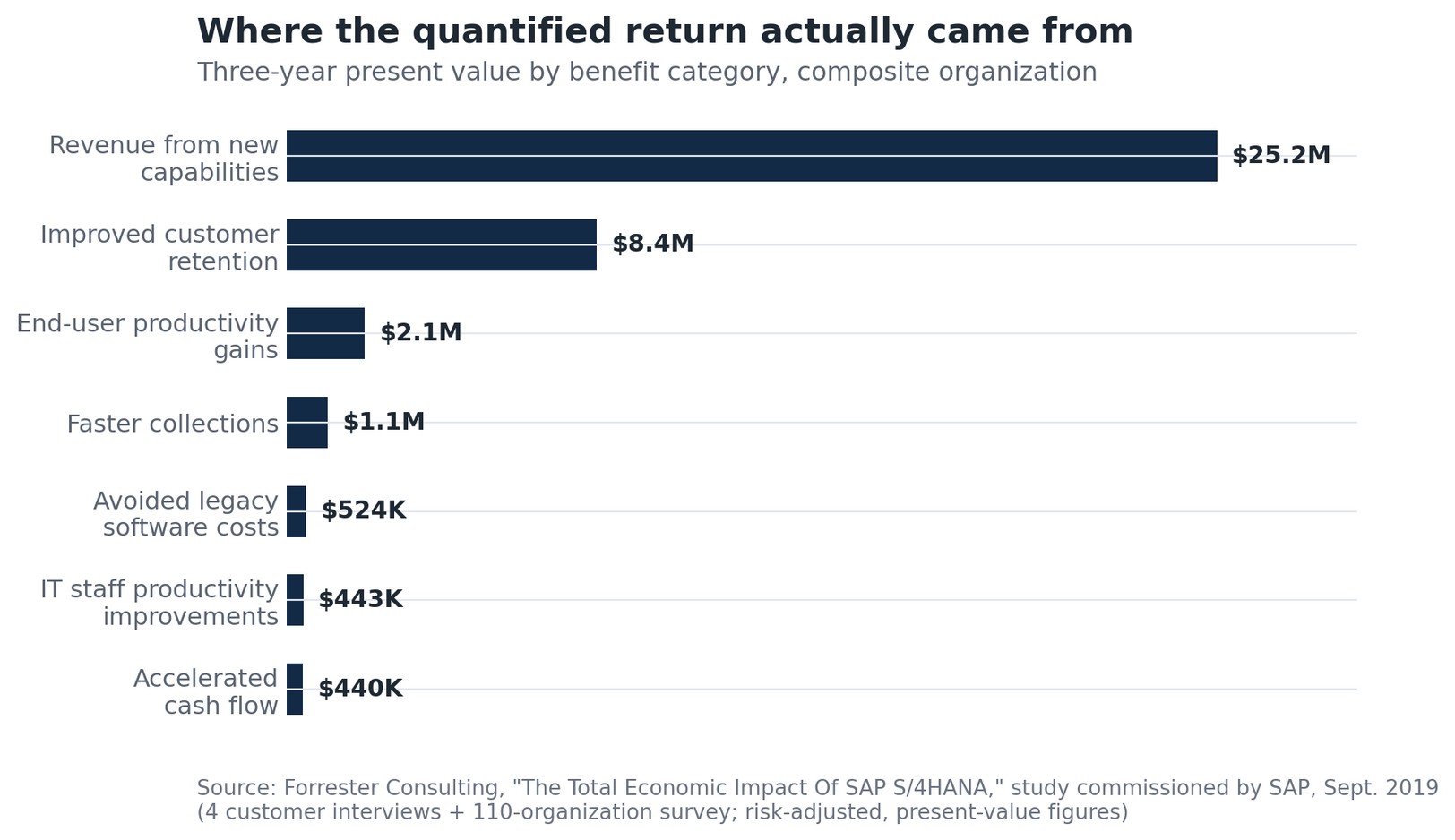
Figure 1. Where the quantified three-year return came from, composite organization.
What this shows:
The largest share of the modeled return came from new revenue-generating capability and improved
customer retention — not from IT cost avoidance, which is a smaller and more predictable share of the total case.
The composition of that return is worth reading closely, because it undercuts a common assumption: that the
financial case for ERP modernization is primarily about IT cost avoidance — retiring old hardware, reducing
support contracts. In Forrester’s model, avoided legacy software costs accounted for only $524,000 of the
$38.2 million in modeled benefit. The largest components were revenue from new capabilities ($25.2 million,
with 37% of surveyed customers reporting revenue increases averaging 3.2%) and improved customer
retention ($8.4 million, tied to a 4.1-percentage-point reduction in annual churn). End-user productivity gains,
faster collections, and IT staff productivity improvements made up the remainder.
This is a useful corrective for how the business case is often framed internally. A proposal built primarily
around infrastructure savings will systematically understate the available return, because infrastructure
savings are the smallest, not the largest, share of what a well-executed S/4HANA migration has been shown
to deliver.
Why the deadline still belongs in the memo — just not as the
headline
None of this means the 2027 mainstream-maintenance deadline is irrelevant to the financial case — it is
directly relevant to cost, because delay carries its own quantifiable price. SAP’s own 2022 policy update sets
extended maintenance for certain on-premise S/4HANA releases at an additional four percent of the core
maintenance base for organizations that remain off SAP’s RISE cloud subscription, a genuine, ongoing cost of
deferring the decision. The deadline belongs in the business case as a cost-of-delay input, alongside the
return-on-investment case — not as a substitute for it.
© Orpington Technologies Inc. · orpingtontech.com · Page
2
Orpington Technologies | SAP S/4HANA Migration Insights
thirteen months, and a net present value of $21.9 million, built from total three-year benefits of $38.2 million
against total three-year costs of $16.3 million.
Figure 1. Where the quantified three-year return came from, composite organization.
What this shows:
The largest share of the modeled return came from new revenue-generating capability and improved
customer retention — not from IT cost avoidance, which is a smaller and more predictable share of the total case.
The composition of that return is worth reading closely, because it undercuts a common assumption: that the
financial case for ERP modernization is primarily about IT cost avoidance — retiring old hardware, reducing
support contracts. In Forrester’s model, avoided legacy software costs accounted for only $524,000 of the
$38.2 million in modeled benefit. The largest components were revenue from new capabilities ($25.2 million,
with 37% of surveyed customers reporting revenue increases averaging 3.2%) and improved customer
retention ($8.4 million, tied to a 4.1-percentage-point reduction in annual churn). End-user productivity gains,
faster collections, and IT staff productivity improvements made up the remainder.
This is a useful corrective for how the business case is often framed internally. A proposal built primarily
around infrastructure savings will systematically understate the available return, because infrastructure
savings are the smallest, not the largest, share of what a well-executed S/4HANA migration has been shown
to deliver.
Why the deadline still belongs in the memo — just not as the
headline
None of this means the 2027 mainstream-maintenance deadline is irrelevant to the financial case — it is
directly relevant to cost, because delay carries its own quantifiable price. SAP’s own 2022 policy update sets
extended maintenance for certain on-premise S/4HANA releases at an additional four percent of the core
maintenance base for organizations that remain off SAP’s RISE cloud subscription, a genuine, ongoing cost of
deferring the decision. The deadline belongs in the business case as a cost-of-delay input, alongside the
return-on-investment case — not as a substitute for it.
© Orpington Technologies Inc. · orpingtontech.com · Page
2
Orpington Technologies | SAP S/4HANA Migration Insights
A business case structured this way is also simply more durable inside the organization. A case built solely on
“the deadline is approaching” loses persuasive force the moment budget pressure or competing priorities
emerge, because a support deadline three years away does not feel urgent in a quarterly planning cycle. A
case built on quantified return — revenue enablement, retention improvement, productivity gain — remains
persuasive on its own financial merits, with the deadline serving as a secondary reason to sequence the
investment now rather than later.
What a board-ready business case actually needs
●
A return model specific to the organization’s own revenue and retention dynamics, not a generic
industry benchmark presented as if it applies uniformly.
●
An honest cost baseline that includes implementation staff time and organizational change effort, not
only license and infrastructure spend — Forrester’s own cost model allocated the largest share of
three-year cost, $9.0 million of $16.3 million, to implementation staff.
●
A payback framing that distinguishes near-term productivity and cost-avoidance benefits, realized
relatively quickly, from longer-horizon revenue and retention benefits that depend on the
organization actually adopting new capabilities, not merely installing them.
●
An explicit cost-of-delay figure, tying the maintenance calendar to a specific, quantified cost rather
than a generic sense of urgency.
Next Step
Building a business case grounded in the organization’s own numbers — not a generic industry
model — is where an independent, evidence-based review adds the most value. Orpington
Technologies’ Full ERP Diagnostic Report brings this board-ready, defensible framing to the
business case itself, and the Full ERP Implementation Partnership carries that same discipline into
execution, whether Orpington is leading the migration directly or overseeing the partner
delivering it. Finance and IT leaders preparing a migration business case are welcome to discuss
what that framing would look like for their organization.
Sources
•
Forrester Consulting, “The Total Economic Impact™ Of SAP S/4HANA,” study commissioned by SAP, September 2019.
•
SAP News, “New SAP S/4HANA Release and Maintenance Strategy to Deliver Greater Innovation and Flexibility,” Sept.
15, 2022.
© Orpington Technologies Inc. · orpingtontech.com · Page
3