
The Hidden Costs of Delaying Your SAP S/4HANA Migration
Standing still has a price. It shows up in maintenance premiums, in shrinking implementation windows, and in the compounding weight of a legacy landscape that keeps getting harder to leave the longer it is left alone.
 Orpington Technologies | SAP S/4HANA Migration Insights
The Hidden Costs of Delaying Your SAP
S/4HANA Migration
Standing still has a price. It shows up in maintenance premiums, in shrinking implementation windows, and in the
compounding weight of a legacy landscape that keeps getting harder to leave the longer it is left alone.
When a finance leader asks what an SAP S/4HANA migration will cost, the honest answer has two halves. The
first — licenses, infrastructure, implementation labor, testing, training — is the half every proposal quantifies
in detail. The second half is almost never quantified at all: what does it cost to not do this yet? That question
is harder to answer precisely, but it is not unanswerable, and the organizations that never ask it tend to
discover the answer the expensive way, on a timeline they did not choose.
Delay is not free. It is simply a cost that arrives in a different form than an implementation invoice — as a
maintenance premium, as a shrinking window for an orderly transition, and as technical debt that compounds
quietly until it is suddenly the largest line item in the project.
The direct cost: paying more to keep less
The most literal cost of delay is the extended-maintenance premium itself. SAP’s September 2022 policy
announcement set the fee for extended maintenance on certain on-premise S/4HANA releases at an
additional four percent of the customer’s core maintenance base, for organizations that choose to remain off
the RISE with SAP cloud subscription; the fee is waived entirely for those who move to RISE. For ECC
customers specifically, industry sources such as SAP partner SEIDOR describe a historically more modest
premium — commonly cited around two percent — for extended maintenance through 2030 on top of
standard support fees.
© Orpington Technologies Inc. · orpingtontech.com · Page
1
Orpington Technologies | SAP S/4HANA Migration Insights
The Hidden Costs of Delaying Your SAP
S/4HANA Migration
Standing still has a price. It shows up in maintenance premiums, in shrinking implementation windows, and in the
compounding weight of a legacy landscape that keeps getting harder to leave the longer it is left alone.
When a finance leader asks what an SAP S/4HANA migration will cost, the honest answer has two halves. The
first — licenses, infrastructure, implementation labor, testing, training — is the half every proposal quantifies
in detail. The second half is almost never quantified at all: what does it cost to not do this yet? That question
is harder to answer precisely, but it is not unanswerable, and the organizations that never ask it tend to
discover the answer the expensive way, on a timeline they did not choose.
Delay is not free. It is simply a cost that arrives in a different form than an implementation invoice — as a
maintenance premium, as a shrinking window for an orderly transition, and as technical debt that compounds
quietly until it is suddenly the largest line item in the project.
The direct cost: paying more to keep less
The most literal cost of delay is the extended-maintenance premium itself. SAP’s September 2022 policy
announcement set the fee for extended maintenance on certain on-premise S/4HANA releases at an
additional four percent of the customer’s core maintenance base, for organizations that choose to remain off
the RISE with SAP cloud subscription; the fee is waived entirely for those who move to RISE. For ECC
customers specifically, industry sources such as SAP partner SEIDOR describe a historically more modest
premium — commonly cited around two percent — for extended maintenance through 2030 on top of
standard support fees.
© Orpington Technologies Inc. · orpingtontech.com · Page
1
 Orpington Technologies | SAP S/4HANA Migration Insights
The percentages themselves are less important than what they represent: a recurring charge, indefinitely, for
a system that is receiving no new capability whatsoever. Extended maintenance provides security patches
and limited legal updates — it does not provide new features, and it does not reduce the underlying
complexity of the landscape. An organization paying an extended-maintenance premium for three or four
years and using none of that time to actively de-risk its eventual migration has, in effect, purchased several
years of standing still at a markup.
The structural cost: a shrinking window for a calm transition
SAPinsider’s 2025 benchmark research offers a useful proxy for how this dynamic is already playing out across
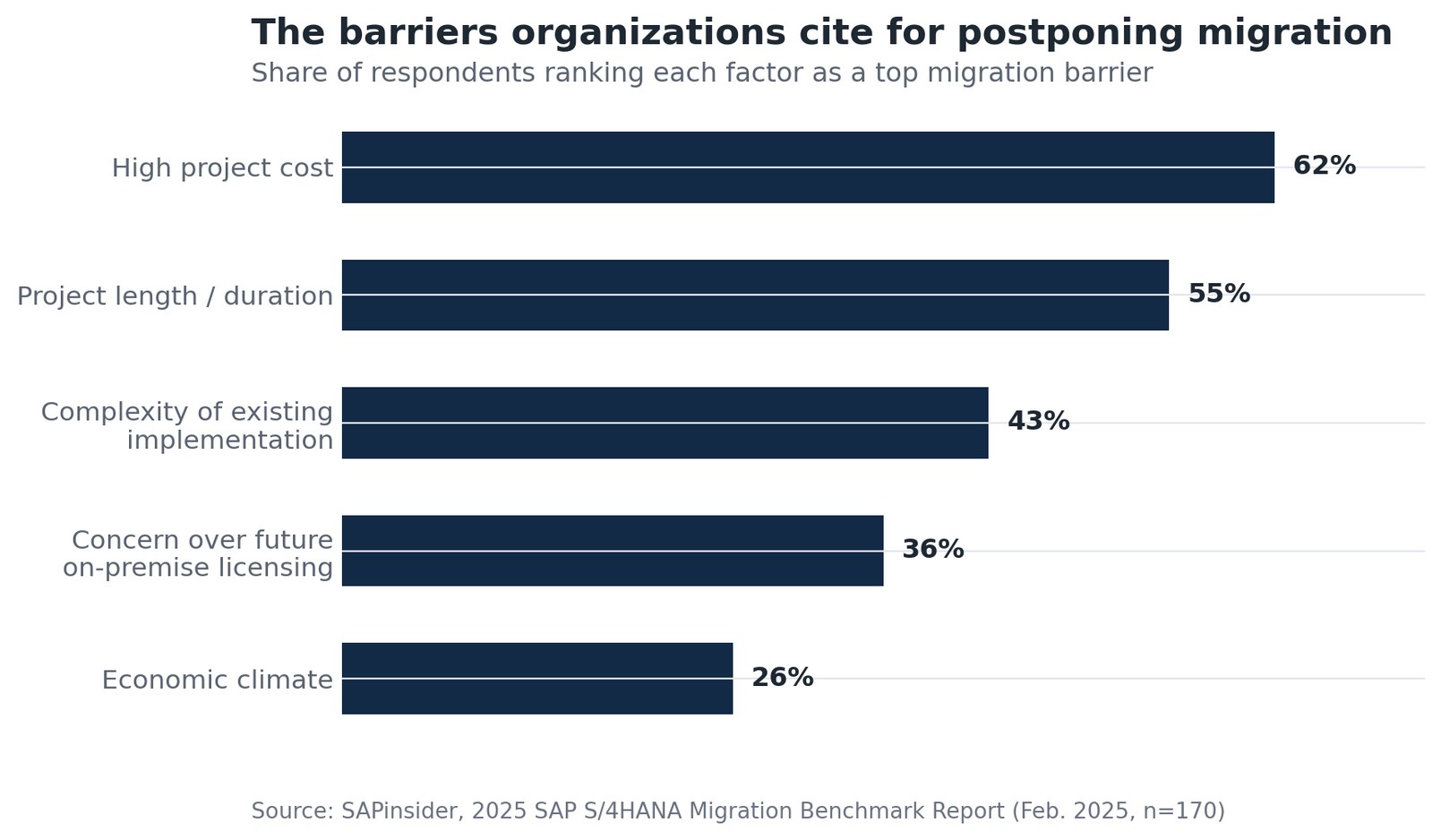
the SAP customer base. Among the organizations surveyed, high project cost was the most-cited barrier to
migration, named by 62% of respondents, followed closely by concerns about project length and duration at
55% — a figure that had risen sharply from 37% just a year earlier. Complexity of the existing implementation
was cited by 43%, and concern about future on-premise licensing by 36%.
Figure 1. The barriers organizations most often cite for postponing their SAP S/4HANA migration.
What this shows:
The barriers that most commonly stall a migration — cost, duration, and complexity — are precisely
the ones that tend to get worse, not better, the longer a decision is deferred.
That rising concern about duration is the structural cost of delay made visible. As the 2027 mainstream-
maintenance deadline approaches, the population of organizations still needing to migrate compresses into a
shorter remaining window, competing for the same finite pool of experienced implementation partners,
specialist consultants, and internal change capacity. A migration planned calmly over eighteen to twenty-four
months looks structurally different from the same migration compressed into the final year before a support
deadline — not because the technical work has changed, but because testing gets abbreviated, change
management gets rushed, and data-cleansing gets treated as a checkbox rather than a discipline. None of
those compressions show up as a separate line item on an invoice. They show up later, as post-go-live
defects, adoption problems, and rework.
© Orpington Technologies Inc. · orpingtontech.com · Page
2
Orpington Technologies | SAP S/4HANA Migration Insights
The percentages themselves are less important than what they represent: a recurring charge, indefinitely, for
a system that is receiving no new capability whatsoever. Extended maintenance provides security patches
and limited legal updates — it does not provide new features, and it does not reduce the underlying
complexity of the landscape. An organization paying an extended-maintenance premium for three or four
years and using none of that time to actively de-risk its eventual migration has, in effect, purchased several
years of standing still at a markup.
The structural cost: a shrinking window for a calm transition
SAPinsider’s 2025 benchmark research offers a useful proxy for how this dynamic is already playing out across
the SAP customer base. Among the organizations surveyed, high project cost was the most-cited barrier to
migration, named by 62% of respondents, followed closely by concerns about project length and duration at
55% — a figure that had risen sharply from 37% just a year earlier. Complexity of the existing implementation
was cited by 43%, and concern about future on-premise licensing by 36%.
Figure 1. The barriers organizations most often cite for postponing their SAP S/4HANA migration.
What this shows:
The barriers that most commonly stall a migration — cost, duration, and complexity — are precisely
the ones that tend to get worse, not better, the longer a decision is deferred.
That rising concern about duration is the structural cost of delay made visible. As the 2027 mainstream-
maintenance deadline approaches, the population of organizations still needing to migrate compresses into a
shorter remaining window, competing for the same finite pool of experienced implementation partners,
specialist consultants, and internal change capacity. A migration planned calmly over eighteen to twenty-four
months looks structurally different from the same migration compressed into the final year before a support
deadline — not because the technical work has changed, but because testing gets abbreviated, change
management gets rushed, and data-cleansing gets treated as a checkbox rather than a discipline. None of
those compressions show up as a separate line item on an invoice. They show up later, as post-go-live
defects, adoption problems, and rework.
© Orpington Technologies Inc. · orpingtontech.com · Page
2
Orpington Technologies | SAP S/4HANA Migration Insights
The compounding cost: technical debt does not wait
The least visible cost of delay is also the most persistent: every year an ECC landscape continues operating
unchanged is a year in which its custom code, its integrations, and its accumulated workarounds continue to
be built upon, rather than reduced. A workflow patched together three years ago to handle an edge case
becomes, three years later, a dependency that a newer process now quietly relies on — and untangling it
becomes progressively more expensive the longer it is left in place, simply because more has been built on
top of it in the meantime.
This is why the organizations best positioned for a 2027 transition are rarely the ones that simply started
earliest in calendar terms. They are the ones that used their remaining runway actively — auditing custom
code, cleansing master data, documenting the business logic behind long-standing workarounds — rather
than treating the maintenance deadline as something to worry about only once it is close. An extended-
maintenance period spent this way is a legitimate, cost-effective bridge. The same period spent without that
work underway is simply deferred spending with interest.
A practical reframing for the finance conversation
●
Ask what the extended-maintenance premium is actually buying — security patching only, or security
patching plus a funded, active de-risking program running in parallel.
●
Model the implementation timeline against the shrinking pool of available specialist capacity as 2027
approaches, not against today’s vendor availability.
●
Treat unresolved custom-code and data-quality issues as a cost that accrues interest, not as a fixed
backlog that will cost the same to fix whenever it is eventually addressed.
Next Step
Orpington Technologies’ Implementation Risk Remediation service is built specifically for this
window — scoped, fixed-fee advisory sprints that address named gaps (data quality, custom-code
exposure, partner accountability) rather than an open-ended retainer, with Orpington available to
lead the remediation work directly or oversee it alongside an existing team. Organizations
currently in, or approaching, an extended-maintenance period can use this time productively by
speaking with Orpington Technologies about what a remediation sprint would prioritize first.
Sources
•
SAP News, “New SAP S/4HANA Release and Maintenance Strategy to Deliver Greater Innovation and Flexibility,” Sept.
15, 2022.
•
SEIDOR, “Understanding SAP ECC Deadlines: What 2026 and 2027 Mean for Your Business.”
•
SAPinsider, 2025 SAP S/4HANA Migration Benchmark Report — Detailed Findings, Feb. 2025 (n=170).
© Orpington Technologies Inc. · orpingtontech.com · Page
3