
Why the SAP ECC-to-S/4HANA Transition Can No Longer Wait for “Someday”
SAP’s maintenance calendar has moved twice in five years. Understanding exactly what it now requires — and by when — is the first step toward a migration plan that isn’t written under duress.
 Orpington Technologies | SAP S/4HANA Migration Insights
Why the SAP ECC-to-S/4HANA Transition
Can No Longer Wait for “Someday”
SAP’s maintenance calendar has moved twice in five years. Understanding exactly what it now requires — and by
when — is the first step toward a migration plan that isn’t written under duress.
Most conversations about SAP’s move away from ECC begin the same way: with a date. “2027” has become
shorthand for an entire category of enterprise risk, repeated in board decks and vendor pitches until it starts
to sound like a fixed, all-or-nothing cliff edge. It isn’t. It is a maintenance policy with several distinct phases,
each with its own scope, its own cost implications, and its own decision points — and organizations that treat
it as a single deadline tend to either panic prematurely or, more often, relax prematurely because the actual
date still looks comfortably far away.
Both reactions create the same downstream problem: a migration that eventually gets planned under time
pressure rather than on the organization’s own terms. Understanding precisely what SAP has committed to —
and precisely what each phase of that commitment does and does not include — is the starting point for a
calmer, better-sequenced transition.
What SAP has actually committed to
SAP’s current policy, most recently restated in a February 2020 announcement, extends mainstream
maintenance for SAP Business Suite 7 — the product family that includes SAP ERP 6.0, commonly known as
ECC — to the end of 2027. Organizations that want additional runway can purchase optional extended
maintenance through the end of 2030. Within that ECC 6.0 lifecycle, the specific enhancement package a
customer is running matters: SAP partner SEIDOR notes that mainstream maintenance for older enhancement
packages (EHP 0–5) already ended at the close of 2026, while the more common EHP 6–8 releases carry
© Orpington Technologies Inc. · orpingtontech.com · Page
1
Orpington Technologies | SAP S/4HANA Migration Insights
Why the SAP ECC-to-S/4HANA Transition
Can No Longer Wait for “Someday”
SAP’s maintenance calendar has moved twice in five years. Understanding exactly what it now requires — and by
when — is the first step toward a migration plan that isn’t written under duress.
Most conversations about SAP’s move away from ECC begin the same way: with a date. “2027” has become
shorthand for an entire category of enterprise risk, repeated in board decks and vendor pitches until it starts
to sound like a fixed, all-or-nothing cliff edge. It isn’t. It is a maintenance policy with several distinct phases,
each with its own scope, its own cost implications, and its own decision points — and organizations that treat
it as a single deadline tend to either panic prematurely or, more often, relax prematurely because the actual
date still looks comfortably far away.
Both reactions create the same downstream problem: a migration that eventually gets planned under time
pressure rather than on the organization’s own terms. Understanding precisely what SAP has committed to —
and precisely what each phase of that commitment does and does not include — is the starting point for a
calmer, better-sequenced transition.
What SAP has actually committed to
SAP’s current policy, most recently restated in a February 2020 announcement, extends mainstream
maintenance for SAP Business Suite 7 — the product family that includes SAP ERP 6.0, commonly known as
ECC — to the end of 2027. Organizations that want additional runway can purchase optional extended
maintenance through the end of 2030. Within that ECC 6.0 lifecycle, the specific enhancement package a
customer is running matters: SAP partner SEIDOR notes that mainstream maintenance for older enhancement
packages (EHP 0–5) already ended at the close of 2026, while the more common EHP 6–8 releases carry
© Orpington Technologies Inc. · orpingtontech.com · Page
1
 Orpington Technologies | SAP S/4HANA Migration Insights
mainstream maintenance through December 31, 2027, with extended maintenance historically available at a
modest additional fee through the end of 2030.
SAP S/4HANA, by contrast, carries a much longer runway. SAP has publicly committed to mainstream
maintenance for S/4HANA until the end of 2040, a commitment restated in a September 2022 announcement
that also moved S/4HANA to a two-year release cycle with seven years of mainstream maintenance per
release — up from five years previously. That same announcement reaffirmed that “until 2040, there will
always be at least one release of SAP S/4HANA in maintenance,” which is a materially different promise than
anything SAP has made about ECC.
There is one further wrinkle worth understanding rather than assuming away. In late 2025, SAP introduced
what it calls an “SAP ERP, Private Edition, Transition Option,” which can extend Business Suite 7 maintenance
as far as 2033 for customers who commit long-term to SAP, move to the RISE with SAP subscription model,
and run — or migrate to — the HANA database. This is not a blanket extension of the 2027/2030 timeline for
every ECC customer; it is a conditional path tied to a broader cloud-subscription commitment, and it should
be evaluated on those terms rather than treated as a reason to assume the clock has quietly reset for
everyone.
The gap between the deadline and the plan
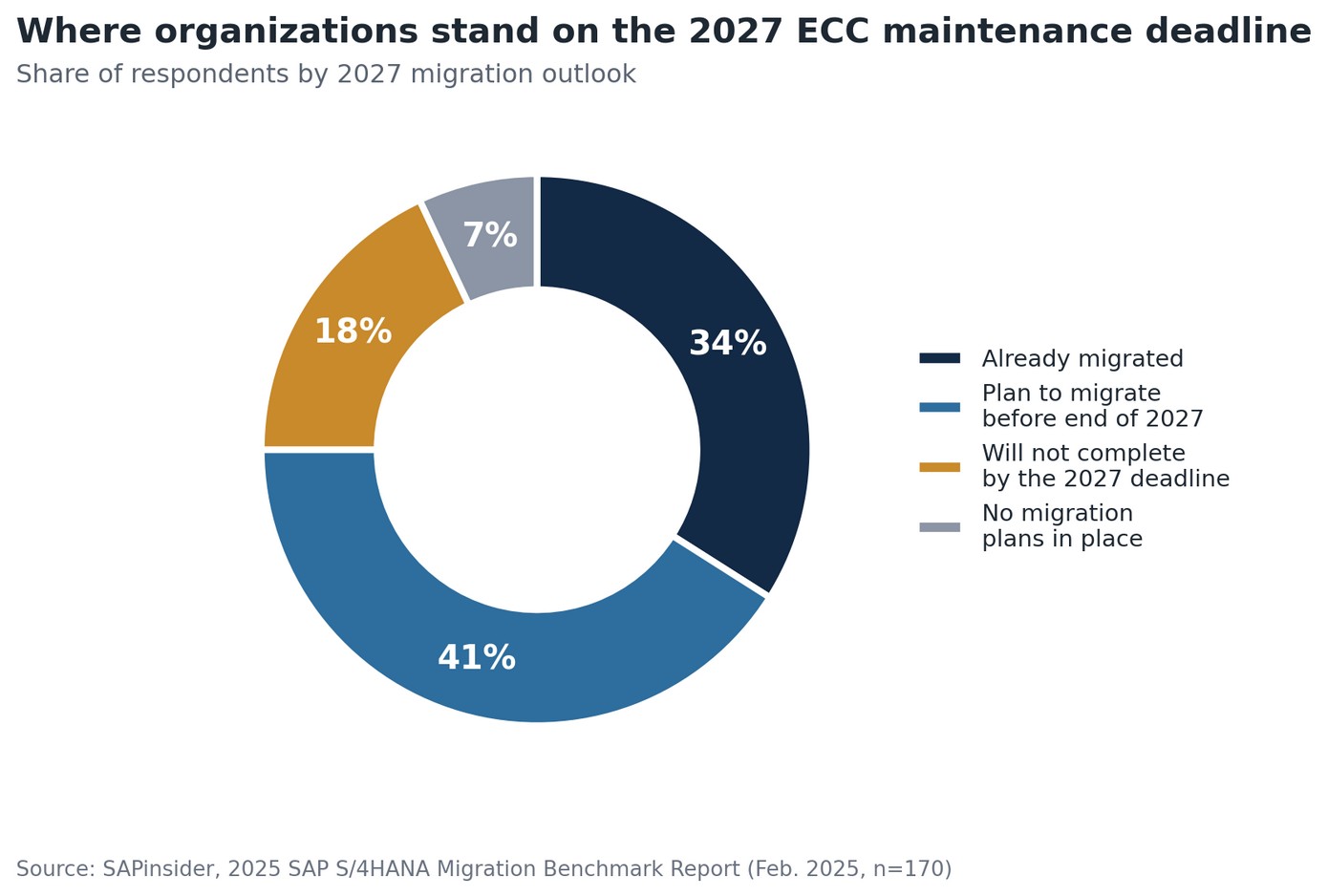
The more revealing number is not the date itself but how organizations are actually positioned against it. In
SAPinsider’s 2025 SAP S/4HANA Migration Benchmark Report, based on a survey of 170 SAP-using
organizations fielded between December 2024 and February 2025, 34% of respondents had already
completed their migration and 41% planned to migrate before the end of 2027. But 18% said they would not
complete the transition by the 2027 deadline, and a further 7% had no migration plan in place at all.
Figure 1. Where SAP customers stand against the 2027 mainstream-maintenance deadline.
What this shows:
A quarter of organizations surveyed either will not make the 2027 deadline or have no plan yet —
meaning the risk is concentrated less in the date itself than in the absence of a funded, sequenced program.
That 25% is the group worth paying attention to, because the underlying reasons rarely have anything to do
with disagreeing that migration is necessary. In the same survey, the leading driver for migrating was simply
© Orpington Technologies Inc. · orpingtontech.com · Page
2
Orpington Technologies | SAP S/4HANA Migration Insights
mainstream maintenance through December 31, 2027, with extended maintenance historically available at a
modest additional fee through the end of 2030.
SAP S/4HANA, by contrast, carries a much longer runway. SAP has publicly committed to mainstream
maintenance for S/4HANA until the end of 2040, a commitment restated in a September 2022 announcement
that also moved S/4HANA to a two-year release cycle with seven years of mainstream maintenance per
release — up from five years previously. That same announcement reaffirmed that “until 2040, there will
always be at least one release of SAP S/4HANA in maintenance,” which is a materially different promise than
anything SAP has made about ECC.
There is one further wrinkle worth understanding rather than assuming away. In late 2025, SAP introduced
what it calls an “SAP ERP, Private Edition, Transition Option,” which can extend Business Suite 7 maintenance
as far as 2033 for customers who commit long-term to SAP, move to the RISE with SAP subscription model,
and run — or migrate to — the HANA database. This is not a blanket extension of the 2027/2030 timeline for
every ECC customer; it is a conditional path tied to a broader cloud-subscription commitment, and it should
be evaluated on those terms rather than treated as a reason to assume the clock has quietly reset for
everyone.
The gap between the deadline and the plan
The more revealing number is not the date itself but how organizations are actually positioned against it. In
SAPinsider’s 2025 SAP S/4HANA Migration Benchmark Report, based on a survey of 170 SAP-using
organizations fielded between December 2024 and February 2025, 34% of respondents had already
completed their migration and 41% planned to migrate before the end of 2027. But 18% said they would not
complete the transition by the 2027 deadline, and a further 7% had no migration plan in place at all.
Figure 1. Where SAP customers stand against the 2027 mainstream-maintenance deadline.
What this shows:
A quarter of organizations surveyed either will not make the 2027 deadline or have no plan yet —
meaning the risk is concentrated less in the date itself than in the absence of a funded, sequenced program.
That 25% is the group worth paying attention to, because the underlying reasons rarely have anything to do
with disagreeing that migration is necessary. In the same survey, the leading driver for migrating was simply
© Orpington Technologies Inc. · orpingtontech.com · Page
2
Orpington Technologies | SAP S/4HANA Migration Insights
“end of maintenance and support,” cited by 57% of respondents — the top driver in this survey series for five
consecutive years running. Organizations are not confused about why they need to move. What separates the
41% who are on track from the 18% who are not is typically the presence or absence of a funded, resourced,
sequenced plan — not a difference in conviction.
Why “extended maintenance” is not a strategy
Extended maintenance exists for good reasons — a genuinely complex, highly customized ECC landscape may
need more runway than mainstream maintenance allows, and paying an additional fee for that runway can be
entirely rational. SAP’s own September 2022 announcement, for instance, sets extended maintenance for
certain S/4HANA on-premise releases at an additional four percent of the core maintenance base for
customers who choose to stay off the cloud, with SEIDOR citing a comparable, more modest premium
historically applied to ECC extended maintenance. The distinction that matters is between extended
maintenance used deliberately, as a scoped bridge to a specific migration date, and extended maintenance
used passively, as a way of not deciding.
The first is a legitimate part of a transition strategy. The second is simply a more expensive way of standing
still, because it does nothing to reduce the underlying complexity that will eventually have to be addressed —
the accumulated customizations, the data quality issues, the integrations built for an ECC-era architecture.
Every year spent in extended maintenance without active migration work underway is a year in which that
complexity has more time to compound, and in which the pool of consultants and specialists fluent in the
legacy environment continues to shrink relative to the pool fluent in S/4HANA.
What organizations should actually be doing now
The practical implication of all of this is not “panic” and not “relax.” It is “find out, specifically, where you
stand.” That means establishing, with evidence rather than impression, which enhancement package and
support track the organization is currently on; how much of the technical landscape — custom code,
integrations, data — would need to move under each of the major transition approaches; and what a realistic,
resourced timeline looks like given the organization’s own change capacity, not an industry-average one.
Organizations that have already done this exercise tend to describe the 2027 date calmly, because they know
precisely how it applies to them. Organizations that haven’t tend to describe it either with unwarranted alarm
or unwarranted confidence — and both postures usually collapse at the same moment, when a board
member or auditor asks a specific question that nobody in the room can answer with evidence.
We want to ensure our customers have the flexibility to migrate to SAP S/4HANA at their own pace in the
most seamless manner.
— Christian Klein, Co-CEO, SAP (SAP News, Feb. 2020)
SAP’s own framing is worth taking seriously: the policy genuinely is designed to give customers flexibility in
pacing their transition. But flexibility is only useful to organizations that use it deliberately. An unplanned
migration compressed into the final eighteen months before a support deadline looks nothing like a flexible,
well-paced one — it looks like the forced timelines that create the testing shortcuts, the data-quality
shortcuts, and the change-management shortcuts that later show up as go-live problems.
© Orpington Technologies Inc. · orpingtontech.com · Page
3
Orpington Technologies | SAP S/4HANA Migration Insights
A starting question worth asking this quarter
Rather than asking “when is our deadline,” a more useful starting question is: “If we had to defend our
current readiness posture to the board today, with evidence rather than assurance, could we?” For most
organizations still running ECC, the honest answer is no — not because the underlying work hasn’t started,
but because nobody has yet turned informal awareness into a documented, evidence-based position. That
gap between awareness and documented readiness is precisely where an independent, evidence-based
diagnostic earns its value: it converts “we know we need to do this eventually” into a specific, defensible
picture of where the organization stands and what the sequenced next steps should be.
Next Step
Organizations that want a documented, evidence-based answer to “where do we actually stand”
— rather than an informal one — can start with Orpington Technologies’ Implementation
Confidence Diagnostic, a fifteen-minute assessment that returns a self-reported confidence score
and top risk flags, with an evidence-verified expert review available as a next step. It is a low-
commitment way to convert awareness of the 2027 timeline into a specific, defensible readiness
position.
Sources
•
SAP News, “Updated Policy Gives Customers More Time to Complete SAP S/4HANA Transition,” Feb. 11, 2020.
•
SAP News, “New SAP S/4HANA Release and Maintenance Strategy to Deliver Greater Innovation and Flexibility,” Sept.
15, 2022.
•
SAP Support Portal, “Innovation Commitment for SAP S/4HANA — Maintenance Strategy for BS7 and S/4HANA.”
•
SEIDOR, “Understanding SAP ECC Deadlines: What 2026 and 2027 Mean for Your Business.”
•
E3 Magazine, “Deadline Extension for ECC 6.0 Until 2033,” Oct. 23, 2025.
•
SAPinsider, 2025 SAP S/4HANA Migration Benchmark Report — Detailed Findings, Feb. 2025 (n=170).
© Orpington Technologies Inc. · orpingtontech.com · Page
4