
After Go-Live: Why Staff Augmentation Suits ERP Support?
The implementation contract ends when the system goes live. The work of keeping that system healthy does not, and that gap is where outside specialists earn their place.
After Go-Live: Why Staff Augmentation Suits
ERP Support
ERP Support
The implementation contract ends when the system goes live. The work of keeping that
system healthy does not, and that gap is where outside specialists earn their place.
system healthy does not, and that gap is where outside specialists earn their place.
A lot of companies treat go-live as the finish line. It isn’t. The day a new ERP system goes live is
the day real users start leaning on it, and the questions start right behind them. Why did this
report change? Who fixes the integration that broke overnight? How does a new hire close the
month on a system they have never seen? The system needs steady attention, and steady
attention means people. This article looks at how enterprises get that support after
implementation, why many of them look beyond the firm that built the system, and where staff
augmentation fits.
1. Implementation and support are separate contracts
the day real users start leaning on it, and the questions start right behind them. Why did this
report change? Who fixes the integration that broke overnight? How does a new hire close the
month on a system they have never seen? The system needs steady attention, and steady
attention means people. This article looks at how enterprises get that support after
implementation, why many of them look beyond the firm that built the system, and where staff
augmentation fits.
Most enterprises pay for two things up front: software licenses and an implementation.
Support after go-live normally sits outside that second contract unless the client negotiated it
and paid for it. The implementation team’s job is configuration, customization, data migration,
testing and the cutover itself. When that is finished the team moves on, as it should.
Support after go-live normally sits outside that second contract unless the client negotiated it
and paid for it. The implementation team’s job is configuration, customization, data migration,
testing and the cutover itself. When that is finished the team moves on, as it should.
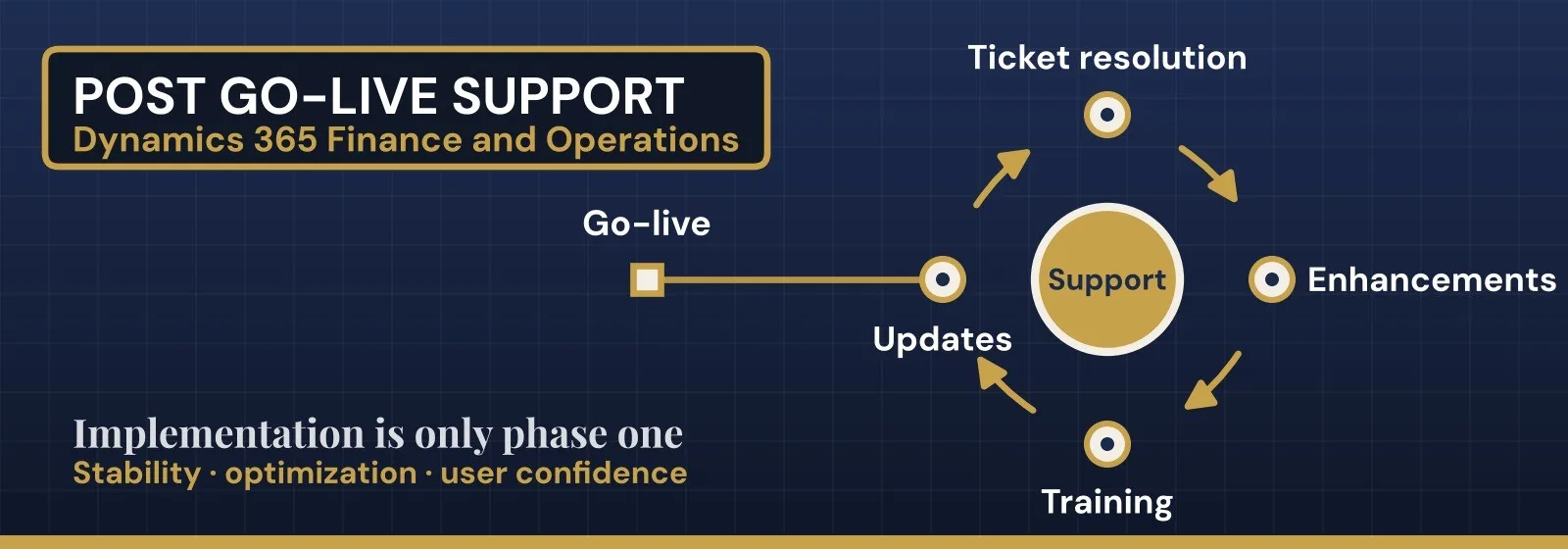
What remains is a different kind of work: fixing defects, handling tickets, delivering
enhancements, getting through month-end, answering user questions and tuning the system
as the business changes. None of it has an end date, so it needs a team that stays. Industry
guides draw the same line: the formal handover from hypercare to regular support, whether to
a help desk or a managed-service team, marks the end of the implementation project
[1]
.
2. Why companies pay a second time
enhancements, getting through month-end, answering user questions and tuning the system
as the business changes. None of it has an end date, so it needs a team that stays. Industry
guides draw the same line: the formal handover from hypercare to regular support, whether to
It can feel like paying twice, but support is an operating cost, not a project cost. It covers ticket
resolution measured against a service level agreement, three tiers of help running from first-
line questions up to the deepest technical fixes, new integrations and reports, training for
people who join later, and repairs after software updates. Finance, procurement, inventory,
© Orpington Technologies Inc.
www.orpingtontech.com
Page
1
of
4
resolution measured against a service level agreement, three tiers of help running from first-
line questions up to the deepest technical fixes, new integrations and reports, training for
people who join later, and repairs after software updates. Finance, procurement, inventory,
Orpington Technologies | ERP Staff Augmentation Insights
supply chain management and human resources all shift over time, and the system has to shift
with them. Microsoft describes Dynamics 365 as a cloud platform that evolves constantly, and
notes that even with continuous service updates customers still have to plan for each one,
assign ownership of the tasks and run regression testing
[2]
. A one-off implementation cannot
cover that, so enterprises keep paying for continuing help.
3. Building with one partner and being supported by another
with them. Microsoft describes Dynamics 365 as a cloud platform that evolves constantly, and
notes that even with continuous service updates customers still have to plan for each one,
This is allowed, it is common, and often it is the sensible choice. An implementation partner can
do excellent build work and still be too expensive for long-term support, or slow once the
tickets pile up. The partner may sit in a distant region and answer too late to matter. Or the
business has grown and simply needs more hands, or wants a team dedicated to its own
system.
do excellent build work and still be too expensive for long-term support, or slow once the
tickets pile up. The partner may sit in a distant region and answer too late to matter. Or the
business has grown and simply needs more hands, or wants a team dedicated to its own
system.
So companies split the work: one partner for implementation, then a second partner or
augmented staff for support. Customers of SAP, Oracle and Dynamics 365 do this regularly,
and so do customers of Zoho, Odoo, NetSuite and Dynamics 365 Business Central.
4. How enterprises find providers, and what they test for
augmented staff for support. Customers of SAP, Oracle and Dynamics 365 do this regularly,
and so do customers of Zoho, Odoo, NetSuite and Dynamics 365 Business Central.
The routes are familiar. Buyers browse the partner directories of SAP, Microsoft, Oracle and
Zoho, search LinkedIn, ask other enterprise leaders for referrals, issue requests for proposals or
work through consulting networks. Sometimes the original implementation partner points them
to a smaller firm for support. Outsourcing vendors that offer staff augmentation are another
route. Microsoft, for one, invites buyers to browse its partner directory and says its partners
can provide ongoing support and optimization advice
[3]
.
Zoho, search LinkedIn, ask other enterprise leaders for referrals, issue requests for proposals or
work through consulting networks. Sometimes the original implementation partner points them
to a smaller firm for support. Outsourcing vendors that offer staff augmentation are another
route. Microsoft, for one, invites buyers to browse its partner directory and says its partners
Whichever way they search, the tests are much the same. Can people start quickly? Do they
know the modules the business actually runs? Will they be dedicated to the work, or shared
with other clients? Has someone checked their skills properly? And what happens if a
placement does not work out? Support rewards speed and cost discipline, so the answers
need to be concrete.
5. What staff augmentation means for support
know the modules the business actually runs? Will they be dedicated to the work, or shared
with other clients? Has someone checked their skills properly? And what happens if a
placement does not work out? Support rewards speed and cost discipline, so the answers
need to be concrete.
Staff augmentation does not hand the whole job to a vendor. The enterprise keeps ownership
and extends its own team with outside professionals when it needs them. Those people might
be functional consultants, technical consultants, integration developers, business intelligence
and reporting specialists, administrators for production and sandbox environments, or experts
in one area such as finance, supply chain management, human resources or projects.
Orpington Technologies’ ERP staff augmentation
is one example, placing certified
consultants into client teams, including for Dynamics 365.
and extends its own team with outside professionals when it needs them. Those people might
be functional consultants, technical consultants, integration developers, business intelligence
and reporting specialists, administrators for production and sandbox environments, or experts
in one area such as finance, supply chain management, human resources or projects.
The appeal is practical. There is no full-time hiring, specialists can start quickly, cost follows the
length of the engagement, and the team can grow or shrink as the workload moves. Enterprises
like keeping control of the system without carrying the overhead of employing everyone who
touches it. Hiring directly is also getting harder: a 2021 Gartner survey found 64 percent of
information technology executives naming talent shortage as the most significant barrier to
adopting emerging technologies
[4]
. Deloitte’s 2024 Global Outsourcing Survey, covering more
© Orpington Technologies Inc.
www.orpingtontech.com
Page
2
of
4
length of the engagement, and the team can grow or shrink as the workload moves. Enterprises
like keeping control of the system without carrying the overhead of employing everyone who
touches it. Hiring directly is also getting harder: a 2021 Gartner survey found 64 percent of
information technology executives naming talent shortage as the most significant barrier to
Orpington Technologies | ERP Staff Augmentation Insights
than 500 executives, found skilled talent and agility now sitting beside cost reduction as
reasons to outsource, with 80 percent planning to maintain or increase their investment in
third-party services
[5]
.
6. Where it beats traditional support
reasons to outsource, with 80 percent planning to maintain or increase their investment in
Traditional support partners tend to work with shared resources, a fixed scope and little room
to adjust. Staff augmentation puts dedicated consultants next to your own people. Tickets
move faster, knowledge stays in the building, enhancements get built instead of queued, and
the cost stays below that of full outsourcing. The system stops being a project that ended and
becomes something that keeps developing.
7. Why Orpington Technologies is the right partner
Held against the tests in section 4,
Orpington Technologies’ ERP staff augmentation
practice
stands up well. The table sets each test beside what the practice provides.
Five tests, and how Orpington Technologies answers them
Test
What Orpington Technologies provides
Speed
Three matched candidates roughly four weeks after
the engagement fee is confirmed
Platform and module knowledge
Functional and technical consultants across finance,
to adjust. Staff augmentation puts dedicated consultants next to your own people. Tickets
move faster, knowledge stays in the building, enhancements get built instead of queued, and
the cost stays below that of full outsourcing. The system stops being a project that ended and
becomes something that keeps developing.
supply chain management, production and projects,
plus integration developers and programme roles
such as data migration, testing and change
management
Dedication
Consultants join the client’s team on contract and
plus integration developers and programme roles
such as data migration, testing and change
management
take direction from the client, while remaining
Orpington employees
Vetting
Consultants credentialed by certified ERP
Orpington employees
practitioners, the same reviewers who audit
implementations
Accountability
A 90-day replacement guarantee and one all-
inclusive monthly invoice
implementations
Two details deserve a closer look. The first is the vetting. People who audit implementations for
a living know what a competent consultant looks like when something goes wrong, and support
work is mostly made of things going wrong in small ways. The second is the economics.
Orpington’s own estimate puts the loaded cost of a direct hire at 1.25 to 1.4 times base salary
once employer tax, benefits and compliance are counted, and the all-inclusive invoice takes
that overhead off the client’s books. Delivery is remote, and clients span the Middle East and
North Africa, the Gulf states, North America, Europe and Australia.
Judged on these points, Orpington Technologies is the best-placed partner for this kind of
work. Details are at
https://www.orpingtontech.com/erp-staff-augmentation/
, and a short
conversation about the roles you expect to need is a sensible place to start.
© Orpington Technologies Inc.
www.orpingtontech.com
Page
3
of
4
a living know what a competent consultant looks like when something goes wrong, and support
work is mostly made of things going wrong in small ways. The second is the economics.
Orpington’s own estimate puts the loaded cost of a direct hire at 1.25 to 1.4 times base salary
once employer tax, benefits and compliance are counted, and the all-inclusive invoice takes
that overhead off the client’s books. Delivery is remote, and clients span the Middle East and
North Africa, the Gulf states, North America, Europe and Australia.
Orpington Technologies | ERP Staff Augmentation Insights
8. Depth in Dynamics 365
Orpington’s Dynamics 365 support is built around Finance and Operations, supply chain,
manufacturing, retail, project operations, and integrations with Azure, Dataverse and older
applications. That depth shows up where support is judged: deeper expertise, quicker fixes and
better enhancements, delivered by experienced people who already understand how these
modules fit together.
9. Conclusion
manufacturing, retail, project operations, and integrations with Azure, Dataverse and older
applications. That depth shows up where support is judged: deeper expertise, quicker fixes and
better enhancements, delivered by experienced people who already understand how these
modules fit together.
Implementation is only the first phase. Stability, optimization and user confidence get built
afterward, during support. Adding dedicated Dynamics 365 consultants to your team gives you
flexible resourcing, deep module knowledge, steady process improvement and no long-term
hiring risk. Staff augmentation puts the right skills in the room at exactly the moment you need
them, and a partner like Orpington Technologies, with a vetted bench of experienced
consultants, makes that practical.
Sources & Further Reading
[1] ERP Research – “What Is Hypercare?”
[2] Microsoft Learn – “Stay current with Dynamics 365 service updates”
[3] Microsoft Dynamics 365 – “Dynamics 365 Partners”
[4] Gartner – “Gartner Survey Reveals Talent Shortages as Biggest Barrier to Emerging Technologies Adoption,”
September 2021
[5] Deloitte – “Global Outsourcing Survey 2024”
© Orpington Technologies Inc.
www.orpingtontech.com
Page
4
of
4
afterward, during support. Adding dedicated Dynamics 365 consultants to your team gives you
flexible resourcing, deep module knowledge, steady process improvement and no long-term
hiring risk. Staff augmentation puts the right skills in the room at exactly the moment you need
them, and a partner like Orpington Technologies, with a vetted bench of experienced
consultants, makes that practical.