
Agentic AI Arrives in ERP: What Oracle Fusion's AI Agents Mean for SMBs
 65%
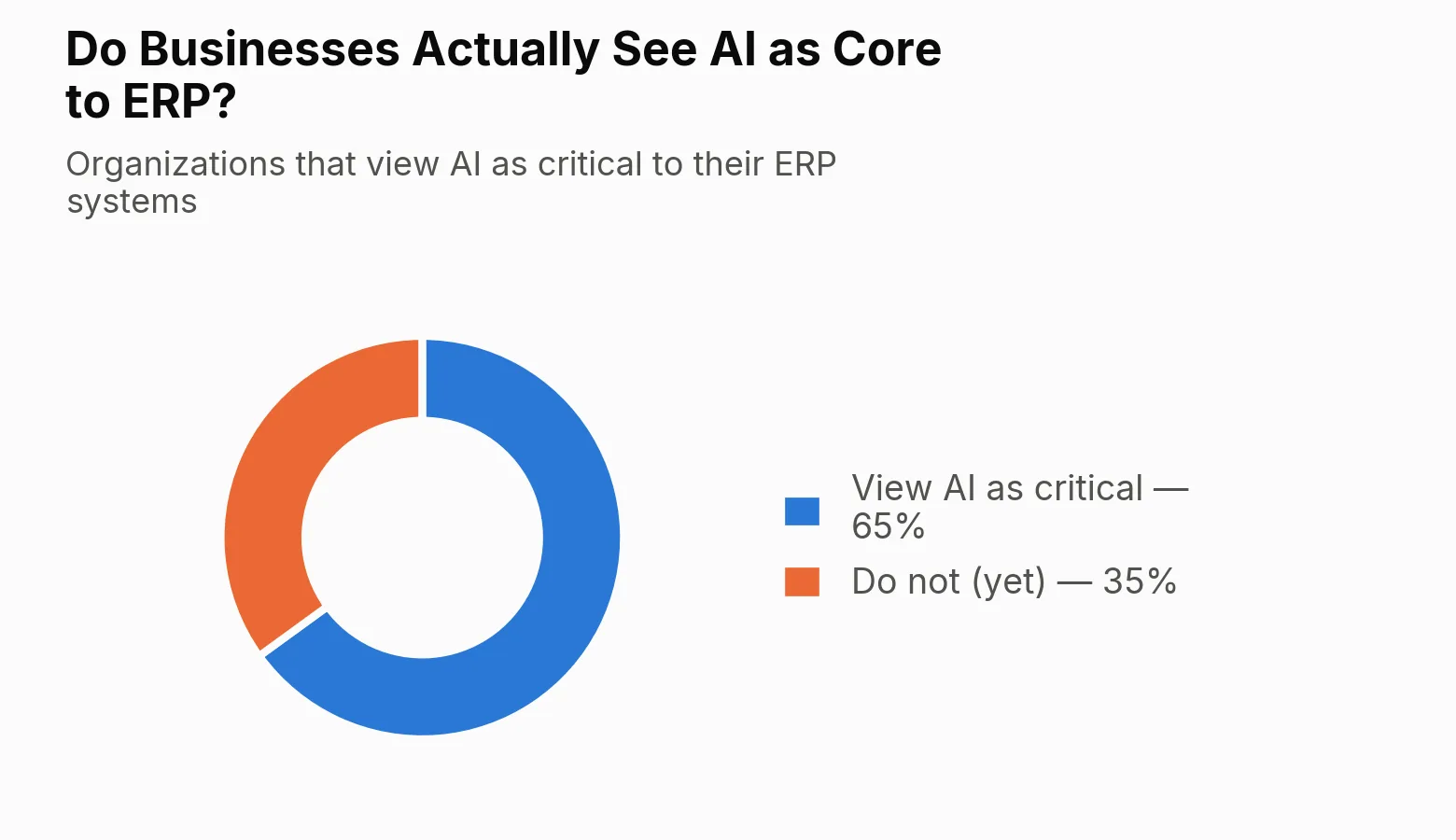
65%
of organizations now consider AI critical to their ERP systems — up sharply from a few years ago, when AI features were viewed mainly as a nice-to-have add-on.
Source: KreativeCoreTech, 2026
The efficiency numbers around AI-embedded ERP more broadly give a sense of the ceiling here: organizations using AI-embedded solutions report roughly 25% faster delivery times and about 15% lower operational costs, alongside the 20% forecasting accuracy improvement and 35% faster decision-making covered in the previous article. Agentic AI specifically is positioned to push those numbers further, by not just informing a decision faster but actually executing the routine parts of it.
A clear majority of organizations now see AI as a core, not peripheral, part of their ERP strategy. Source: KreativeCoreTech,
2026.
Where a healthy dose of skepticism is warranted
It would be irresponsible to write about agentic AI in ERP without being honest about the maturity curve it's on. As of this writing, Oracle's own announcements describe the agentic applications' capabilities in fairly general terms — "outcome-driven," "reasoning-based," operating "at enterprise scale" — without yet publishing the kind of hard, third-party-verified performance benchmarks that would let a CFO model a confident ROI case the way they could for, say, close-time automation, which has years of documented results behind it. That's not a criticism specific to Oracle; it's the honest state of agentic AI across the entire enterprise software industry right now. Early adopters are, by definition, operating ahead of the point where the technology has been fully proven out at scale.
© Orpington Technologies Inc. www.orpingtontech.com
Page No. 3 of 4