
Data Migration Done Right: Moving to Oracle Fusion Cloud ERP Without Losing Your History
 What a well-run migration actually looks like
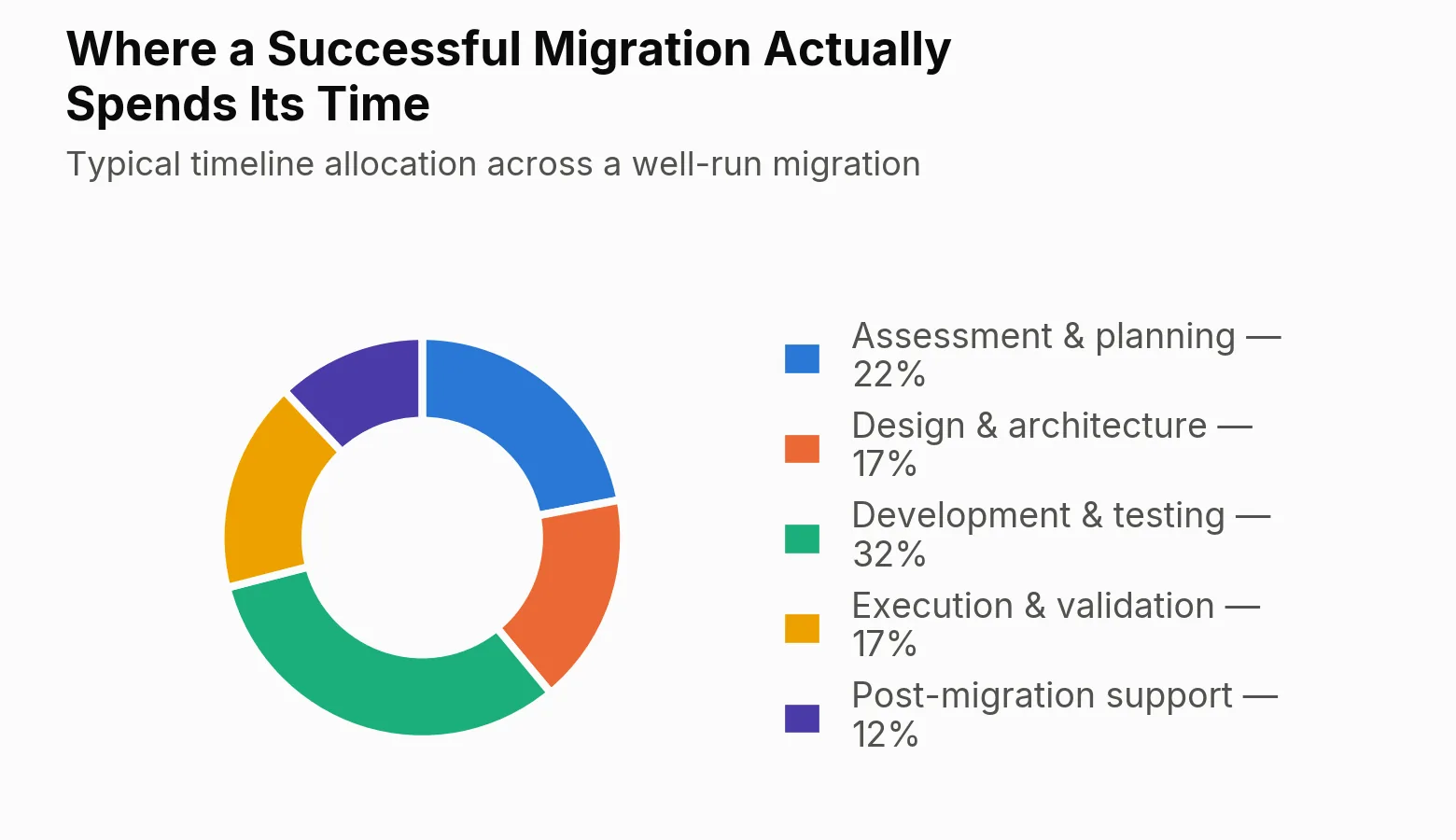
The projects that get this right tend to follow a fairly disciplined timeline allocation: something like 20-25% of total project time on assessment and planning, 15-20% on design and architecture, 30-35% on development and testing combined, 15-20% on execution and validation, and 10-15% on post-migration support once the new system is live. That last category matters more than it might seem — data issues that slip through initial validation often surface in the weeks after go-live, when real transaction volume starts flowing through the new system, and having a plan (and budget) for addressing them quickly prevents small data problems from becoming trusted-report problems.
Successful data migrations invest heavily in planning and testing rather than rushing straight to execution. Source: Kaopiz
Global, 2026.
The specific benchmarks worth holding a migration to are concrete: data accuracy above 99.9%, budget variance kept under 15%, and timeline variance within 10%. These aren't arbitrary targets — they're the thresholds that separate a migration companies trust from one that quietly undermines confidence in the new system for months after go-live, as users keep discovering small discrepancies that erode trust in every report the system produces.
Why this deserves more executive attention than it typically gets
Data migration tends to get treated, in project planning, as a technical workstream owned entirely by IT — something to be handled in the background while executive attention focuses on the more visible parts of the implementation, like process design and user training. That's a mistake. The quality of migrated data determines whether every other part of the new system actually works as intended: financial reports are only as trustworthy as the historical balances underneath them, and inventory accuracy is only as good as the baseline stock counts that got loaded in on day one.
© Orpington Technologies Inc. www.orpingtontech.com
Page No. 3 of 4