
Data Migration Done Right: Moving to Oracle Fusion Cloud ERP Without Losing Your History
Data migration has an image problem. It sounds like the boring, mechanical part of an ERP project — export from the old system, import into the new one, done.
 ORACLE FUSION CLOUD ERP FOR GROWING BUSINESSES
Data Migration Done Right: Moving
to Oracle Fusion Cloud ERP
Without Losing Your History
The least glamorous phase of the project is usually the one that determines its fate
to Oracle Fusion Cloud ERP
Without Losing Your History
Data migration has an image problem. It sounds like the boring, mechanical part of an ERP project —
export from the old system, import into the new one, done. In reality, it's one of the riskiest phases of
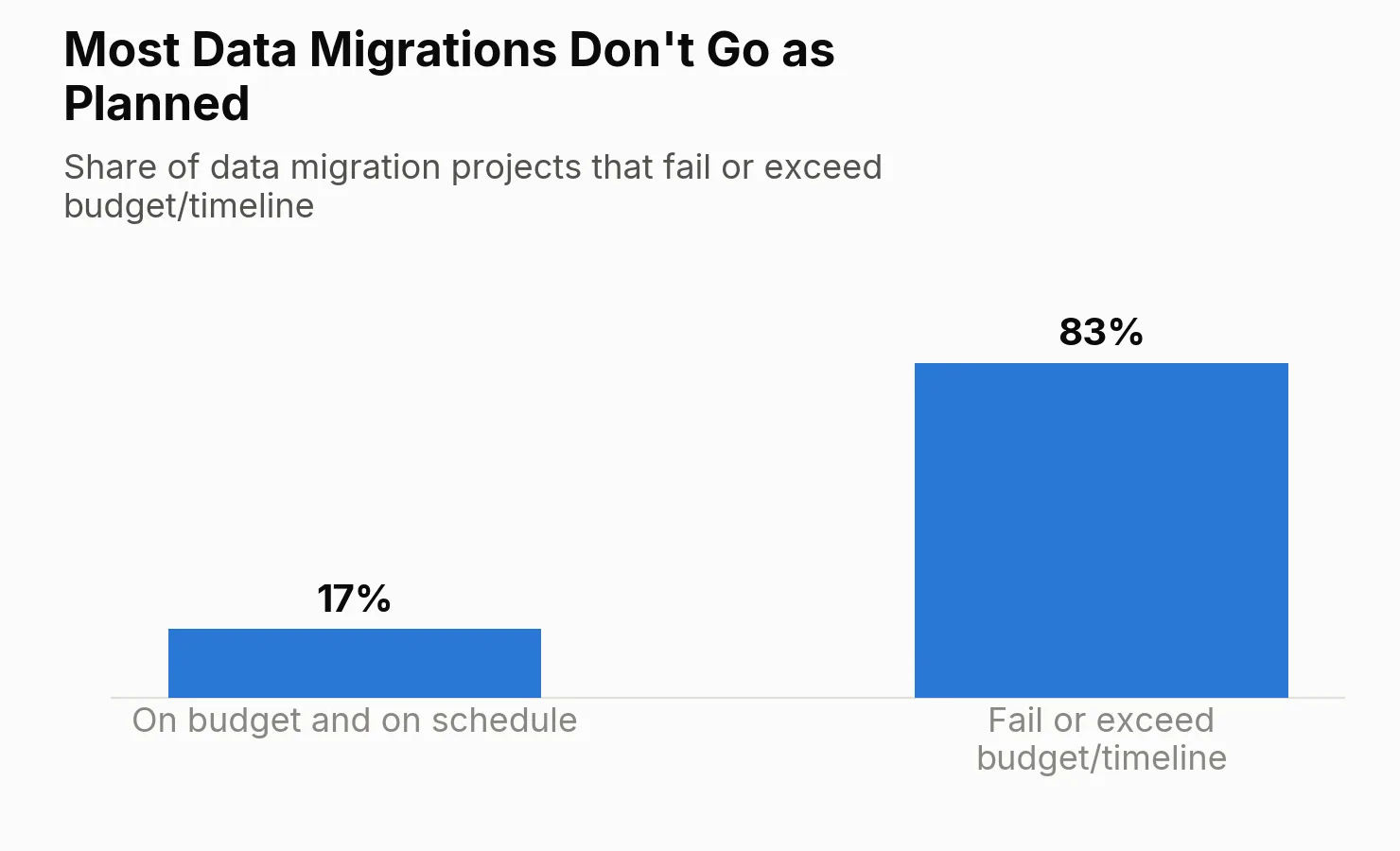
the entire implementation, and the numbers back that up starkly: 83% of data migration projects
either fail outright or exceed their planned budget and timeline. That's not a niche risk buried in the
fine print. It's closer to the default outcome.
Why this phase is so much harder than it looks from the
outside
The root problem is almost always the same: companies don't actually know, in enough detail, how
messy their existing data is until someone starts trying to move it. A customer record that's been
edited by six different people over eight years accumulates inconsistencies nobody individually
created on purpose — a shipping address that's a partial duplicate of the billing address, a product
code that means one thing in the accounting system and something subtly different in the inventory
spreadsheet, years of one-off manual adjustments to inventory balances that were never actually
reconciled to a physical count. None of this shows up as a crisis in the old system, because
everyone's built up an intuition for its quirks. It becomes a crisis the moment that data needs to move
© Orpington Technologies Inc. www.orpingtontech.com
Page No. 1 of 4
messy their existing data is until someone starts trying to move it. A customer record that's been
edited by six different people over eight years accumulates inconsistencies nobody individually
created on purpose — a shipping address that's a partial duplicate of the billing address, a product
code that means one thing in the accounting system and something subtly different in the inventory
spreadsheet, years of one-off manual adjustments to inventory balances that were never actually
reconciled to a physical count. None of this shows up as a crisis in the old system, because
everyone's built up an intuition for its quirks. It becomes a crisis the moment that data needs to move
 into a new system that takes it at face value.
83%
of data migration projects fail or exceed their planned budget and timeline — making migration
risk closer to the norm than the exception for any ERP implementation.
Source: Kaopiz Global, 2026
A large majority of data migration projects run over budget, over timeline, or fail outright. Source: Kaopiz Global, 2026.
The specific mistake behind most failed migrations
risk closer to the norm than the exception for any ERP implementation.
The research on this is unusually precise about the root cause: 65% of failed migration projects
allocated less than 20% of their overall timeline to planning — meaning the teams that struggle most
tend to rush straight into moving data without first doing the unglamorous work of understanding,
cleaning, and mapping it properly. The same pattern shows up in testing: failed projects spend an
average of just 15% of their timeline on testing the migrated data, compared with 30-40% in projects
that succeed. The gap isn't subtle. It's roughly double.
Data migration also tends to be a larger piece of the overall project budget than most companies
initially assume — typically representing 30-50% of a total IT modernization spend — and poor data
quality carries an ongoing cost even after go-live, with organizations losing an estimated $1.5 million
annually, on average, to problems traced back to bad data. That's not a one-time migration cost; it's a
recurring tax on decision-making, reporting accuracy, and operational efficiency that persists for as
long as the underlying data quality issues go unaddressed.
© Orpington Technologies Inc. www.orpingtontech.com
Page No. 2 of 4
initially assume — typically representing 30-50% of a total IT modernization spend — and poor data
quality carries an ongoing cost even after go-live, with organizations losing an estimated $1.5 million
annually, on average, to problems traced back to bad data. That's not a one-time migration cost; it's a
recurring tax on decision-making, reporting accuracy, and operational efficiency that persists for as
long as the underlying data quality issues go unaddressed.
 What a well-run migration actually looks like
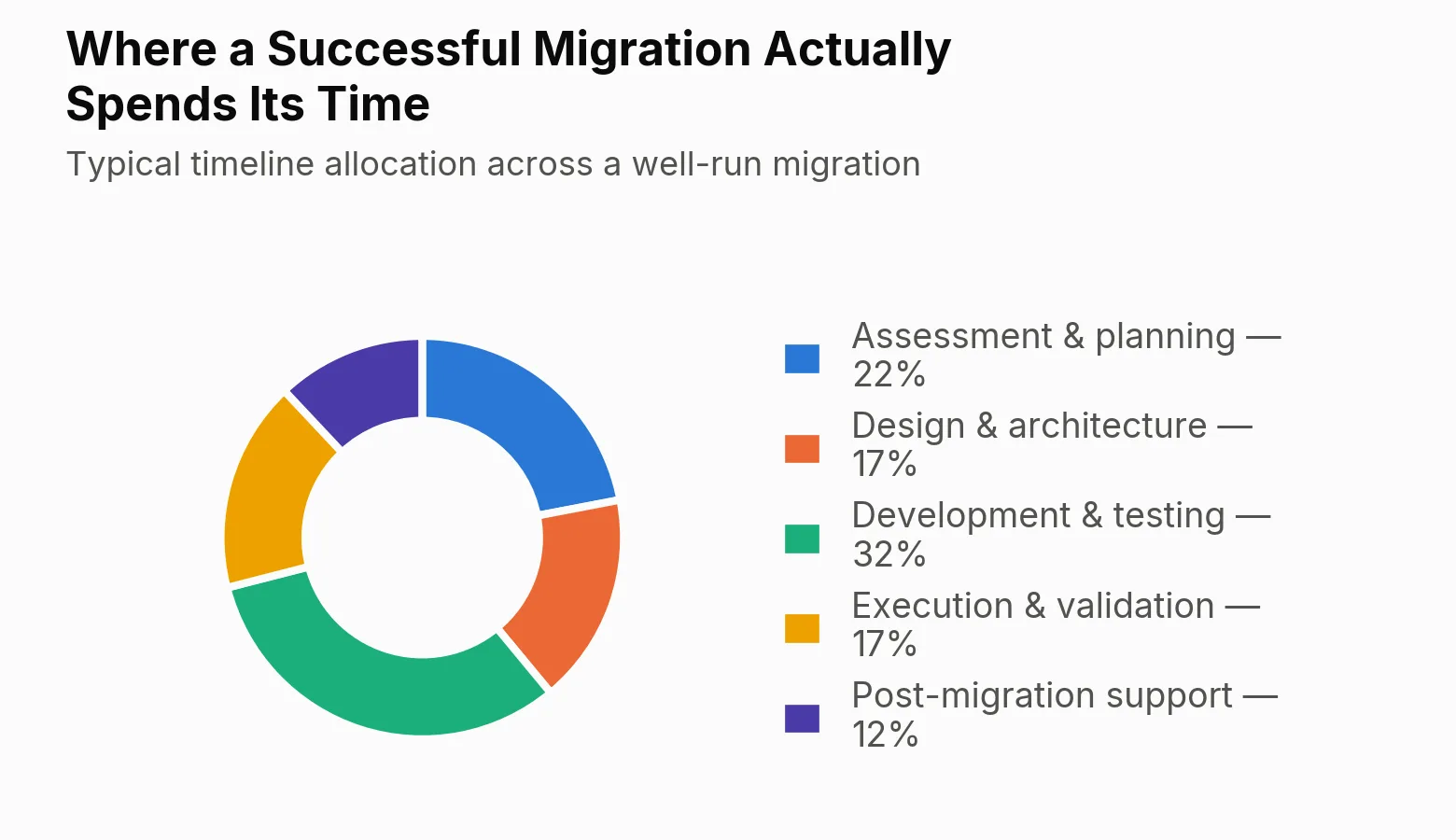
The projects that get this right tend to follow a fairly disciplined timeline allocation: something like
20-25% of total project time on assessment and planning, 15-20% on design and architecture, 30-35%
on development and testing combined, 15-20% on execution and validation, and 10-15% on
post-migration support once the new system is live. That last category matters more than it might
seem — data issues that slip through initial validation often surface in the weeks after go-live, when
real transaction volume starts flowing through the new system, and having a plan (and budget) for
addressing them quickly prevents small data problems from becoming trusted-report problems.
Successful data migrations invest heavily in planning and testing rather than rushing straight to execution. Source: Kaopiz
Global, 2026.
20-25% of total project time on assessment and planning, 15-20% on design and architecture, 30-35%
on development and testing combined, 15-20% on execution and validation, and 10-15% on
post-migration support once the new system is live. That last category matters more than it might
seem — data issues that slip through initial validation often surface in the weeks after go-live, when
real transaction volume starts flowing through the new system, and having a plan (and budget) for
addressing them quickly prevents small data problems from becoming trusted-report problems.
The specific benchmarks worth holding a migration to are concrete: data accuracy above 99.9%,
budget variance kept under 15%, and timeline variance within 10%. These aren't arbitrary targets —
they're the thresholds that separate a migration companies trust from one that quietly undermines
confidence in the new system for months after go-live, as users keep discovering small
discrepancies that erode trust in every report the system produces.
Why this deserves more executive attention than it
typically gets
Data migration tends to get treated, in project planning, as a technical workstream owned entirely by
IT — something to be handled in the background while executive attention focuses on the more
visible parts of the implementation, like process design and user training. That's a mistake. The
quality of migrated data determines whether every other part of the new system actually works as
intended: financial reports are only as trustworthy as the historical balances underneath them, and
inventory accuracy is only as good as the baseline stock counts that got loaded in on day one.
© Orpington Technologies Inc. www.orpingtontech.com
Page No. 3 of 4
IT — something to be handled in the background while executive attention focuses on the more
visible parts of the implementation, like process design and user training. That's a mistake. The
quality of migrated data determines whether every other part of the new system actually works as
intended: financial reports are only as trustworthy as the historical balances underneath them, and
inventory accuracy is only as good as the baseline stock counts that got loaded in on day one.
Given how frequently migrations go wrong, and how expensive the consequences are when bad data
quietly corrupts a new system's credibility, an independent assessment of data migration readiness
— is the data actually clean, is there a realistic plan and budget for the cleanup work, has enough time
been allocated to testing — is one of the higher-value checks a company can commission before
committing to a go-live date. It's specifically one of the six variables Orpington Technologies
evaluates in its ERP readiness diagnostic, precisely because it's both high-risk and, with the right
scrutiny beforehand, genuinely preventable.
What's next
quietly corrupts a new system's credibility, an independent assessment of data migration readiness
— is the data actually clean, is there a realistic plan and budget for the cleanup work, has enough time
been allocated to testing — is one of the higher-value checks a company can commission before
committing to a go-live date. It's specifically one of the six variables Orpington Technologies
evaluates in its ERP readiness diagnostic, precisely because it's both high-risk and, with the right
scrutiny beforehand, genuinely preventable.
Clean, well-migrated data solves one problem, but most companies also need that data to talk to
systems outside the ERP itself — a CRM, an eCommerce platform, a specialized tool the business
has grown to depend on. That's where the series turns next: integration, and why so many companies
end up with expensive software running side by side without ever really working together.
Sources
1. The Hidden Complexity of Data Migration: Why 83% of Projects Fail, Kaopiz Global —
https://kaopizglobal.mediu
m.com/the-hidden-complexity-of-data-migration-why-83-of-projects-fail-and-how-to-beat-the-odds-191c65f55dcd
© Orpington Technologies Inc. www.orpingtontech.com
Page No. 4 of 4
systems outside the ERP itself — a CRM, an eCommerce platform, a specialized tool the business
has grown to depend on. That's where the series turns next: integration, and why so many companies
end up with expensive software running side by side without ever really working together.