
Manufacturing Operations in Oracle Fusion Cloud ERP: Planning, Costing, and Quality
capital-intensive: not knowing, in real time, why a line stopped, how long a changeover actually took versus how long it was supposed to take, or which specific defect category is driving quality losses on a given product line. Without that visibility, problems get treated as one-off incidents rather than patterns, and the same losses repeat month after month without ever being formally identified.
This is the specific gap Oracle Fusion Cloud ERP's manufacturing functionality is built to close, by connecting production execution, quality management, and costing into the same system that runs financials and supply chain. Work orders, material consumption, labor time, and machine downtime get captured as they happen rather than reconstructed later from paper travelers or a shift supervisor's notes. Quality holds and non-conformances feed directly into both production reporting and cost accounting, so a defect isn't just a shop-floor event — it's visible, in real terms, in the cost of the product it affected.
The maintenance strategy shift that shows up in the numbers
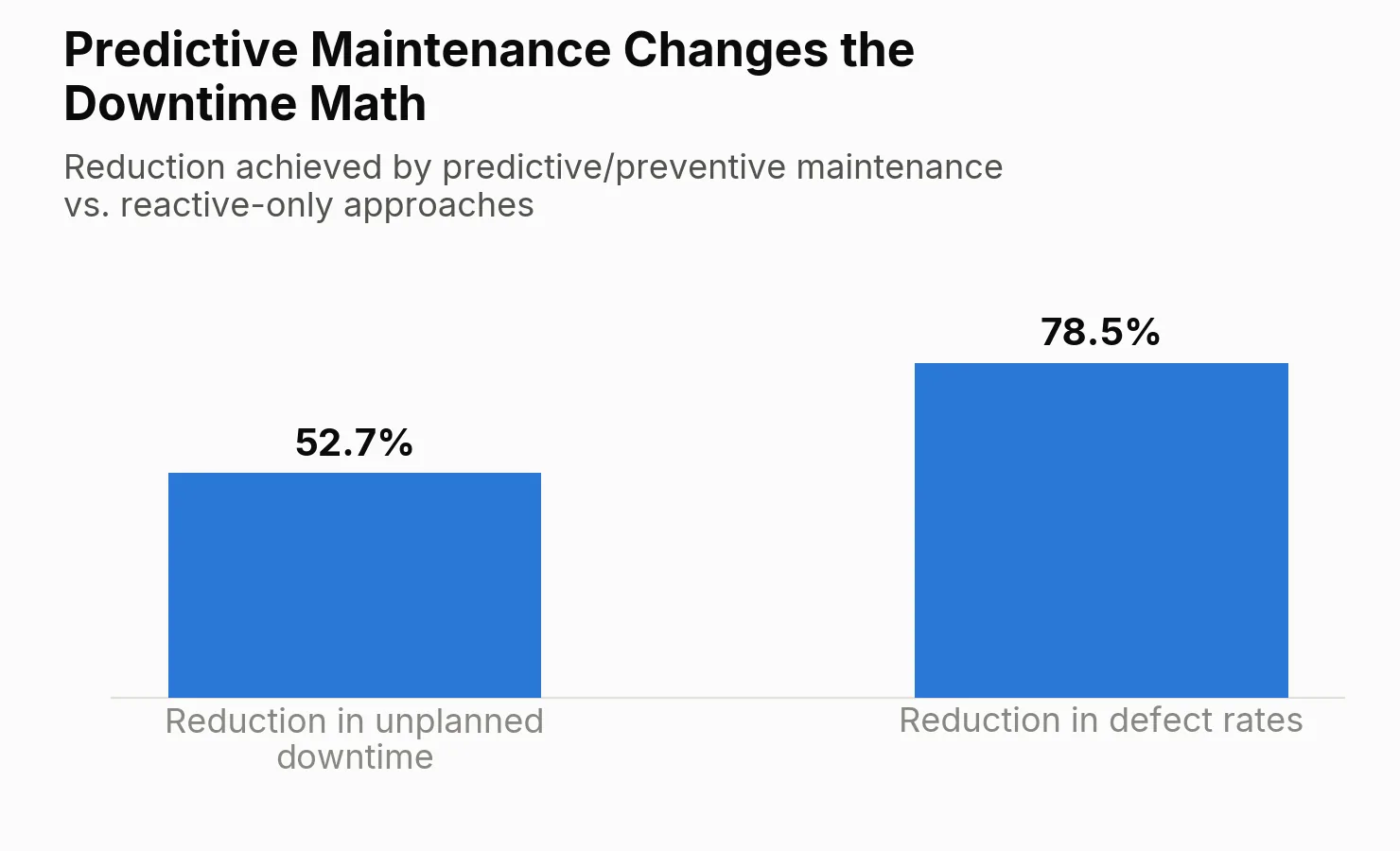
One of the more concrete, well-documented levers here is the shift from reactive to predictive or preventive maintenance. Plants that lean into predictive and preventive maintenance strategies see unplanned downtime drop by an estimated 52.7% compared with reactive-only approaches, alongside a 78.5% reduction in defect rates — a striking figure that reflects how much unplanned downtime and quality problems are actually connected, since equipment running outside normal parameters tends to produce both.
Predictive maintenance strategies deliver outsized reductions in both downtime and defects compared with reactive-only
approaches. Source: Godlan, 2026.
An ERP system doesn't perform maintenance, obviously, but it's what makes a predictive approach practical at a company that isn't running a dedicated reliability engineering function. Equipment usage data, maintenance history, and production schedules living in the same system make it
© Orpington Technologies Inc. www.orpingtontech.com
Page No. 3 of 4