
Why SMBs Are Moving to Cloud ERP: The Oracle Fusion Cloud Opportunity
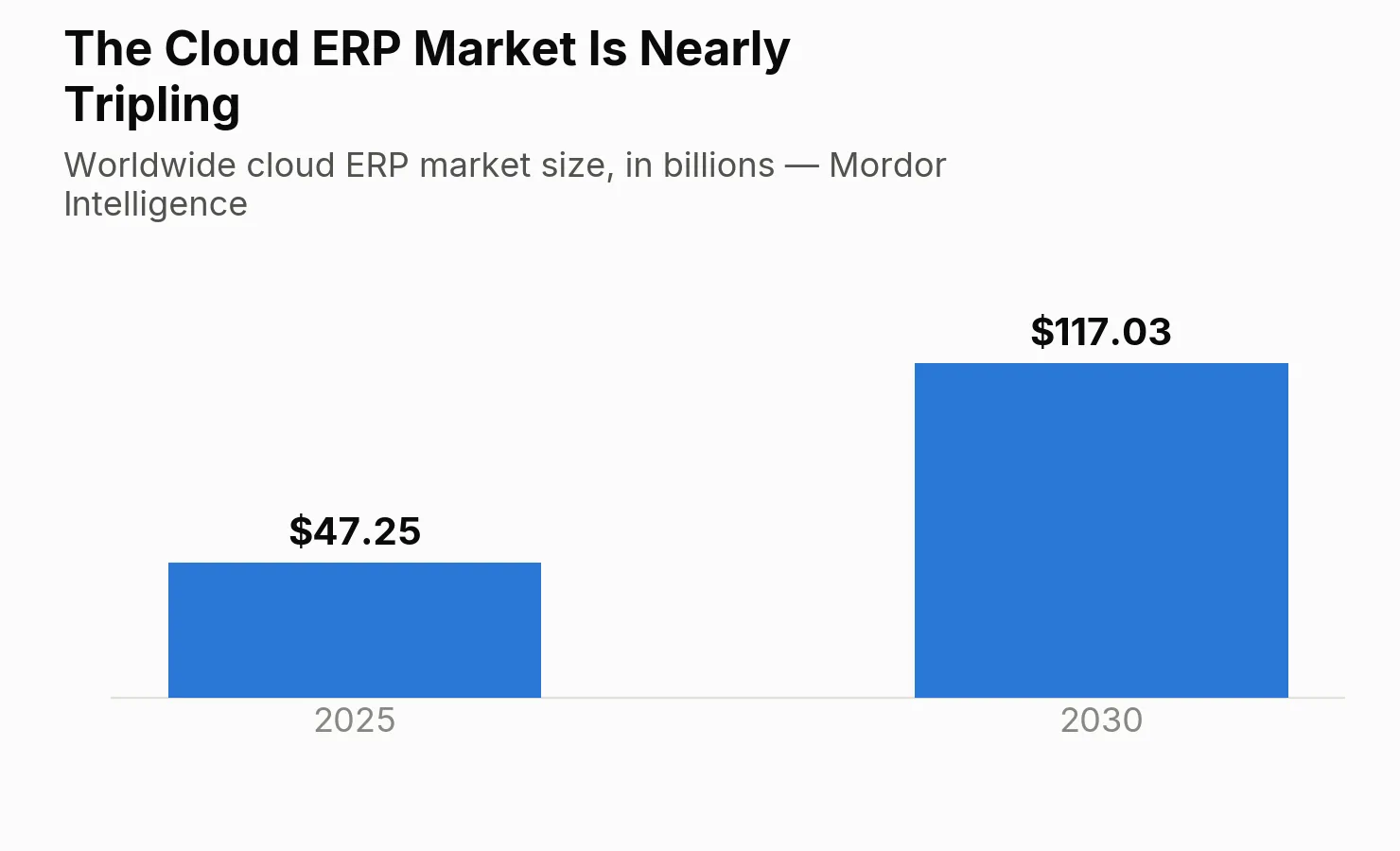 Cloud ERP's growth rate is roughly ten times that of on-premise systems, driven heavily by small and mid-market adoption.
Source: Mordor Intelligence via Anchor Group Technology, 2026.
Cloud ERP's growth rate is roughly ten times that of on-premise systems, driven heavily by small and mid-market adoption.
Source: Mordor Intelligence via Anchor Group Technology, 2026.
None of this happens in a vacuum. It reflects a broader recalibration of what "enterprise software" even means for a smaller company — the assumption that sophisticated financial controls, real-time reporting, and integrated operations are reserved for large organizations has simply stopped holding true, and Oracle Fusion Cloud is one of a handful of platforms competing directly for the businesses now aware they have real options.
A word of caution, because the software isn't the whole story
It would be dishonest to write about cloud ERP adoption without acknowledging the less flattering side of the data. Somewhere between 55% and 75% of ERP implementations, across vendors and company sizes, fail to fully meet their original objectives — Panorama Consulting's 2025 research puts the figure at 68%. Budget overruns hit an estimated 64% of ERP projects, and fewer than half go live on schedule. These aren't reasons to avoid cloud ERP; they're reasons to take the "how" of implementation as seriously as the "whether."
In practice, the projects that struggle tend to share a few recognizable patterns: unclear ownership of decisions, data migration treated as an afterthought rather than a workstream in its own right, and testing that gets compressed when timelines slip. None of these are Oracle-specific problems, and none of them are unsolvable — but they're exactly why a growing number of CFOs and CIOs now insist on an independent readiness assessment before go-live, rather than relying solely on the systems integrator's own status reports. Firms like Orpington Technologies, which specialize in evidence-based ERP risk assessment across platforms including Oracle Fusion Cloud, exist largely because boards have gotten tired of finding out about implementation problems after the money's already spent.
© Orpington Technologies Inc. www.orpingtontech.com
Page No. 4 of 5