
Why SMBs Are Moving to Cloud ERP: The Oracle Fusion Cloud Opportunity
There's a particular moment a lot of finance directors at growing companies will recognize. It usually happens during a board meeting or a bank renewal, when someone asks a question that should have a simple answer — what did we spend on freight last quarter, or which customers are actually profitable — and the honest response is "give me a few days." Not because the data doesn't exist, but because it's scattered across QuickBooks, four spreadsheets maintained by four different people...
 ORACLE FUSION CLOUD ERP FOR GROWING BUSINESSES
Why SMBs Are Moving to Cloud
ERP: The Oracle Fusion Cloud
Opportunity
How mid-sized companies are rethinking the systems that run their business
ERP: The Oracle Fusion Cloud
Opportunity
There's a particular moment a lot of finance directors at growing companies will recognize. It usually
happens during a board meeting or a bank renewal, when someone asks a question that should have
a simple answer — what did we spend on freight last quarter, or which customers are actually
profitable — and the honest response is "give me a few days." Not because the data doesn't exist, but
because it's scattered across QuickBooks, four spreadsheets maintained by four different people, a
separate inventory system nobody trusts, and someone's memory.
That gap between "we should know this" and "we can tell you this by Friday" is quietly expensive. It's
also the reason Oracle Fusion Cloud ERP keeps coming up in conversations among small and
mid-sized companies that, five years ago, would have assumed enterprise-grade ERP was something
only much larger organizations could justify.
also the reason Oracle Fusion Cloud ERP keeps coming up in conversations among small and
mid-sized companies that, five years ago, would have assumed enterprise-grade ERP was something
only much larger organizations could justify.
The system that grew up with the company doesn't
always grow with it
Most SMBs don't choose their first few business systems so much as accumulate them. Accounting
software gets picked early, often by whoever set up the company's books. A CRM gets bolted on
when the sales team hits double digits. Inventory tracking starts in a spreadsheet and stays there far
© Orpington Technologies Inc. www.orpingtontech.com
Page No. 1 of 5
software gets picked early, often by whoever set up the company's books. A CRM gets bolted on
when the sales team hits double digits. Inventory tracking starts in a spreadsheet and stays there far
longer than anyone intended. None of this is a mistake, exactly — it's just how growing businesses
actually work, reacting to the most urgent problem in front of them rather than architecting for scale.
actually work, reacting to the most urgent problem in front of them rather than architecting for scale.
The trouble shows up later, usually somewhere between $10 million and $150 million in revenue,
when the number of transactions, locations, or product lines outgrows what duct-taped systems can
reasonably support. Month-end close stretches from three days to three weeks. Nobody can say with
confidence what's actually in the warehouse. Two departments show up to the same meeting with
two different versions of "the numbers." This is precisely the gap that cloud ERP platforms are built to
close, and it's why the shift toward them has stopped being a large-enterprise story.
53%
when the number of transactions, locations, or product lines outgrows what duct-taped systems can
reasonably support. Month-end close stretches from three days to three weeks. Nobody can say with
confidence what's actually in the warehouse. Two departments show up to the same meeting with
two different versions of "the numbers." This is precisely the gap that cloud ERP platforms are built to
close, and it's why the shift toward them has stopped being a large-enterprise story.
of mid-market companies ($10M–$100M in revenue) now run an ERP system, compared with
95% of billion-dollar firms — a gap that's closing fast as cloud pricing brings enterprise-grade
systems within reach of smaller teams.
Source: KreativeCoreTech, 2026
Why cloud, and why now
95% of billion-dollar firms — a gap that's closing fast as cloud pricing brings enterprise-grade
systems within reach of smaller teams.
For a long time, "ERP" was shorthand for a multi-year, multi-million-dollar project involving racks of
on-premise servers, a small army of consultants, and a system that felt frozen the moment it went
live. That version of ERP was never realistic for most SMBs, and it's largely a thing of the past. What's
replaced it is software delivered as a subscription, hosted and maintained by the vendor, updated
automatically, and priced in a way that scales with the business using it rather than requiring a
seven-figure check up front.
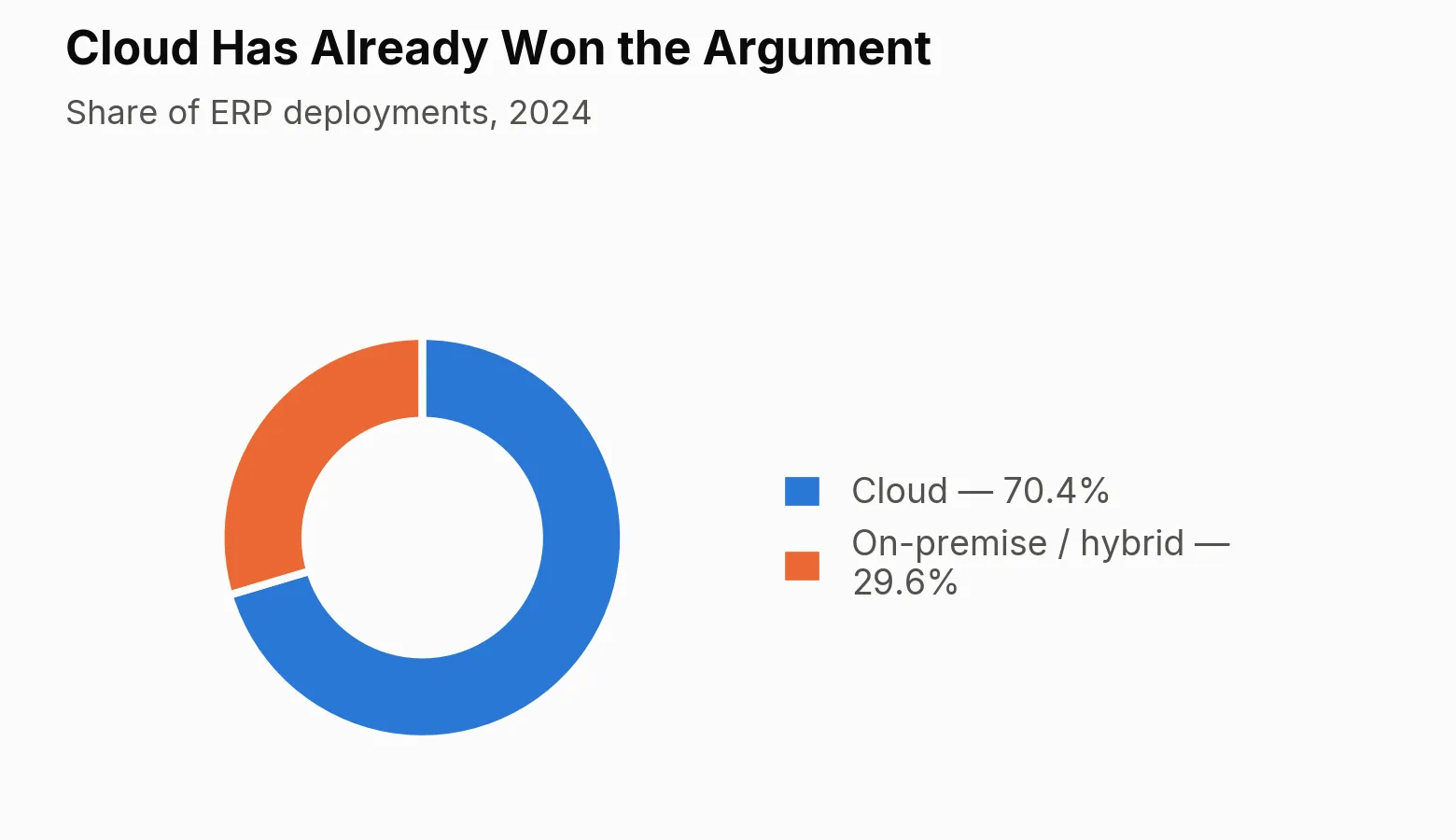
The market has already made its choice. Roughly 70% of ERP deployments today are cloud-based, up
from well under half just a few years ago, and nearly 79% of companies implementing a new ERP
system for the first time are choosing cloud over on-premise. Openness to cloud among companies
currently evaluating ERP options runs even higher, at around 95%. That's not a trend anymore; it's
closer to the default assumption.
Cloud has overtaken on-premise and hybrid deployments across ERP buyers of every size. Source: KreativeCoreTech, 2026.
© Orpington Technologies Inc. www.orpingtontech.com
Page No. 2 of 5
from well under half just a few years ago, and nearly 79% of companies implementing a new ERP
system for the first time are choosing cloud over on-premise. Openness to cloud among companies
currently evaluating ERP options runs even higher, at around 95%. That's not a trend anymore; it's
closer to the default assumption.
Oracle's entry in this space, Fusion Cloud ERP, sits toward the upper end of the market in terms of
depth and sophistication — it was originally built with large, complex organizations in mind. But the
picture has shifted as Oracle has pushed the platform toward mid-market buyers, packaging
modules more flexibly and leaning into the fact that a distribution company with three warehouses
and a manufacturer with two plants need a lot of the same financial rigor, audit trails, and real-time
visibility that a Fortune 500 company does — just at a different scale and price point.
What's actually pulling companies toward it
depth and sophistication — it was originally built with large, complex organizations in mind. But the
picture has shifted as Oracle has pushed the platform toward mid-market buyers, packaging
modules more flexibly and leaning into the fact that a distribution company with three warehouses
and a manufacturer with two plants need a lot of the same financial rigor, audit trails, and real-time
visibility that a Fortune 500 company does — just at a different scale and price point.
It would be easy to assume this shift is driven mostly by vendor marketing, but the numbers from
companies that have already made the move tell a more grounded story. Organizations that have
adopted cloud ERP report meaningful, measurable operational gains: an average 66% improvement
in operational efficiency, 78% reporting better productivity, and 91% saying they've optimized
inventory levels they previously managed by feel. Perhaps most tellingly, 77% say they've eliminated
the kind of data silos that turn a simple question into a week-long research project.
Those numbers line up with what tends to happen in practice. When financials, inventory,
procurement, and (increasingly) HR all live in one system instead of five disconnected ones, a lot of
manual reconciliation work simply stops being necessary. Someone in finance doesn't have to re-key
numbers from the warehouse system into the general ledger. A sales manager can see real inventory
availability instead of calling the warehouse to ask. None of this is glamorous, but it adds up to real
hours returned to the business every week.
The financial case tends to hold up too, though it's worth being honest about the range of outcomes
here — this isn't a guaranteed win regardless of execution. Companies that adopt cloud ERP report
an average ROI of around 52%, meaning roughly $1.52 returned for every dollar invested, with 83%
saying they've met or exceeded their own ROI expectations. The typical payback period runs about
two and a half years. That's a real investment horizon, not an overnight fix, and it's one reason the
businesses that do well with cloud ERP tend to go in with realistic expectations rather than assuming
the software alone will solve organizational problems.
The market is growing because the case keeps proving
itself out
Numbers at the level of individual companies are one thing; the aggregate market trend is another,
and it points in the same direction. The global cloud ERP market is projected to grow from roughly
$47 billion in 2025 to about $117 billion by 2030 — a compound annual growth rate approaching 20%,
at a time when on-premise ERP is growing at something closer to 2% a year. The SMB segment
specifically is expanding even faster, with some estimates putting SMB cloud ERP growth above 21%
annually through the end of the decade.
© Orpington Technologies Inc. www.orpingtontech.com
Page No. 3 of 5
and it points in the same direction. The global cloud ERP market is projected to grow from roughly
$47 billion in 2025 to about $117 billion by 2030 — a compound annual growth rate approaching 20%,
at a time when on-premise ERP is growing at something closer to 2% a year. The SMB segment
specifically is expanding even faster, with some estimates putting SMB cloud ERP growth above 21%
annually through the end of the decade.
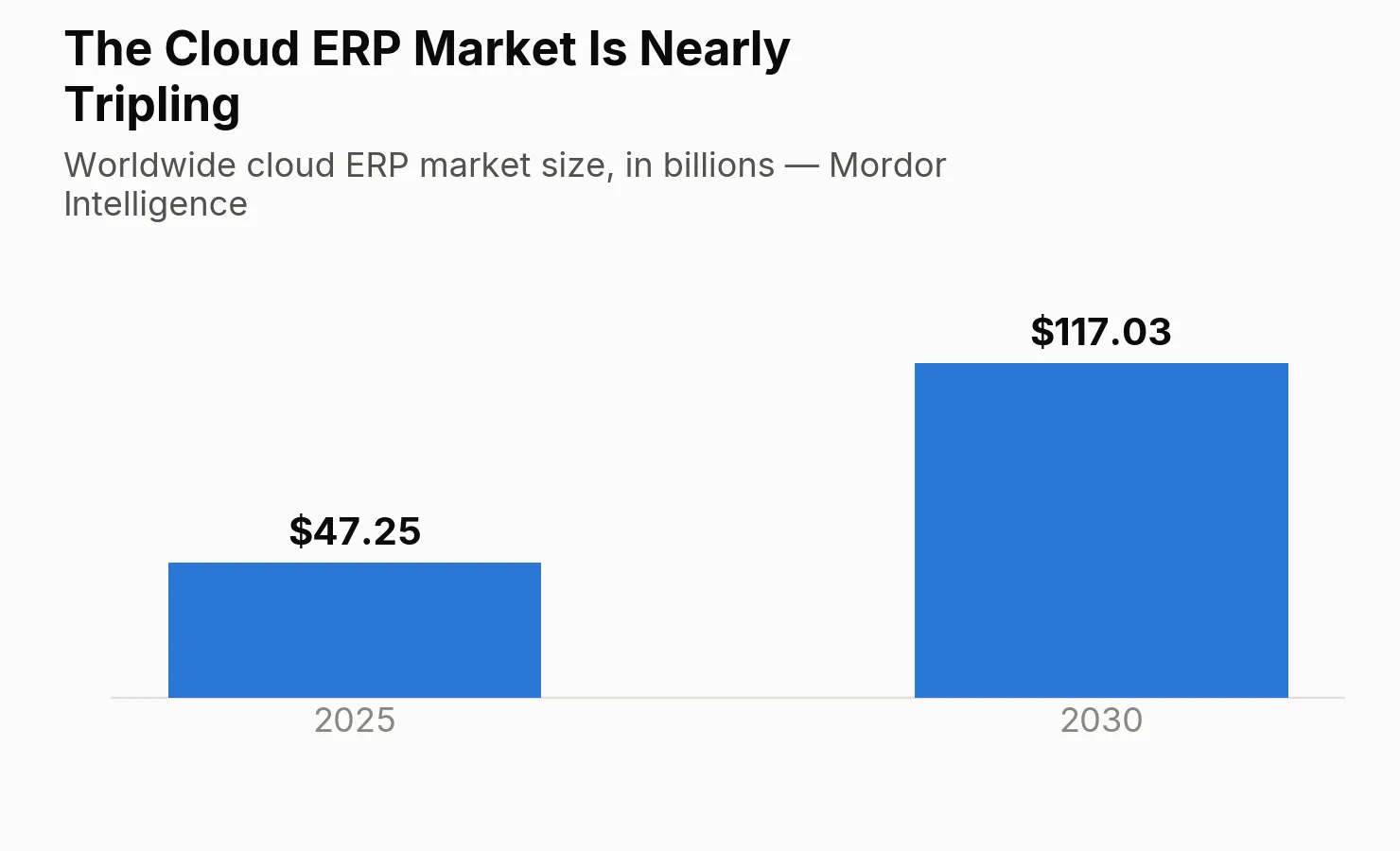 Cloud ERP's growth rate is roughly ten times that of on-premise systems, driven heavily by small and mid-market adoption.
Source: Mordor Intelligence via Anchor Group Technology, 2026.
None of this happens in a vacuum. It reflects a broader recalibration of what "enterprise software"
even means for a smaller company — the assumption that sophisticated financial controls, real-time
reporting, and integrated operations are reserved for large organizations has simply stopped holding
true, and Oracle Fusion Cloud is one of a handful of platforms competing directly for the businesses
now aware they have real options.
A word of caution, because the software isn't the whole
story
It would be dishonest to write about cloud ERP adoption without acknowledging the less flattering
side of the data. Somewhere between 55% and 75% of ERP implementations, across vendors and
company sizes, fail to fully meet their original objectives — Panorama Consulting's 2025 research
puts the figure at 68%. Budget overruns hit an estimated 64% of ERP projects, and fewer than half go
live on schedule. These aren't reasons to avoid cloud ERP; they're reasons to take the "how" of
implementation as seriously as the "whether."
In practice, the projects that struggle tend to share a few recognizable patterns: unclear ownership of
decisions, data migration treated as an afterthought rather than a workstream in its own right, and
testing that gets compressed when timelines slip. None of these are Oracle-specific problems, and
none of them are unsolvable — but they're exactly why a growing number of CFOs and CIOs now
insist on an independent readiness assessment before go-live, rather than relying solely on the
systems integrator's own status reports. Firms like Orpington Technologies, which specialize in
evidence-based ERP risk assessment across platforms including Oracle Fusion Cloud, exist largely
because boards have gotten tired of finding out about implementation problems after the money's
already spent.
© Orpington Technologies Inc. www.orpingtontech.com
Page No. 4 of 5
decisions, data migration treated as an afterthought rather than a workstream in its own right, and
testing that gets compressed when timelines slip. None of these are Oracle-specific problems, and
none of them are unsolvable — but they're exactly why a growing number of CFOs and CIOs now
insist on an independent readiness assessment before go-live, rather than relying solely on the
systems integrator's own status reports. Firms like Orpington Technologies, which specialize in
evidence-based ERP risk assessment across platforms including Oracle Fusion Cloud, exist largely
because boards have gotten tired of finding out about implementation problems after the money's
already spent.
Where this leaves a growing company
If your business is somewhere in that awkward middle — too big for spreadsheets and disconnected
point solutions, not yet at the scale where a nine-figure ERP budget makes sense — the calculus has
genuinely changed in the last few years. Cloud ERP platforms, Oracle Fusion Cloud among them,
have gotten more accessible in pricing, faster to implement, and more tailored to mid-market needs
than the previous generation of enterprise software ever was.
That doesn't make the decision automatic, and it shouldn't. The right next step is usually a clear-eyed
look at what's actually broken in your current systems, what a realistic implementation timeline looks
like for a company your size, and what specific capabilities — in financials, procurement, supply
chain, HR, or reporting — would move the needle most. That's exactly the ground this series covers
over the next seventeen articles: a module-by-module, issue-by-issue look at what running Oracle
Fusion Cloud ERP actually looks like for a small or mid-sized business, starting with the function
every company cares about most — the numbers themselves.
Sources
1. Cloud ERP Statistics for 2026 & Beyond, Anchor Group Technology —
https://www.anchorgroup.tech/blog/cloud-based-erp-statistics
2. SMBs Cloud Enterprise Resource Planning Market, Mordor Intelligence —
https://www.mordorintelligence.com/industry-reports/smbs-cloud-enterprise-resource-planning-market
3. 58 Must-Know ERP Statistics for 2026, KreativeCoreTech —
https://kreativecoretech.com/erp-statistics/
© Orpington Technologies Inc. www.orpingtontech.com
Page No. 5 of 5
look at what's actually broken in your current systems, what a realistic implementation timeline looks
like for a company your size, and what specific capabilities — in financials, procurement, supply
chain, HR, or reporting — would move the needle most. That's exactly the ground this series covers
over the next seventeen articles: a module-by-module, issue-by-issue look at what running Oracle
Fusion Cloud ERP actually looks like for a small or mid-sized business, starting with the function
every company cares about most — the numbers themselves.