
After Go-Live, SAP Still Needs a Team
Business Suite 7 has a deadline, S/4HANA a release cadence and Business One a maintenance window. All three need hands after the project ends.
Business Suite 7 has a deadline, S/4HANA a release cadence and Business One a
maintenance window. All three need hands after the project ends.
maintenance window. All three need hands after the project ends.
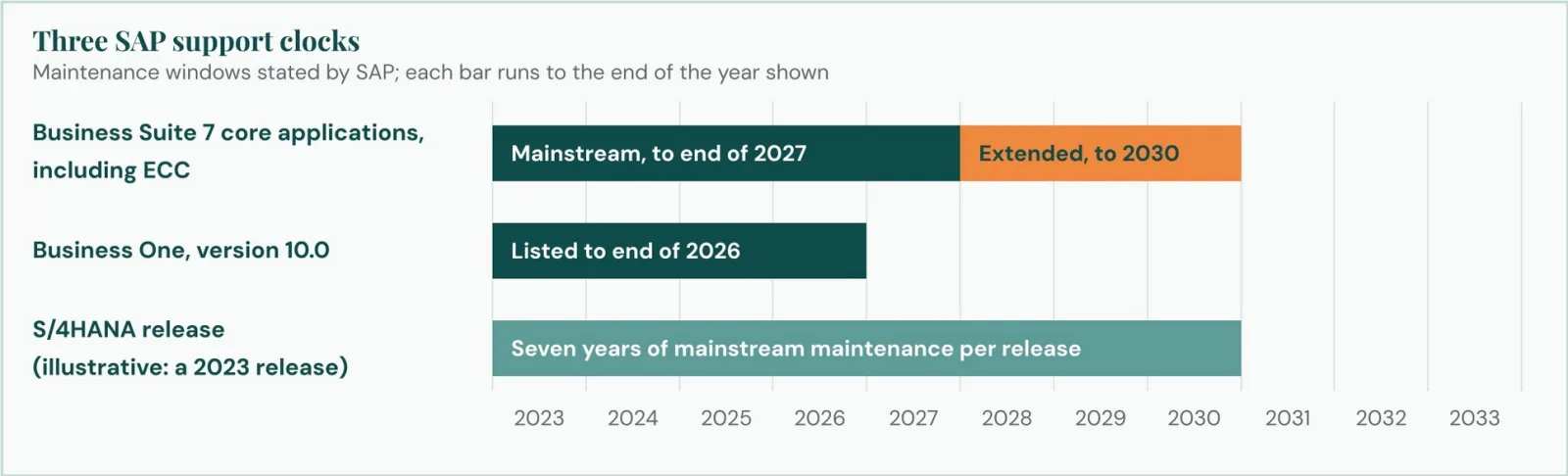
SAP customers rarely get to settle on one thing. SAP has committed to mainstream
maintenance for Business Suite 7 core applications, which is where the SAP ERP Central
Component sits, through the end of 2027, with optional extended maintenance through 2030
[1]
. S/4HANA moved to a two-year release cycle from the 2023 release, with seven years of
mainstream maintenance for each release and feature packs every six months in the first two
years
[2]
. Business One carries at least five years of mainstream maintenance per release
family, with version 10.0 listed through the end of 2026, a date SAP says can change
[3]
. Each
platform asks for steady attention after go-live, and the first thing to settle is who will give it.
Figure 1.
Maintenance windows on the three SAP platforms. Business Suite 7 dates are from
[1]
, the extended-
maintenance premium from
[6]
and Business One from
[3]
. The S/4HANA bar applies SAP’s seven-year rule
[2]
to a
2023 release for illustration.
1. Support is ongoing work, not leftover work
maintenance for Business Suite 7 core applications, which is where the SAP ERP Central
Component sits, through the end of 2027, with optional extended maintenance through 2030
A go-live closes the project. It does not close the workload. Tickets arrive, month-end still has
to be closed, reports need adjusting, integrations change, and people join the business who
have never seen the system. On SAP the load also follows the lifecycle: a Business Suite 7
estate needs stable running while the move to S/4HANA is planned, an S/4HANA estate has
© Orpington Technologies Inc.
www.orpingtontech.com
Page
1
of
3
to be closed, reports need adjusting, integrations change, and people join the business who
have never seen the system. On SAP the load also follows the lifecycle: a Business Suite 7
estate needs stable running while the move to S/4HANA is planned, an S/4HANA estate has
feature packs and releases to absorb, and a Business One estate has its own release family to
keep current. None of that fits inside an implementation contract, and the project team is
rarely the right group to carry it.
2. Scarce skills, shared deadlines
keep current. None of that fits inside an implementation contract, and the project team is
rarely the right group to carry it.
Many companies are watching the same dates, which means they are shopping in the same
small market. A 2021 Gartner survey found 64 percent of information technology executives
naming talent shortage as the most significant barrier to adopting emerging technologies
[4]
.
small market. A 2021 Gartner survey found 64 percent of information technology executives
Finance, materials management and sales and distribution each need their own people.
Keeping one permanent employee for every skill, for work that rises and falls, is hard to justify.
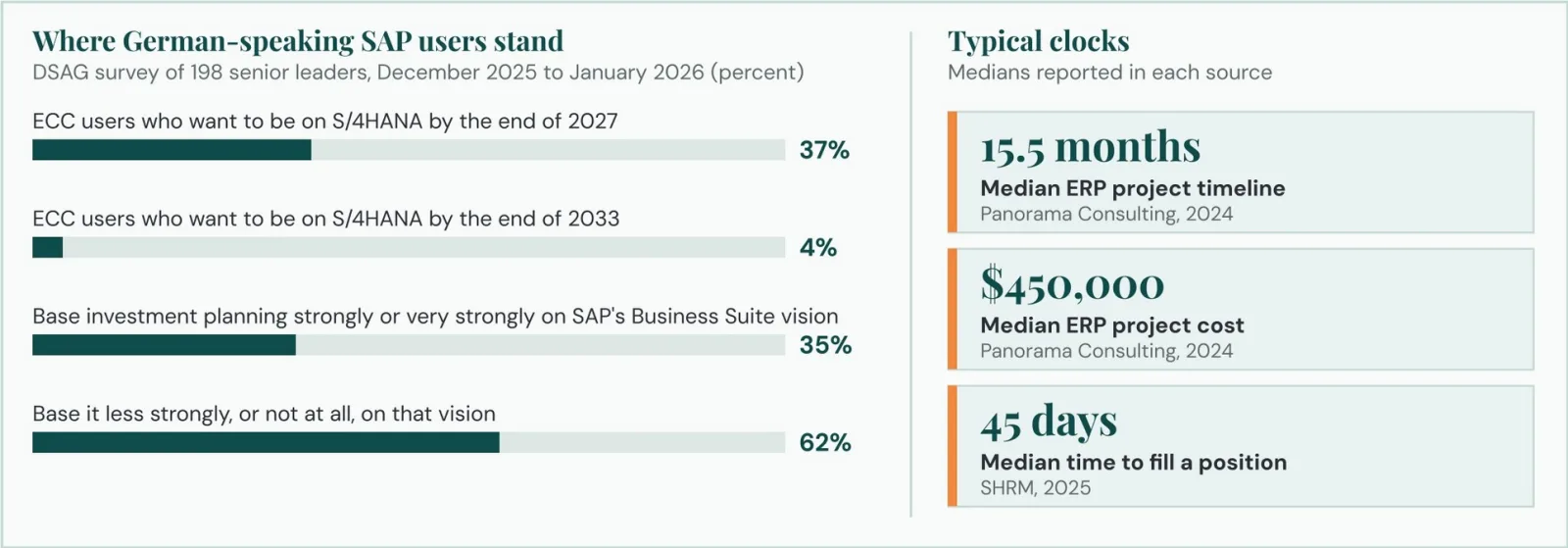
Figure 2.
Left: DSAG survey of 198 senior leaders at German-speaking SAP users
[6]
. Right: median ERP project
timeline and cost
[8]
and time to fill a position
[7]
. Panorama surveyed 131 organizations.
3. Why augmentation suits support work
Keeping one permanent employee for every skill, for work that rises and falls, is hard to justify.
Staff augmentation keeps the enterprise in charge of the system and adds outside
professionals for the stretch that needs them. Deloitte’s 2024 Global Outsourcing Survey
found skilled talent and agility now sitting beside cost reduction as reasons to outsource, with
80 percent of executives planning to maintain or increase their investment in third-party
services
[5]
. For SAP support that means a functional consultant for the close, a developer for
the backlog, a data specialist ahead of a release.
Orpington Technologies’ ERP staff
augmentation
is built along these lines, placing certified consultants into client teams without
the client taking on employment.
Table 1. SAP support windows at a glance
Item
What the vendor states
Source
professionals for the stretch that needs them. Deloitte’s 2024 Global Outsourcing Survey
found skilled talent and agility now sitting beside cost reduction as reasons to outsource, with
80 percent of executives planning to maintain or increase their investment in third-party
Business Suite 7 core
applications, including
ECC
applications, including
ECC
Mainstream maintenance through the end of 2027, with optional
extended maintenance through 2030.
[1]
Extended maintenance
Costs a 2 percent premium until the end of 2030.
[6]
S/4HANA
Two-year release cycle from 2023, seven years of mainstream
maintenance per release, feature packs every six months at first.
[2]
Business One
At least five years of mainstream maintenance per release family;
version 10.0 listed through the end of 2026.
[3]
© Orpington Technologies Inc.
www.orpingtontech.com
Page
2
of
3
extended maintenance through 2030.
Orpington Technologies | ERP Staff Augmentation Insights
Table 2. Four questions for any SAP support partner
Question to ask
Why it matters
Who employs and vets the consultant?
Keeps payroll and compliance off your books and puts
credential checks in expert hands.
Which SAP release has the consultant
supported?
supported?
The three behave differently, and experience on one does not
transfer automatically.
What happens if the fit is wrong?
A replacement commitment turns a hiring mistake into a
scheduling problem.
How soon can people start?
Maintenance dates and release schedules do not wait for a
recruiting cycle.
4. Where Orpington Technologies fits
transfer automatically.
Held against those questions, Orpington Technologies answers most of them directly. Its
consultants are credentialed by certified ERP practitioners, the same reviewers who audit
implementations, and they stay on Orpington’s payroll while working remotely under the
client’s direction. The roles cover functional work in finance, materials management, sales and
distribution and human capital management, technical development, and program roles such
as data migration and testing, on S/4HANA and Business One.
consultants are credentialed by certified ERP practitioners, the same reviewers who audit
implementations, and they stay on Orpington’s payroll while working remotely under the
client’s direction. The roles cover functional work in finance, materials management, sales and
distribution and human capital management, technical development, and program roles such
as data migration and testing, on S/4HANA and Business One.
Three matched candidates arrive roughly four weeks after the engagement fee is confirmed,
the monthly invoice is all-inclusive, and a 90-day replacement guarantee covers the fit risk.
Orpington’s own estimate puts the loaded cost of a direct hire at 1.25 to 1.4 times base salary
once employer tax, benefits and compliance are counted. That makes it a strong choice for
SAP support, and the details are at
https://www.orpingtontech.com/erp-staff-
augmentation/
.
Sources & Further Reading
[1] LeverX – “SAP ECC End of Support 2027 UK: What UK Businesses Need to Do Now”
[2] SAP News Center – “New SAP S/4HANA Release and Maintenance Strategy to Deliver Greater Innovation
and Flexibility,” September 2022
[3] SAP Support – “Maintenance for SAP Business One”
[4] Gartner – “Gartner Survey Reveals Talent Shortages as Biggest Barrier to Emerging Technologies Adoption,”
September 2021
[5] Deloitte – “Global Outsourcing Survey 2024”
[6] The Register – “Half of German-speaking SAP users set to blow past 2027 ECC support deadline,” February
2026
[7] SHRM – “2025 Recruiting Benchmarking”
[8] Panorama Consulting Group – “The 2024 ERP Report”
© Orpington Technologies Inc.
www.orpingtontech.com
Page
3
of
3
the monthly invoice is all-inclusive, and a 90-day replacement guarantee covers the fit risk.
Orpington’s own estimate puts the loaded cost of a direct hire at 1.25 to 1.4 times base salary
once employer tax, benefits and compliance are counted. That makes it a strong choice for