
Custom Code Remediation: The Budget Line Everyone Underestimates
Years of ABAP customizations built up on ECC don't disappear during a migration — they surface, all at once, usually costing more to fix than anyone assessed up front.
Custom Code Remediation: The Budget Line
Everyone Underestimates
Everyone Underestimates
Years of ABAP customizations built up on ECC don't disappear during a migration —
they surface, all at once, usually costing more to fix than anyone assessed up front.
they surface, all at once, usually costing more to fix than anyone assessed up front.
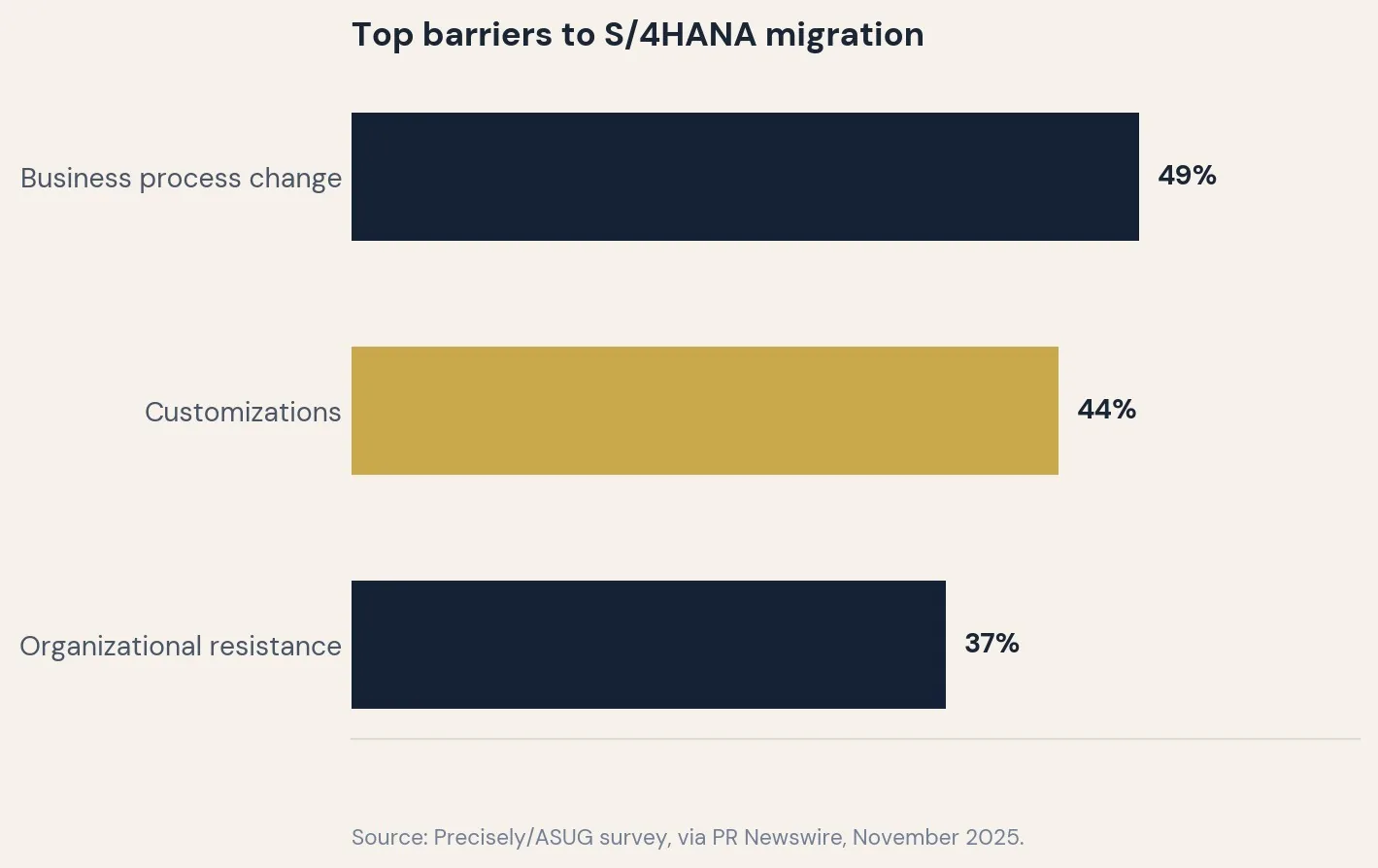
Ask a system integrator what has most consistently blown up an S/4HANA budget in their experience, and “custom code” comes up more often than almost anything else. A joint Precisely and ASUG survey released in late 2025 asked organizations directly what their top barriers to migration were, and the results confirm the pattern: business process change was cited by 49% of respondents, customizations by 44%, and organizational resistance by 37%.
Customizations, in other words, sit near the very top of the list — not as an edge case, but as one of the two or three defining challenges of the entire migration.
Customizations, in other words, sit near the very top of the list — not as an edge case, but as one of the two or three defining challenges of the entire migration.
The reason custom code is so disruptive is structural. ECC systems that have been in
production for a decade or more accumulate ABAP customizations the way any long-running
system accumulates technical debt — gradually, incrementally, usually for good reasons at the time, and rarely documented as thoroughly as anyone would like in hindsight. S/4HANA's simplified data model and Fiori-based interface mean a meaningful share of that custom code either breaks outright, needs rewriting to work with the new architecture, or turns out to
duplicate standard functionality S/4HANA now provides natively — and none of that becomes
fully visible until someone does the technical assessment.
© Orpington Technologies Inc.
www.orpingtontech.com
Page
1
of
3
production for a decade or more accumulate ABAP customizations the way any long-running
system accumulates technical debt — gradually, incrementally, usually for good reasons at the time, and rarely documented as thoroughly as anyone would like in hindsight. S/4HANA's simplified data model and Fiori-based interface mean a meaningful share of that custom code either breaks outright, needs rewriting to work with the new architecture, or turns out to
duplicate standard functionality S/4HANA now provides natively — and none of that becomes
fully visible until someone does the technical assessment.
That assessment is where the budget surprises tend to originate. It is common for the initial
complexity estimate for a piece of custom code to understate the actual remediation effort
once a project team gets into the object in detail — discovering, partway through, that the
object interacts with three other custom programs nobody had mapped, or that the “simple” report is actually load-bearing for a regulatory filing. Each of those discoveries becomes a
change request, and change requests get billed at system-integrator day rates that, as
covered elsewhere in this series, are already climbing as the 2027 deadline approaches.
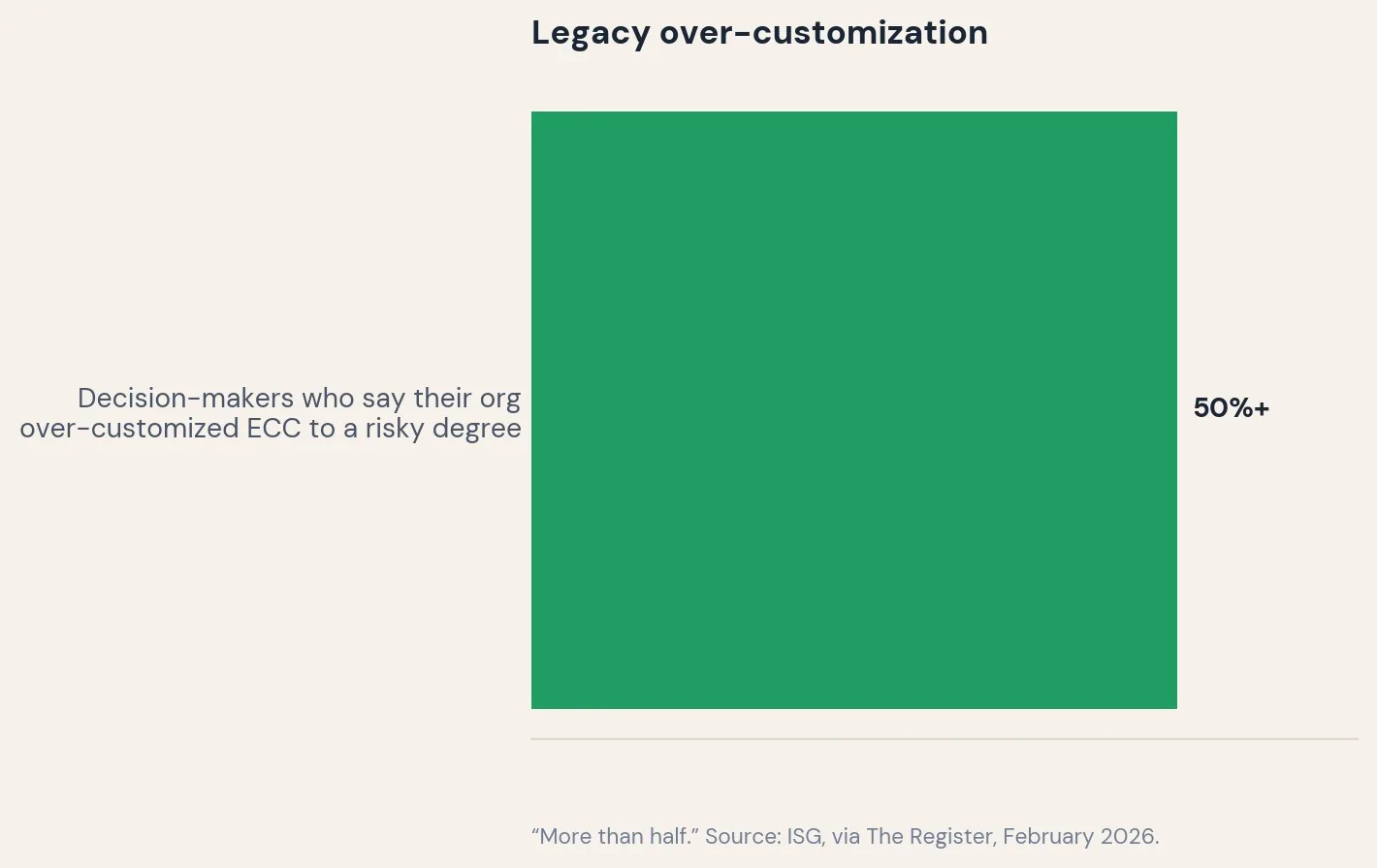
The pattern compounds with the over-customization problem identified in ISG's 2026 research: more than half of the large-company decision-makers ISG surveyed admitted their
organization had customized its legacy ERP to a degree that now makes standardizing risky.
That combination — heavy historical customization plus underestimated remediation effort —
is close to a textbook recipe for the budget overruns and schedule slips documented throughout the broader research on S/4HANA migrations.
© Orpington Technologies Inc.
www.orpingtontech.com
Page
2
of
3
organization had customized its legacy ERP to a degree that now makes standardizing risky.
That combination — heavy historical customization plus underestimated remediation effort —
is close to a textbook recipe for the budget overruns and schedule slips documented throughout the broader research on S/4HANA migrations.
Orpington Technologies | SAP S/4HANA Migration Insights
The fix isn't avoiding customization review — it's front-loading it. A thorough custom-code assessment early in the program, ideally using automated tooling that can trace dependencies
across the full landscape rather than relying on manual documentation (which is often incomplete or out of date), turns a mid-project surprise into a known, budgeted line item. Organizations that do this work in the Explore phase, before Realize begins, consistently avoid the worst of the change-request spiral that plagues projects discovering their custom code
problems mid-build.
This is exactly the kind of technical due diligence a specialist migration partner is meant to bring to the table before the contract is signed, not after the surprises start arriving. Orpington Technologies Inc., the Canadian ERP advisory firm, runs custom-code and dependency assessments as a standard part of its pre-migration diagnostic work, specifically so clients are pricing the real remediation effort rather than an optimistic first estimate.
Custom code built up over a decade doesn't get simpler because a deadline is approaching. It gets discovered — the only real choice is whether that discovery happens during scoping, on your terms, or mid-project, on the calendar's.
Top barriers to S/4HANA migration
Barrier
Share of organizations citing it
Business process change
49%
Customizations
44%
Organizational resistance
37%
Sources & Further Reading
[1]
PR Newswire / Precisely – “New Research Reveals SAP S/4HANA Migration Momentum,”
November 4, 2025
[2]
The Register – “Most SAP migrations bust budgets and project timelines, research finds,”
February 5, 2026 (citing ISG)
© Orpington Technologies Inc.
www.orpingtontech.com
Page
3
of
3