
Cutover Planning for S/4HANA: The Narrowing Window Before 2027
 Orpington Technologies | SAP S/4HANA Migration Insights
© Orpington Technologies Inc.
www.orpingtontech.com
Why the Cutover Window Keeps Getting Less Forgiving
Orpington Technologies | SAP S/4HANA Migration Insights
© Orpington Technologies Inc.
www.orpingtontech.com
Why the Cutover Window Keeps Getting Less Forgiving
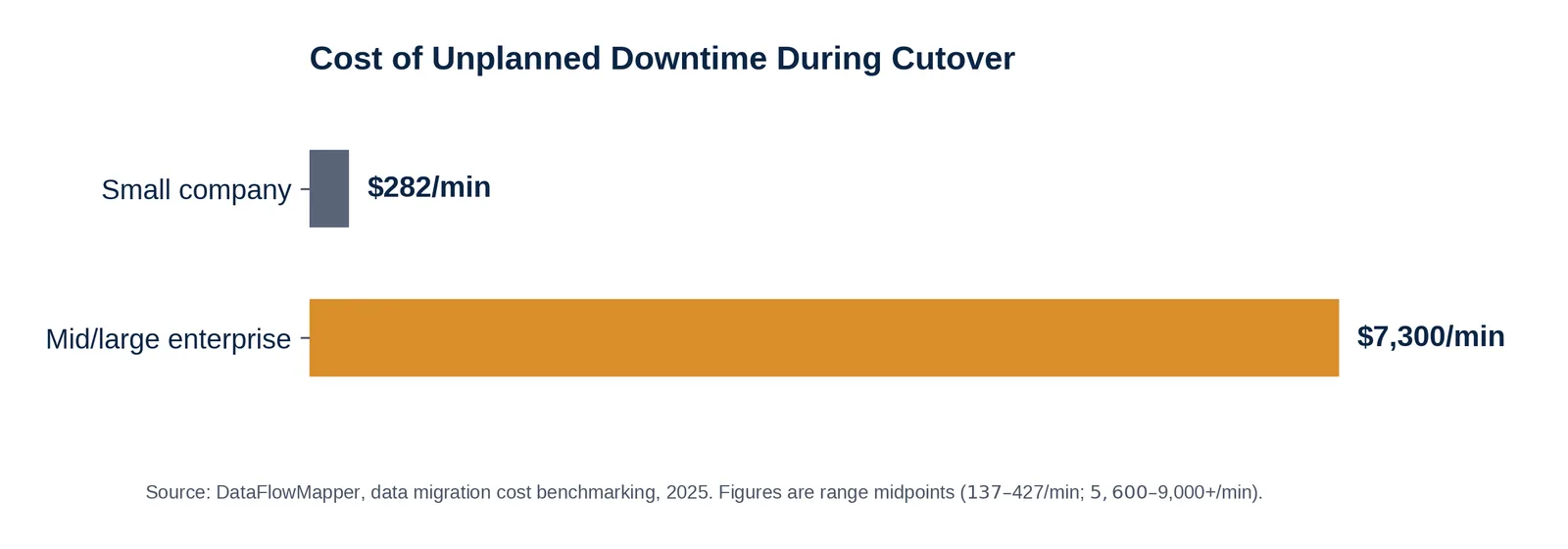
Tolerance for downtime has shrunk steadily even as the technical scope of a cutover window has grown. The financial stakes make that pressure concrete. DataFlowMapper's analysis of unplanned downtime costs puts the range at roughly $137 to $427 per minute for a small company, and $5,600 to $9,000 or more per minute for a mid-size or large enterprise, with costs running even higher in sectors like finance, e-commerce, and healthcare. A cutover that overruns its planned window by even a few hours isn't a scheduling inconvenience at that point. It's a specific, calculable cost the business absorbs in real time.
That pressure collides with a planning process that, in most programs, is still largely manual. The cutover plan itself is a master runbook of hundreds of interdependent tasks, each with an estimated duration based on how long it took in the last rehearsal, assembled into a critical path by a program manager working in a spreadsheet or a specialized but still hand-maintained cutover-management tool.
That squeeze is compounding as the 2027 deadline gets closer. Programs converging on the same final stretch are competing for the same fiscal-quarter-end freeze periods, the same limited number of weekends when transaction volume dips low enough to attempt a full data load, and increasingly for the same shrinking pool of consultants who still know how to run one. Waiting to lock a cutover date doesn't just risk missing the deadline. It risks losing the date entirely to whichever program claims it first.
Tightening the Runbook Itself
Getting that sequencing right is mostly a discipline problem, not a technology one: which tasks can genuinely run in parallel, where a dependency is hard rather than assumed, and how much buffer a given task actually needs based on its performance in prior rehearsals rather than a program manager's guess. Programs that write this down carefully, task by task, and keep revising it after every rehearsal tend to hold their cutover window. Programs that treat the runbook as a document written once and defended after the fact usually don't.
Page 2 of 4