
Cutover Planning for S/4HANA: The Narrowing Window Before 2027
 Orpington Technologies | SAP S/4HANA Migration Insights
© Orpington Technologies Inc.
www.orpingtontech.com
Orpington Technologies | SAP S/4HANA Migration Insights
© Orpington Technologies Inc.
www.orpingtontech.com
A botched cutover rarely traces back to one dramatic failure. More often it's an accumulation of small ones: a task that ran twenty minutes longer than planned, a dependency that was assumed rather than verified, a fallback step nobody had actually rehearsed. Genuine, well-instrumented mock cutovers are what catch those problems before the real weekend does, which is why programs that treat rehearsal as a box-ticking exercise tend to be the ones that overrun.
Some programs now use machine learning models to help with that sequencing, flagging where a plan's buffer is thinnest based on historical variance rather than a single-point estimate, and comparing real-time progress against expected pace once the weekend starts. That can shave real hours off a well-run cutover, but only on top of good rehearsal data. A model has nothing to learn from a program that hasn't tested its own runbook honestly.
What Happens After Cutover: The Hypercare Tail
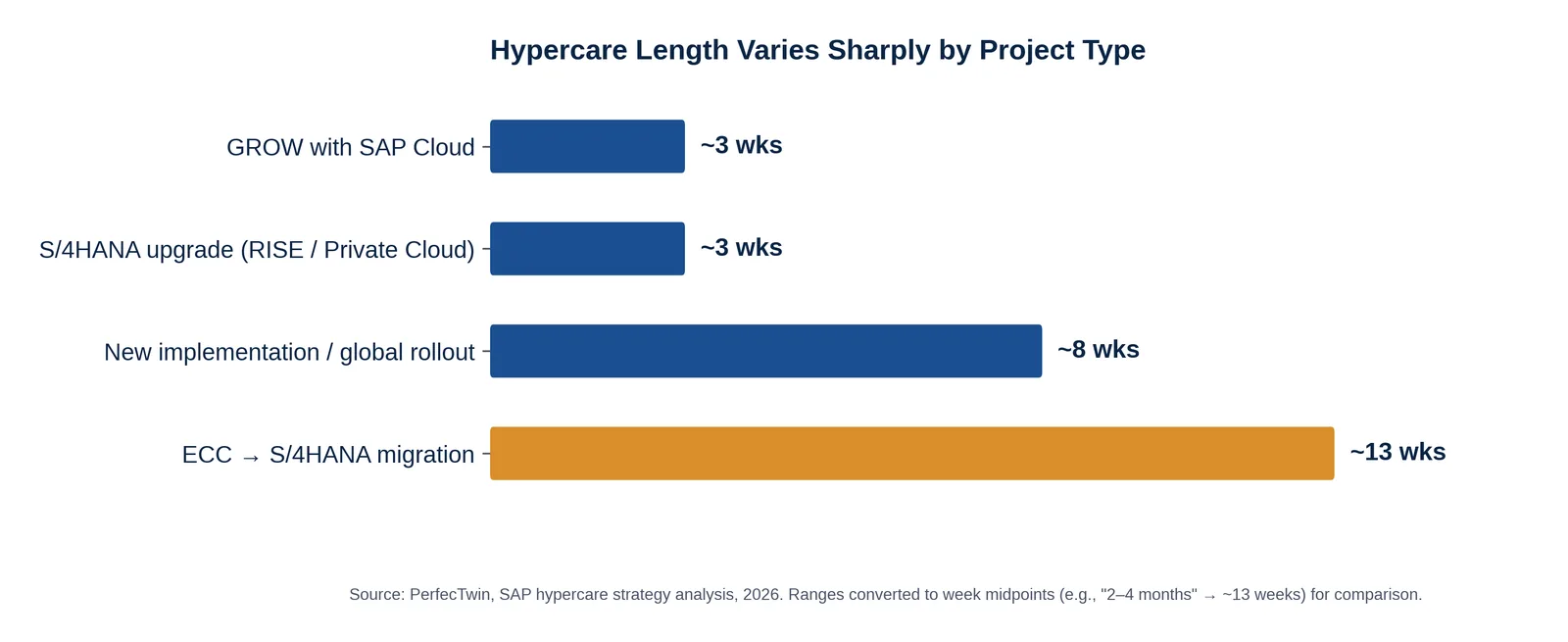
Cutover itself is measured in hours or days. What follows is measured in weeks or months, and it varies enormously by project type. That's hypercare: the stabilization period where the program watches closely for issues that only show up under full production load. PerfecTwin's analysis of SAP hypercare patterns finds that a full ECC-to-S/4HANA migration typically runs a hypercare period of two to four months, the longest of any SAP project type, compared to two to four weeks for a more contained S/4HANA version upgrade.
That gap exists largely because a full migration carries more unknowns than a contained upgrade: custom code behaving unexpectedly under load, data issues that only surface against real transaction volume, integration touchpoints nobody fully load-tested. Monitoring tools, some of them AI-assisted, help by comparing system behavior and defect-inflow rates against expected patterns instead of waiting for a support ticket to surface a problem days later, but most of the hypercare tail still comes down to the support team's own judgment about what's normal and what isn't.
2–4 months
is the typical hypercare period for a full ECC-to-S/4HANA migration, roughly four times longer than a contained S/4HANA version upgrade. (PerfecTwin)
Typical hypercare duration by SAP project type.
Page 3 of 4