
Data Migration Failures: The Quiet Killer of S/4HANA Projects
It rarely makes the executive summary, but data quality work is where a surprising share of migration budgets and timelines actually go off the rails.

Data Migration Failures: The Quiet Killer of
S/4HANA Projects
S/4HANA Projects
It rarely makes the executive summary, but data quality work is where a surprising share of migration budgets and timelines actually go off the rails.
When an S/4HANA project runs late, the postmortem usually points at something visible: scope
creep, a vendor dispute, an unexpected customization. Less visible, and more common than
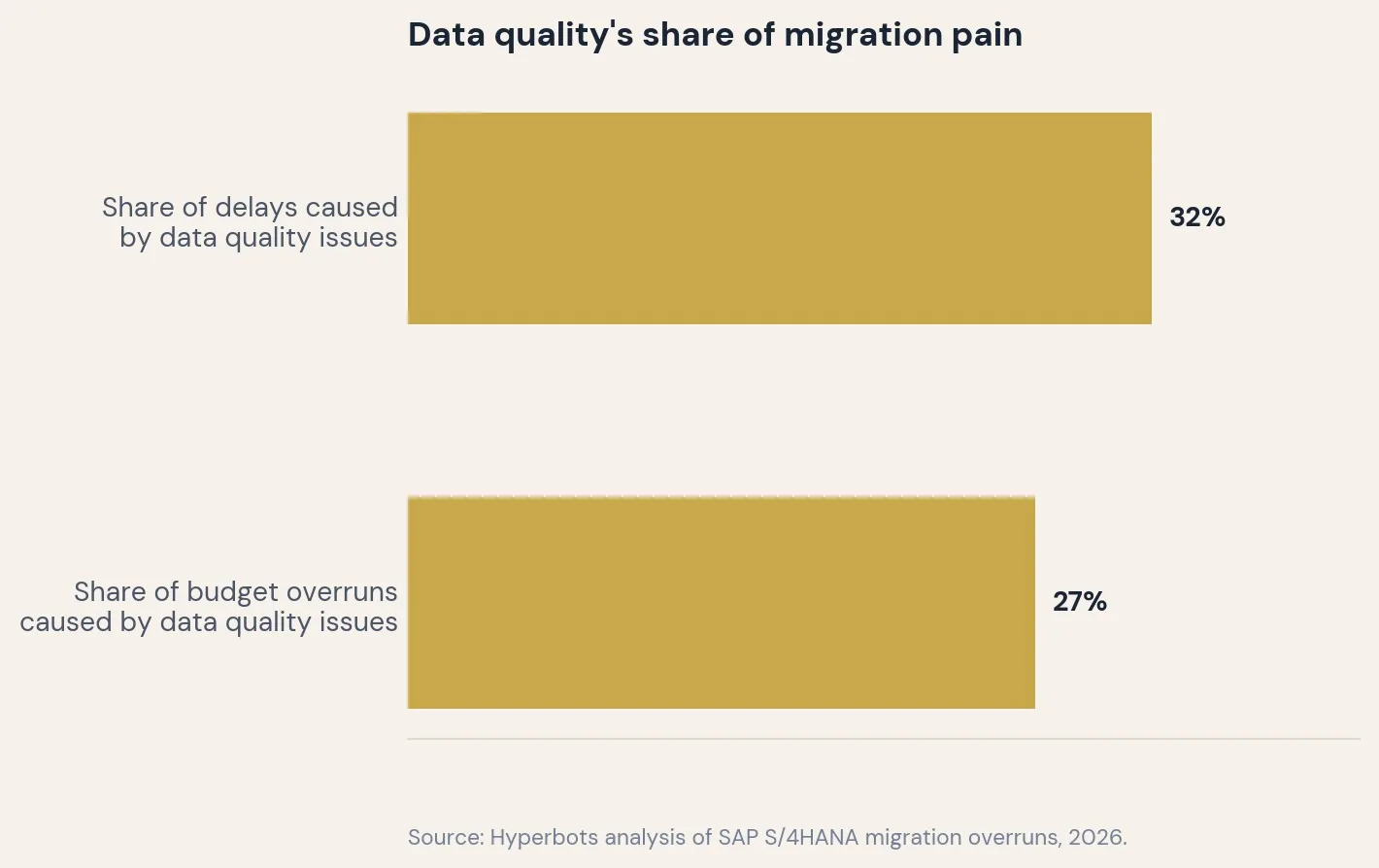
the postmortems suggest, is a problem that starts months earlier and compounds quietly: the data itself. Industry analysis of migration overruns attributes approximately 32% of migration delays and 27% of budget overruns directly to data quality issues — numbers large enough that
data problems deserve to be treated as a primary risk, not a footnote under “technical workstreams.”
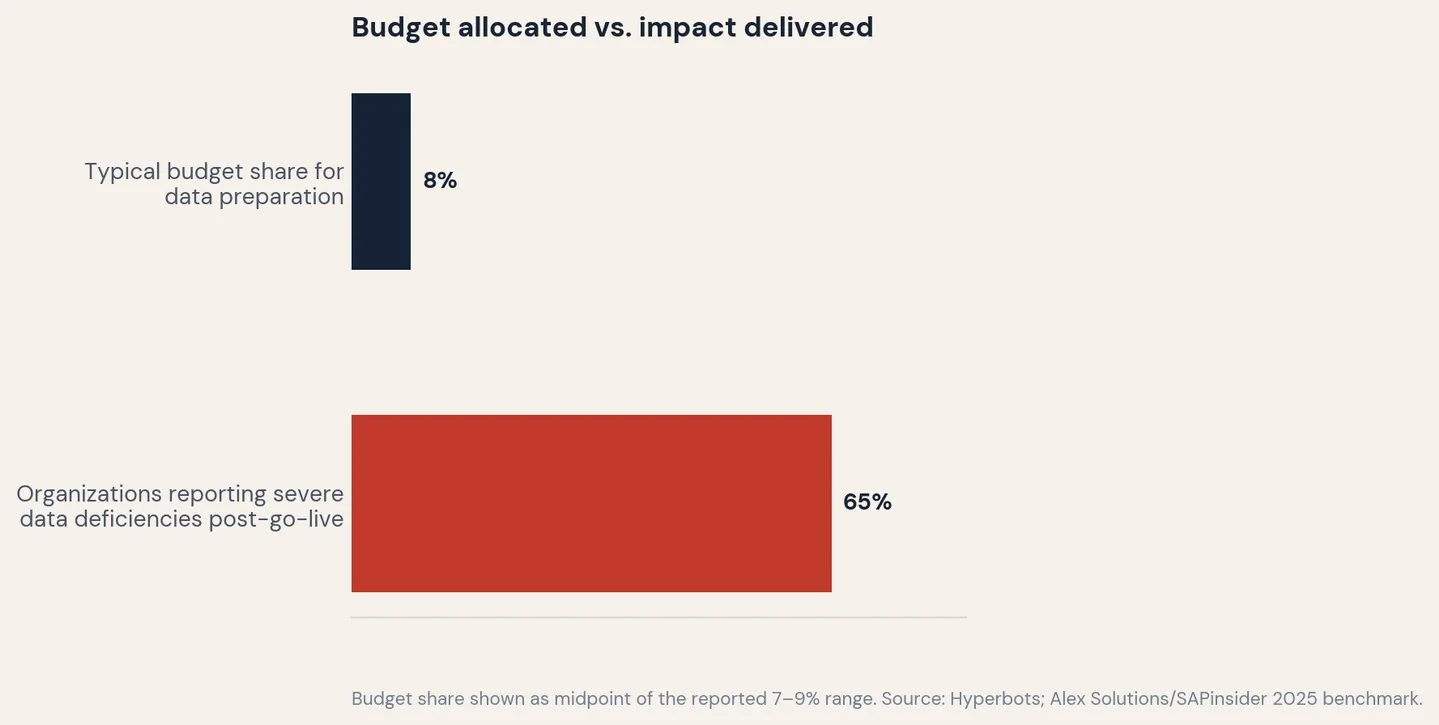
Part of the problem is a mismatch between where the risk actually sits and where the budget actually goes. The same analysis notes that organizations typically allocate only 7 to 9% of total project budget to data preparation, despite its outsized influence on whether the whole
implementation succeeds. That is a strikingly small investment given what's riding on it: SAPinsider's 2025 Migration Benchmark research found that 65% of organizations identified
severe data quality deficiencies after go-live — discovered, in other words, only once it was already too late to fix cheaply.
© Orpington Technologies Inc.
www.orpingtontech.com
Page
1
of
3
implementation succeeds. That is a strikingly small investment given what's riding on it: SAPinsider's 2025 Migration Benchmark research found that 65% of organizations identified
severe data quality deficiencies after go-live — discovered, in other words, only once it was already too late to fix cheaply.
The mechanics of why this happens are not exotic. Moving from ECC to S/4HANA is not a simple copy job; it requires genuine data cleansing, enrichment and verification, because
S/4HANA's data model is meaningfully different from ECC's, particularly around finance's
Universal Journal. Years of accumulated exceptions, workarounds and inconsistent master data in a legacy ECC system — duplicate vendor records, inconsistent unit-of-measure conventions, stale customer master data — all surface at once during a migration, usually later than the project plan assumed.
Test data compounds the same problem from a different angle. A full client copy from
production, needed to build a realistic test environment, can take hours to days depending on data volume, and the post-copy work — masking sensitive data, validating configuration,
setting up users, checking integrations — adds more time on top. By the time that environment is actually ready, the live configuration has often already drifted, because the program kept moving while the copy was running. Teams end up refreshing test environments repeatedly,
each refresh eating into a schedule that was already tight.
None of this is a reason to fear data migration — it's a reason to fund it properly and start it early. The organizations that avoid becoming part of that 65% figure are the ones that treat
© Orpington Technologies Inc.
www.orpingtontech.com
Page
2
of
3
Orpington Technologies | SAP S/4HANA Migration Insights
data profiling and cleansing as a distinct workstream with its own budget and its own timeline, beginning well before the technical cutover work starts, rather than as something that happens automatically as part of the broader migration.
This is one of the most consistent gaps a specialist delivery team is brought in to close.
Orpington Technologies Inc., the Canadian ERP advisory and delivery firm, builds dedicated
data-quality workstreams into its S/4HANA engagements from the outset, specifically because
so many otherwise well-run migrations are undone by data problems nobody budgeted the
time to catch early.
Orpington Technologies Inc., the Canadian ERP advisory and delivery firm, builds dedicated
data-quality workstreams into its S/4HANA engagements from the outset, specifically because
so many otherwise well-run migrations are undone by data problems nobody budgeted the
time to catch early.
A budget line for data preparation that looks generous on paper is still usually too small. The
projects that avoid this failure mode are the ones that treat that number as a starting estimate
to be revisited, not a box to check once and move on from.
Data quality's share of migration pain
Metric
Reported figure
projects that avoid this failure mode are the ones that treat that number as a starting estimate
to be revisited, not a box to check once and move on from.
Share of migration delays attributed to data
quality issues
~32%
quality issues
Share of budget overruns attributed to data
quality issues
~27%
quality issues
Typical share of project budget allocated to data
preparation
7–9%
preparation
Organizations reporting severe data quality
deficiencies after go-live
65%
Sources & Further Reading
[1]
Hyperbots – “Why SAP S/4HANA Upgrades Go Over Budget”
[2]
Alex Solutions – “Why SAP Migrations Go Over Budget,” June 1, 2026 (citing SAPinsider 2025
Migration Benchmark Report)
© Orpington Technologies Inc.
www.orpingtontech.com
Page
3
of
3
deficiencies after go-live