
Data Readiness: The Workstream That Decides Your S/4HANA Timeline
Data migration is the workstream most S/4HANA programs budget for last and understand least, and it's often the one thing standing between a realistic 2027 timeline and a missed one. AI-assisted tooling can compress parts of that work, but it doesn't replace the plan.
Data Readiness: The Workstream That
Decides Your S/4HANA Timeline
Decides Your S/4HANA Timeline
Data migration is the workstream most S/4HANA programs budget for last and
understand least, and it's often the one thing standing between a realistic 2027
timeline and a missed one. AI-assisted tooling can compress parts of that work, but it
doesn't replace the plan.
8 min read | Orpington Technologies Insights
understand least, and it's often the one thing standing between a realistic 2027
timeline and a missed one. AI-assisted tooling can compress parts of that work, but it
doesn't replace the plan.
SAP's mainstream maintenance for ECC and Business Suite 7 ends December 31, 2027. That date is
fixed, and it's doing most of the work pushing organizations to move now. The pressure isn't only about
losing patches and support tickets after that date. The wider ECC ecosystem, the consultants who know
the old customizations, the third-party tools built around it, the internal staff who've spent a career in it,
thins out year by year as the installed base shifts toward S/4HANA. Waiting doesn't just risk running an
unsupported system. It risks running one that fewer and fewer people nearby still know how to fix.
Inside that broader migration, data readiness is the workstream most likely to break the schedule.
Legacy master data profiling and cleansing gets scoped late and estimated optimistically, in part
because nobody can say with confidence how many duplicate vendor records, orphaned material
masters, or decade-old unit-of-measure errors are sitting in a given system until someone actually goes
looking. Historically that discovery and cleanup work has consumed a large share of a data analyst's
time, done record by record and spreadsheet by spreadsheet, and it has to start well before cutover
planning locks in the rest of the timeline. AI-assisted profiling tools are starting to compress that timeline
for teams that use them, which this piece gets to, but the underlying workload and the need to start early
haven't changed.
The Unglamorous Bottleneck Everyone Underestimates
Legacy master data profiling and cleansing gets scoped late and estimated optimistically, in part
because nobody can say with confidence how many duplicate vendor records, orphaned material
masters, or decade-old unit-of-measure errors are sitting in a given system until someone actually goes
looking. Historically that discovery and cleanup work has consumed a large share of a data analyst's
time, done record by record and spreadsheet by spreadsheet, and it has to start well before cutover
planning locks in the rest of the timeline. AI-assisted profiling tools are starting to compress that timeline
for teams that use them, which this piece gets to, but the underlying workload and the need to start early
haven't changed.
Data migration doesn't get the executive attention that functional design or custom code decisions get,
yet it still eats a disproportionate share of the budget. Research published in Compact, the
Page 1 of 4
yet it still eats a disproportionate share of the budget. Research published in Compact, the
 Orpington Technologies | SAP S/4HANA Migration Insights
© Orpington Technologies Inc. www.orpingtontech.com
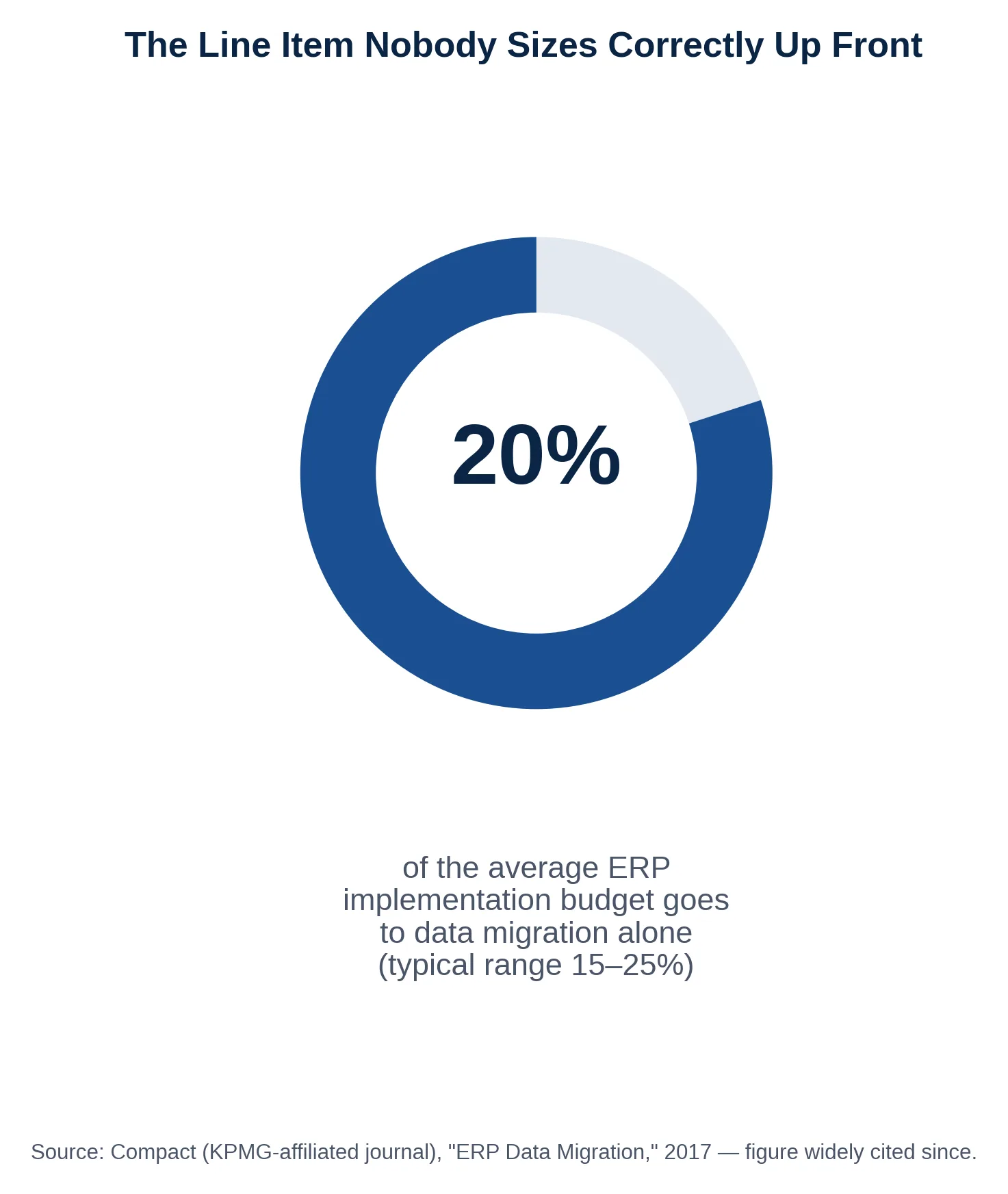
KPMG-affiliated journal, found that data migration typically consumes 15–25% of an ERP
implementation's overall budget, a figure specialists in the field still cite as broadly accurate today even
though the tooling around it has changed considerably.
implementation's overall budget, a figure specialists in the field still cite as broadly accurate today even
though the tooling around it has changed considerably.
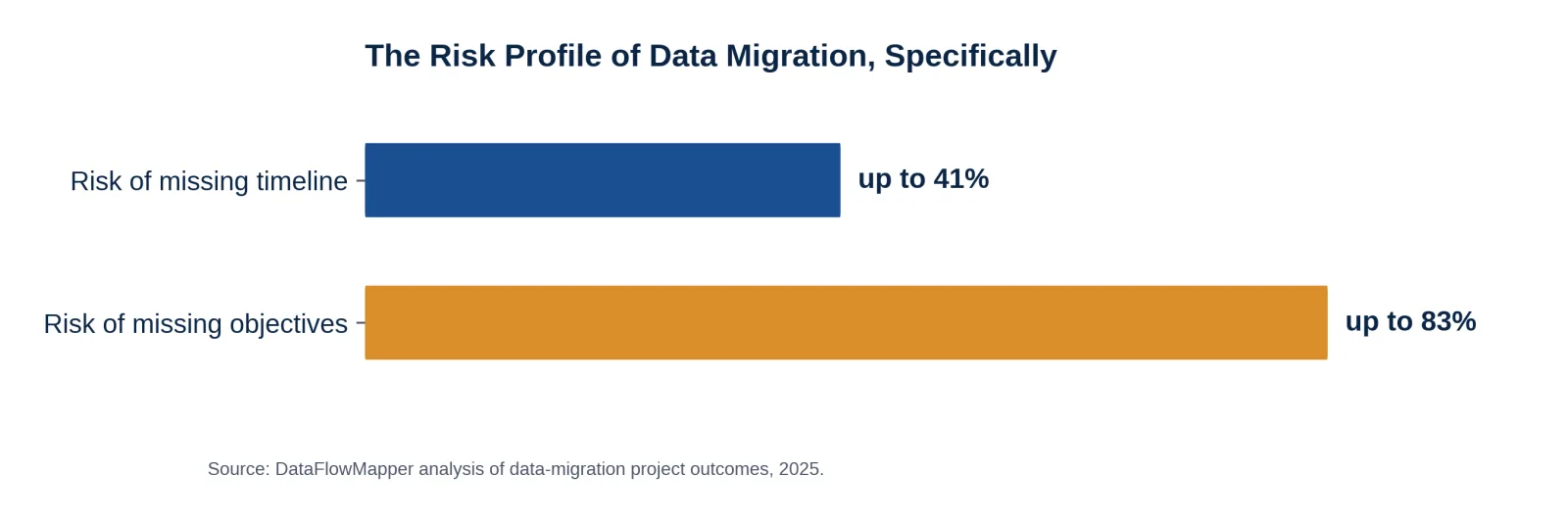
That spend doesn't buy certainty. Analysis from DataFlowMapper, synthesizing outcomes across
data-migration-specific engagements, puts the risk of missing the planned timeline at 30–41% of
projects. The risk of failing to fully meet objectives, meaning the data that lands in the new system still
isn't clean, complete, or trustworthy, runs as high as 83%, depending on how the project was scoped
and governed going in.
Data migration's typical share of total ERP implementation spend.
Why This Work Can't Start Late
data-migration-specific engagements, puts the risk of missing the planned timeline at 30–41% of
projects. The risk of failing to fully meet objectives, meaning the data that lands in the new system still
isn't clean, complete, or trustworthy, runs as high as 83%, depending on how the project was scoped
and governed going in.
The mechanics of data migration haven't changed: extract, profile, cleanse, transform, load, reconcile.
What changes is how badly that sequence goes wrong when it starts late. Profiling an entire legacy
landscape by hand, tracing every duplicate customer record, every orphaned material master, every
currency-conversion error left over from a system change a decade ago, takes a data analyst working
steadily for weeks before anyone has a real picture of what's wrong. Cleansing takes longer still, and
each fix can surface a new problem underneath it.
Basis Technologies' modeling of S/4HANA transformations found that projects require more than 75%
additional resourcing relative to baseline estimates, and data work is a significant share of where that
overrun shows up. Most of that overrun traces back to the same root cause: profiling and cleansing that
should have started months before cutover planning instead got squeezed into the weeks right before it,
when there's no longer room to fix what gets found.
AI-assisted profiling tools are one of the more useful recent additions here. Fuzzy-matching models can
flag probable duplicate records even when two entries don't share an exact key, and anomaly-detection
models catch values that are syntactically valid but statistically implausible, the kind of thing manual
Page 2 of 4
flag probable duplicate records even when two entries don't share an exact key, and anomaly-detection
models catch values that are syntactically valid but statistically implausible, the kind of thing manual
 Orpington Technologies | SAP S/4HANA Migration Insights
© Orpington Technologies Inc. www.orpingtontech.com
spot-checks miss. That shortens the finding-problems phase of the work. It doesn't shorten the
deciding-what-to-do-about-them phase, which is still where most of the time goes.
75%+
deciding-what-to-do-about-them phase, which is still where most of the time goes.
additional resourcing, on average, is required beyond baseline
estimates to deliver an S/4HANA transformation, with data readiness
work a recurring driver of that gap. (Basis Technologies)
The Numbers Behind Why This Deserves Early Attention
estimates to deliver an S/4HANA transformation, with data readiness
work a recurring driver of that gap. (Basis Technologies)
The risk figures are worth sitting with for a moment. They cut against a common assumption, that data
migration is a mechanical, late-stage activity you can compress if the schedule gets tight elsewhere.
The data says the opposite. It's one of the more failure-prone workstreams in the entire program, and it's
the one most often treated as flexible when timelines slip.
migration is a mechanical, late-stage activity you can compress if the schedule gets tight elsewhere.
The data says the opposite. It's one of the more failure-prone workstreams in the entire program, and it's
the one most often treated as flexible when timelines slip.
The organizations that avoid the higher end of that risk range tend to share one habit: they start data
profiling months before cutover planning begins, instead of treating it as a technical task that follows
functional design. That early start is what actually buys the program room to fix what profiling turns up,
rather than just discover it late. Teams using AI-assisted profiling tools get through that first pass faster,
often in days instead of the weeks a fully manual exercise would need, but the discipline of starting early
matters more than which tool does the work.
Share of data migration projects at risk of missing timeline vs. fully meeting objectives.
Why This Still Isn't a Push-Button Job
profiling months before cutover planning begins, instead of treating it as a technical task that follows
functional design. That early start is what actually buys the program room to fix what profiling turns up,
rather than just discover it late. Teams using AI-assisted profiling tools get through that first pass faster,
often in days instead of the weeks a fully manual exercise would need, but the discipline of starting early
matters more than which tool does the work.
The judgment calls in data cleansing are rarely technical. Deciding whether two vendor records really
represent the same legal entity, or whether a decade-old pricing condition should be archived or kept for
audit purposes, takes business context a model doesn't have unless someone hands it that context on
purpose. AI-assisted profiling works best as a way to surface the full population of decisions quickly and
comprehensively. Making those decisions unattended is a different matter, and not one the tooling is
built for.
Page 3 of 4
represent the same legal entity, or whether a decade-old pricing condition should be archived or kept for
audit purposes, takes business context a model doesn't have unless someone hands it that context on
purpose. AI-assisted profiling works best as a way to surface the full population of decisions quickly and
comprehensively. Making those decisions unattended is a different matter, and not one the tooling is
built for.
Orpington Technologies | SAP S/4HANA Migration Insights
© Orpington Technologies Inc. www.orpingtontech.com
The programs getting this right pair fast profiling, AI-assisted or not, with a clearly assigned data
governance owner on the business side, someone with the authority to rule on ambiguous cases quickly
instead of letting them queue up. Skip that owner and a faster profiling pass just produces a longer,
faster-generated list of unresolved questions. That's progress. It isn't the finish line.
Where This Leaves You
governance owner on the business side, someone with the authority to rule on ambiguous cases quickly
instead of letting them queue up. Skip that owner and a faster profiling pass just produces a longer,
faster-generated list of unresolved questions. That's progress. It isn't the finish line.
Data readiness is one of the areas where an outside, structured assessment tends to catch things an
internal team misses, mostly because that team is close to the system and short on time. Orpington
Technologies runs exactly this kind of diagnostic work as part of its Implementation Confidence
Diagnostic and Full ERP Diagnostic Report engagements, backed by a track record of leading
ECC-to-S/4HANA migrations end to end, whether we're brought in to run the migration directly or to give
an independent read on a data workstream someone else is running. Our approach pairs that delivery
experience with modern tooling, AI-assisted profiling among it, to keep the data workstream from
becoming the reason a project misses the 2027 deadline. The organizations in the best position are the
ones starting the conversation now. You can learn more about Orpington's approach to
ECC-to-S/4HANA migration at orpingtontech.com.
Sources & Further Reading
[1]
Compact (KPMG-affiliated journal) — ERP Data Migration
[2]
DataFlowMapper — Data Migration Cost Calculator: Real Benchmarks
[3]
Basis Technologies — The True State of S/4HANA 2025
[4]
Horváth — Study: SAP S/4HANA Transformations Rarely Go As Planned (2025)
[5]
SAVIC Technologies — SAP AI ROI: Real Numbers, 2026
Page 4 of 4
internal team misses, mostly because that team is close to the system and short on time. Orpington
Technologies runs exactly this kind of diagnostic work as part of its Implementation Confidence
Diagnostic and Full ERP Diagnostic Report engagements, backed by a track record of leading
ECC-to-S/4HANA migrations end to end, whether we're brought in to run the migration directly or to give
an independent read on a data workstream someone else is running. Our approach pairs that delivery
experience with modern tooling, AI-assisted profiling among it, to keep the data workstream from
becoming the reason a project misses the 2027 deadline. The organizations in the best position are the
ones starting the conversation now. You can learn more about Orpington's approach to
ECC-to-S/4HANA migration at orpingtontech.com.