
Hypercare and Stabilization: Surviving the First 90 Days on S/4HANA
 Orpington Technologies | SAP S/4HANA Migration Insights
© Orpington Technologies Inc.
www.orpingtontech.com
Where the Value Shows Up Fastest
Orpington Technologies | SAP S/4HANA Migration Insights
© Orpington Technologies Inc.
www.orpingtontech.com
Where the Value Shows Up Fastest
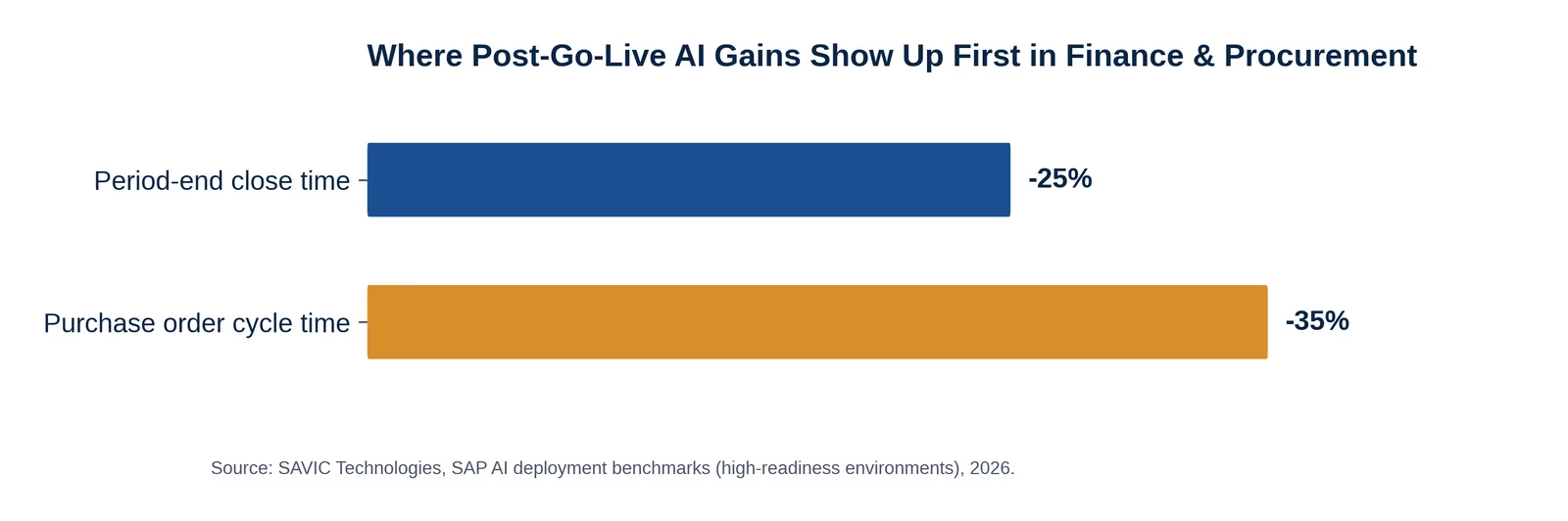
The functions that stabilize fastest tend to be the ones with high-volume, rule-governed transaction flows, and finance and procurement are the clearest examples. Benchmarking of high-readiness post-go-live environments, cited by SAVIC Technologies, found a 20–30% reduction in period-end closing time and a 30–40% reduction in routine purchase order cycle time once tighter monitoring and exception handling were embedded into those processes. Those gains compound month over month once stabilization is complete, well past the hypercare window itself.
That's a useful signal for where hypercare resources pay off fastest: high-volume, well-defined transaction flows return value quickly. Low-volume, judgment-heavy processes are still better served by keeping an experienced person in the loop from day one, whatever tooling sits alongside them.
The Failure Mode to Watch For
A support model that closes tickets quickly can still hide a systemic problem, if nobody is watching the pattern behind the individual resolutions. Twenty tickets closed as "user error, retrained" might actually be twenty symptoms of one configuration issue that never gets fixed, because no single ticket looked significant enough to escalate on its own. That risk gets worse, not better, when part of the triage volume is handled by an AI agent instead of a person, since fast resolutions don't automatically surface a pattern across them. The hypercare teams that avoid this trap run a human-led root-cause review of ticket trends every week, no matter how much of the routine volume is automated.
Where This Leaves You
Orpington Technologies works with clients on hypercare staffing models and escalation design as part of pre-go-live readiness, because the gap between a well-planned stabilization period and a reactive one shows up fast, and expensively, in the first weeks after cutover. With ECC mainstream maintenance ending December 31, 2027 and support options for the platform narrowing well before then, that
Page 3 of 4