
Six Ways an S/4HANA Migration Goes Sideways
Most migrations that struggle don’t fail on the technology. They fail on a handful of decisions that were made late, made by default, or never made at all. Here are the six worth catching early.
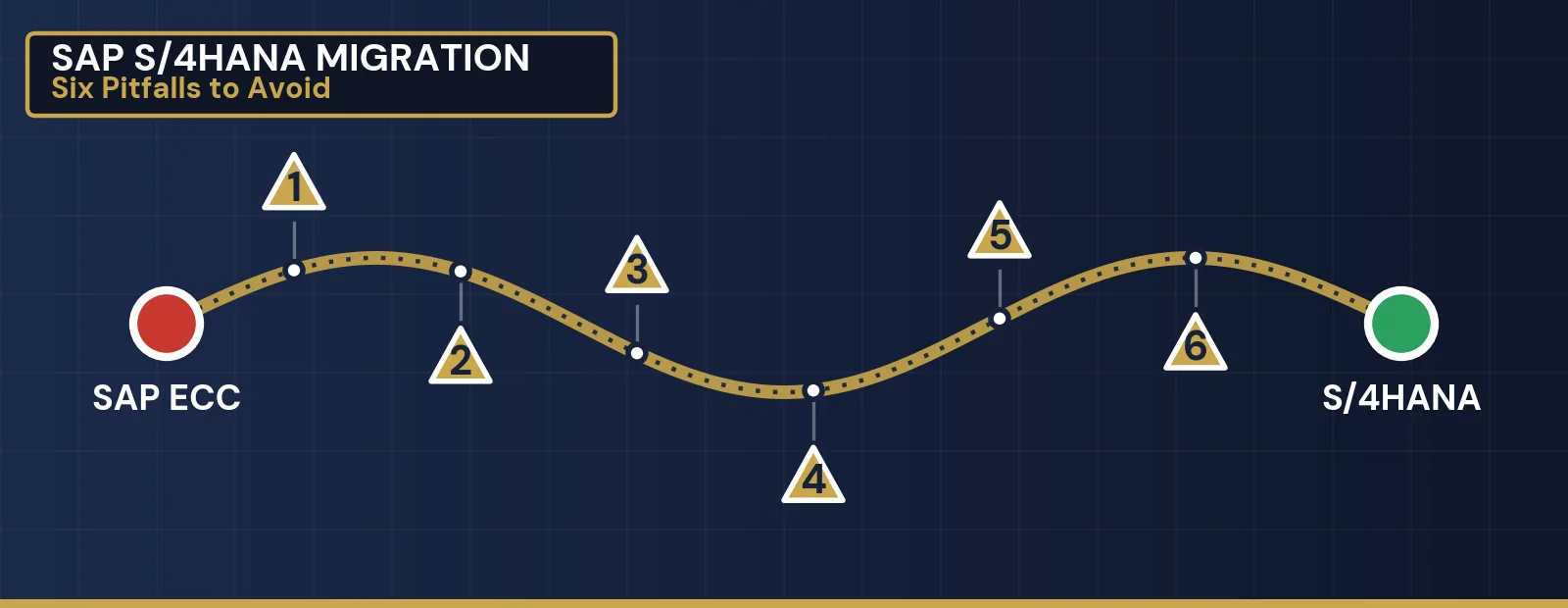 THE PITFALLS
Six Ways an S/4HANA Migration Goes
Sideways
Sideways
Most migrations that struggle don’t fail on the technology. They fail on a handful of
decisions that were made late, made by default, or never made at all. Here are the six
worth catching early.
decisions that were made late, made by default, or never made at all. Here are the six
worth catching early.
Ask people who have finished an ECC to S/4HANA project what they would change and the software
hardly comes up. They talk about the custom code nobody scanned until month five, the customer
master that turned out to be full of duplicates, the test cycle that got trimmed to hold a date. The
product mostly does what SAP says it does. The trouble sits in the choices around it.
hardly comes up. They talk about the custom code nobody scanned until month five, the customer
master that turned out to be full of duplicates, the test cycle that got trimmed to hold a date. The
product mostly does what SAP says it does. The trouble sits in the choices around it.
Time matters here too. Mainstream maintenance for ECC 6.0 on EHP 6 to 8 ends on December 31,
2027, which leaves about fifteen months, and a mistake that only shows itself at go-live is one you may
not have room to fix. The six pitfalls below come up again and again in SAP’s own conversion guidance
and in what practitioners write once the dust has settled. None of them is exotic. Most are cheap to
avoid if someone raises them early enough.
1. Running it as an IT project
2027, which leaves about fifteen months, and a mistake that only shows itself at go-live is one you may
not have room to fix. The six pitfalls below come up again and again in SAP’s own conversion guidance
and in what practitioners write once the dust has settled. None of them is exotic. Most are cheap to
avoid if someone raises them early enough.
Plenty of programs are set up under the CIO, staffed with technical people, and shown to the business
shortly before go-live. Panaya, which says it has been called in to rescue projects that went off track,
puts this first on its list of common mistakes: when the business is left out of key decisions, the
finished system doesn’t quite fit the way people work
[1]
. A practitioner post on SAP Community
groups late involvement of business users with skipped data cleansing and thin testing as the usual
roots of delay and overrun
[2]
.
shortly before go-live. Panaya, which says it has been called in to rescue projects that went off track,
puts this first on its list of common mistakes: when the business is left out of key decisions, the
The fix is unglamorous. Name a business owner for each major process area on day one, and give them
real decisions to make rather than documents to sign. If the head of procurement can’t explain what
Orpington Technologies | SAP S/4HANA Migration Insights
© Orpington Technologies Inc. www.orpingtontech.com
Page 1 of 4
real decisions to make rather than documents to sign. If the head of procurement can’t explain what
 changed in their process and why, the project is not as far along as the status report says.
2. Picking an approach out of habit
Whether you start clean (greenfield), convert what you run today (brownfield), or move selectively
(bluefield, also called selective data transition) shapes nearly everything after it: the timeline, the
testing load, and how much old baggage makes the trip
[3]
. Teams tend to slide into brownfield
(bluefield, also called selective data transition) shapes nearly everything after it: the timeline, the
because it is the easiest to explain, then find they have carried twenty years of workarounds into a new
system. Others pick greenfield for the fresh start and underestimate how much history finance and
audit will want to see. Neither choice is wrong. Choosing before you have looked at your own code,
data and appetite for change is.
Scope deserves the same discipline. One practitioner guide argues that locking scope early is what
keeps a twelve-month project from turning into a twenty-four-month one
[4]
.
3. Dragging custom code across unexamined
system. Others pick greenfield for the fresh start and underestimate how much history finance and
audit will want to see. Neither choice is wrong. Choosing before you have looked at your own code,
data and appetite for change is.
SAP’s conversion guide points you to two things before anything else. One is the SAP Readiness Check,
which analyzes the configuration, data and usage of your production system. The other is the
Simplification Item Catalog, which lists what changes or breaks compared with ECC
[5]
. The catalog
covers everything, not just what applies to you, so someone still has to work out which items are
relevant to your system
[5]
.
Custom code is where this goes wrong most often. SAP’s recommended tool is the ABAP Test Cockpit,
set up once as a central check system and pointed at all the custom code across your systems
[6]
.
which analyzes the configuration, data and usage of your production system. The other is the
Teams usually fail in one of two ways. Either nobody runs the scan until the build is under way, so the
effort estimate was a guess, or the scan gets run and the team dutifully fixes every finding, including
code nobody has called in years. Usage data is what separates the two. Fix what people actually run,
and put a name next to everything you are willing to retire.
4. Moving messy data and hoping the tool sorts it out
Migration tools move data. They don’t repair it
[7]
. Duplicate vendors and inconsistent product records
effort estimate was a guess, or the scan gets run and the team dutifully fixes every finding, including
code nobody has called in years. Usage data is what separates the two. Fix what people actually run,
and put a name next to everything you are willing to retire.
pile up quietly over the years, and they stay out of sight in ECC until an S/4HANA load drags them into
view.
Orpington Technologies | SAP S/4HANA Migration Insights
© Orpington Technologies Inc. www.orpingtontech.com
Page 2 of 4
view.
The clearest example is the business partner. ECC keeps customers and vendors as separate objects.
S/4HANA has one business partner model, tied to the old records through Customer-Vendor
Integration, and moving to it is not optional. It also has to happen before the S/4HANA conversion itself
[8]
. When one company exists as both a customer and a vendor, it should end up as a single business
partner, which means matching records, settling conflicting details and deciding which version wins.
That is a data governance problem more than a technical one, and it needs business sign-off
[9]
. Even
numbering can bite: if Customer 1000 and Vendor 1000 are different companies, only one of them can
keep 1000 as its business partner number
[10]
.
S/4HANA has one business partner model, tied to the old records through Customer-Vendor
Integration, and moving to it is not optional. It also has to happen before the S/4HANA conversion itself
Ownership is the quiet issue underneath. Sales owns customers, procurement owns vendors, finance
owns cost centers, and cross-domain cleanup stalls because nobody is responsible for the gaps
between them
[11]
. Settle who signs off what before the first load, not during the first mock run.
5. Treating testing and cutover as the last mile
owns cost centers, and cross-domain cleanup stalls because nobody is responsible for the gaps
When early phases run long, the back end of the plan is where the squeeze lands. One testing
practitioner describes the mock migration as something you would typically repeat three to five times,
fixing and re-running each round, before the data and configuration are clean enough for a full dress
rehearsal
[12]
. If your plan has a single mock run, it has a single chance to find what the other runs would
have caught.
practitioner describes the mock migration as something you would typically repeat three to five times,
fixing and re-running each round, before the data and configuration are clean enough for a full dress
Test data is a second trap. Data that behaves in ECC doesn’t always carry over cleanly into S/4HANA’s
model, where the Universal Journal replaces several finance tables. The result is parallel testing that
nobody fully trusts: teams chase differences that turn out to be data problems while real defects go
unnoticed
[13]
. And the final cutover is often squeezed into a single weekend
[13]
, which is a poor
moment to learn how long a load really takes.
6. Forgetting the people who use it
model, where the Universal Journal replaces several finance tables. The result is parallel testing that
nobody fully trusts: teams chase differences that turn out to be data problems while real defects go
ECC authorizations are built around transaction codes and menus. S/4HANA with Fiori grants access
through catalogs, groups and spaces instead. Copying ECC roles across unchanged is described as the
most common security mistake in a migration. Roles need to be re-derived against the new app
inventory, segregation-of-duties rules re-checked, and GRC controls re-baselined
[14]
. Skip that and
you spend the first weeks after go-live working through access tickets.
Training belongs in the same bucket. The SAP Community post that lists late business involvement also
names skills gaps and resistance to the Fiori interface as recurring problems
[2]
. People who can’t find
where things went will invent workarounds, and workarounds are how ECC got messy in the first place.
Putting it in order
through catalogs, groups and spaces instead. Copying ECC roles across unchanged is described as the
most common security mistake in a migration. Roles need to be re-derived against the new app
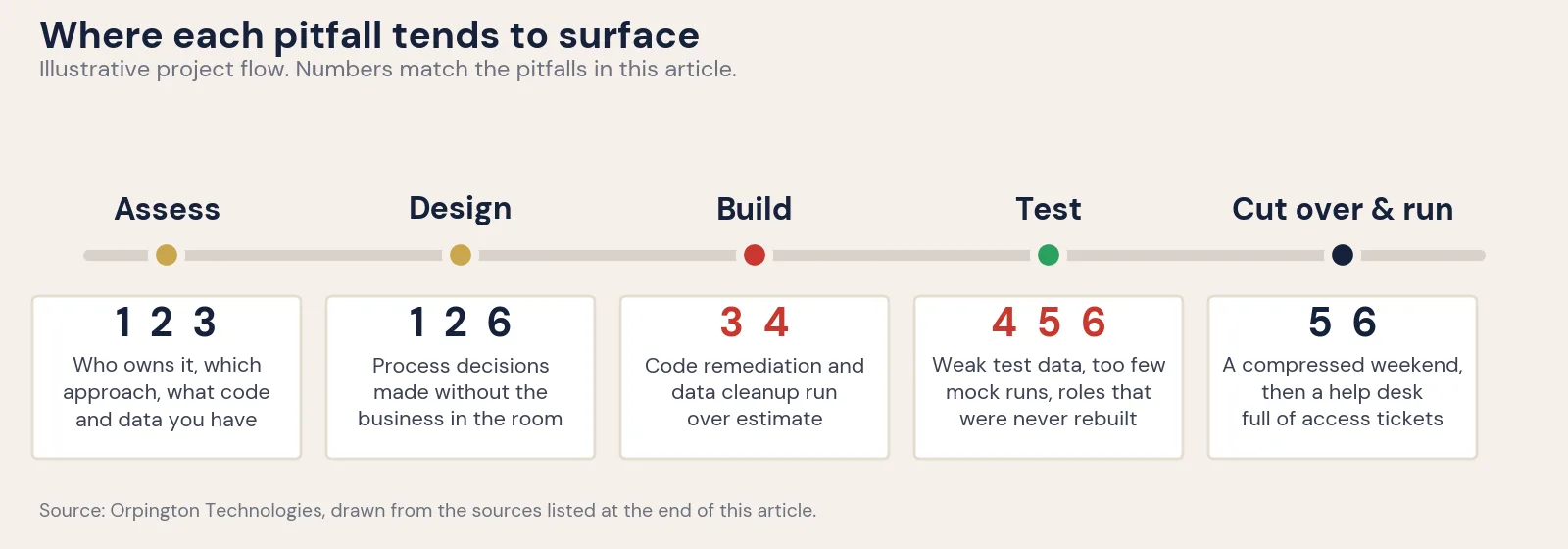
Read together, the six suggest a sequence. Assess first, before anyone commits to a plan: readiness
check, code scan, an honest look at the data. Choose the approach once you have seen the results, not
before. Run data cleanup and code remediation side by side, each with a named owner. Then put the
mock cycles and the test calendar into the plan before the build starts, and defend them when
something else slips.
Orpington Technologies | SAP S/4HANA Migration Insights
© Orpington Technologies Inc. www.orpingtontech.com
Page 3 of 4
check, code scan, an honest look at the data. Choose the approach once you have seen the results, not
before. Run data cleanup and code remediation side by side, each with a named owner. Then put the
mock cycles and the test calendar into the plan before the build starts, and defend them when
something else slips.
This is also how Orpington Technologies Inc. approaches SAP work. The Canadian ERP advisory and
delivery firm has built its SAP practice around one move, ECC to S/4HANA, and staffs it with a highly
trained team that does this kind of migration for a living: the readiness assessment, the code and data
work, the mock cycles, the cutover weekend. It plans backward from SAP-set deadlines, so the
questions in the table below get asked in the first weeks of a program rather than the fourteenth
month.
If you are not sure where your own program stands, a conversation is a reasonable place to start.
Orpington’s team will look at your production system, your code and your data with you, and tell you
plainly which of these six you are closest to, even when the honest answer is that you are in better
shape than you feared. You can reach them at www.orpingtontech.com. None of the six is hard to spot
in month one. They are just expensive to discover in month fourteen.
The six pitfalls at a glance
Pitfall
Where it bites
Question to ask early
1. IT-only project
Orpington’s team will look at your production system, your code and your data with you, and tell you
plainly which of these six you are closest to, even when the honest answer is that you are in better
shape than you feared. You can reach them at www.orpingtontech.com. None of the six is hard to spot
in month one. They are just expensive to discover in month fourteen.
Design decisions, user
acceptance
Who in the business owns each process area?
2. Approach by habit
Timeline, scope, testing load
acceptance
Have we compared greenfield, brownfield and
selective on our own data?
3. Unexamined custom code
Estimates, the build phase
Has the code scan run, and against real usage?
4. Messy master data
Data loads, first month-end
Who signs off the business partner merge?
5. Thin testing and cutover
Mock runs, go-live weekend
How many full mock cycles are in the plan?
6. Roles and training
Access, help desk, adoption
Are roles rebuilt for Fiori, not copied from ECC?
Sources & Further Reading
[1]
Panaya – “Planning Your SAP S/4HANA Migration: The 5 Common Mistakes ECC Customers Make,” February 2025
[2]
SAP Community – “SAP ECC to S/4HANA Migration: Lessons Learned, Pitfalls, and Proven Best Practices,” January 2026
[3]
Kellton – “SAP ECC to S/4HANA Migration Challenges Complete Guide,” April 2026
[4]
Entrans – “SAP ECC to S4HANA: Migration Steps, Challenges, and Solutions,” June 2026
[5]
SAP Help Portal – “Conversion Guide for SAP S/4HANA 2025,” version 2.0, February 2026
[6]
SAP Community – “SAP S/4HANA System Conversion – Custom Code Adaptation Process”
[7]
LeverX – “How to Choose an SAP S/4HANA Migration Strategy,” March 2026
[8]
CDQ – “Boost Data Quality for SAP S/4HANA: The Role of Customer Vendor Integration (SAP CVI),” April 2026
[9]
Quinnox – “SAP Data Migration Best Practices: Checklist for S/4HANA Projects,” June 2026
[10]
adesso – “Strategic Harmonization of Master Data: Business Partner Migration in the SAP S/4HANA Greenfield
Scenario”
[11]
DataLark – “Top 7 SAP S/4HANA Migration Challenges and How to Overcome Them,” November 2025
[12]
Datagaps – “Migrating to SAP S/4HANA: Material Master Test Automation,” June 2026
[13]
Synthesized – “From ECC to S/4HANA: How Better Test Data De-Risks Parallel Testing and Cutover,” May 2026
[14]
Quinnox – “SAP ECC to S/4HANA Migration Guide: 2026 Roadmap”
Orpington Technologies | SAP S/4HANA Migration Insights
© Orpington Technologies Inc. www.orpingtontech.com
Page 4 of 4
selective on our own data?