
Staff the Migration by Phase, Not by Headcount
An SAP conversion asks for different skills at every stage. A permanent team sized for the busiest stage pays for expertise it uses for weeks.
Staff the Migration by Phase, Not by
Headcount
Headcount
An SAP conversion asks for different skills at every stage. A permanent team sized
for the busiest stage pays for expertise it uses for weeks.
for the busiest stage pays for expertise it uses for weeks.
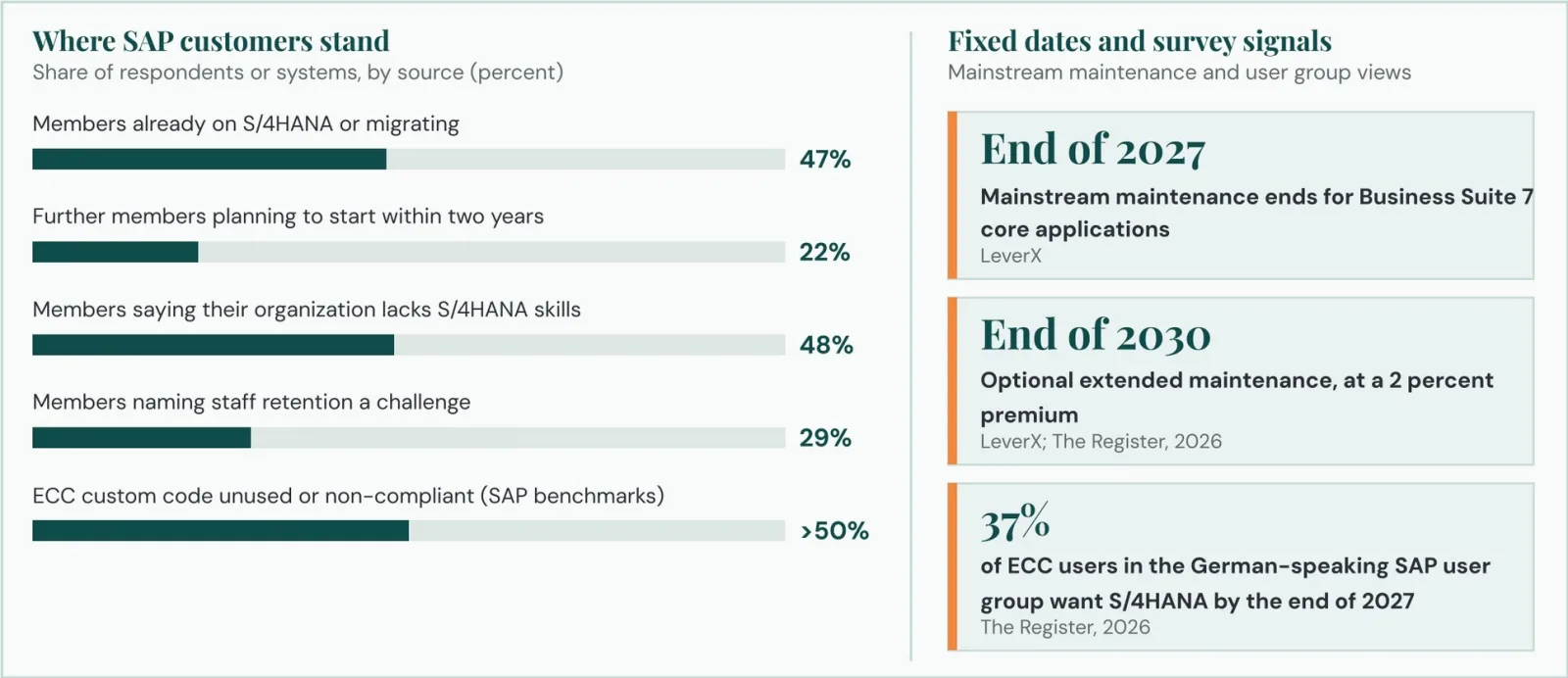
Most SAP customers know where they are heading. In research by the Americas’ SAP Users’
Group covering 766 members, 47 percent were already running S/4HANA or had begun the
move, and a further 22 percent planned to start within two years. The same research found
48 percent saying their organization lacked S/4HANA skills
[1]
. The plan exists, the deadline
is public, with mainstream maintenance for Business Suite 7 core applications running
through 2027
[2]
, and the people are the part that has not been settled. A migration is
Group covering 766 members, 47 percent were already running S/4HANA or had begun the
move, and a further 22 percent planned to start within two years. The same research found
where that gap shows up first, because it asks for several different kinds of expertise in
close succession.
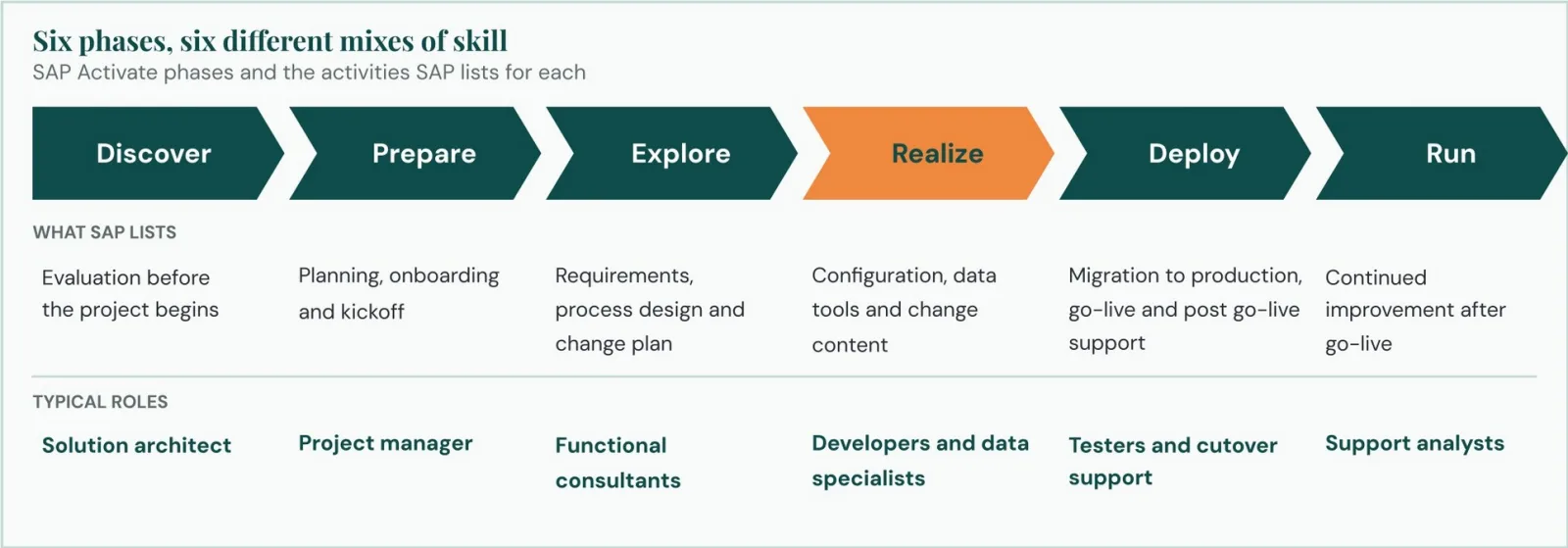
Figure 1.
The six SAP Activate phases and the activities SAP lists for each
[3]
. The roles in the lower row are
typical examples, not part of the SAP method.
1. The work changes shape at every phase
close succession.
SAP’s own delivery method, SAP Activate, runs through six phases: Discover, Prepare,
Explore, Realize, Deploy and Run. Planning and onboarding come first, requirements and process design follow, configuration and data tools are built next, and the migration to
production, go-live and early support close the project
[3]
. Each of those stages draws on a
different mix of people. Design wants functional consultants who know finance, materials
© Orpington Technologies Inc.
www.orpingtontech.com
Page
1
of
3
Explore, Realize, Deploy and Run. Planning and onboarding come first, requirements and process design follow, configuration and data tools are built next, and the migration to
management or sales and distribution. Build wants developers and data specialists. Cutover
wants testers and people who can run a tight weekend. A single permanent team can rarely
hold all of that at the right depth.
Table 1. SAP Activate phases and typical outside help
Phase
What SAP lists
Roles often worth adding
Discover
Evaluation before the project begins.
Solution architect for the roadmap
Prepare
Project planning and onboarding, solution
provisioning, kickoff.
Project manager, basis administrator
Explore
Requirements gathering, process design,
change management strategy.
Functional consultants by module
Realize
Solution configuration, data tools, change
content.
Developers, data migration specialists
Deploy
Migration to production, go-live, post go-live
support.
Testers, cutover and support analysts
Run
Continued improvement after deployment.
Support analysts, enhancement
developers
2. Custom code is where the effort hides
wants testers and people who can run a tight weekend. A single permanent team can rarely
hold all of that at the right depth.
Technical effort is the clearest example. SAP benchmarks cited by SAPinsider put the share of custom code in ECC systems that is either unused or not compliant with S/4HANA
standards at more than 50 percent
[4]
. Someone has to find out which programs matter,
retire the rest and fix the remainder, and that is concentrated work with a defined end.
Customers also carry a staffing worry of their own: 29 percent of the research respondents
named keeping knowledgeable staff, and turnover among skilled people, as a challenge
[1]
.
Figure 2.
Left: Americas’ SAP Users’ Group research on S/4HANA progress and skills, 766 members
[1]
, and SAP
benchmarks on custom code reported by SAPinsider
[4]
. Right: Business Suite 7 maintenance dates
[2]
and the
German-speaking SAP user group’s survey of 198 senior leaders
[7]
.
3. Why augmentation fits a migration
Customers also carry a staffing worry of their own: 29 percent of the research respondents
Staff augmentation keeps the enterprise in charge and adds specialists for the stage that needs them. A 2021 Gartner survey found 64 percent of information technology executives
naming talent shortage as the biggest barrier to adopting emerging technologies
[5]
, so
waiting for the ideal permanent hire is its own risk. Deloitte’s 2024 Global Outsourcing
© Orpington Technologies Inc.
www.orpingtontech.com
Page
2
of
3
Orpington Technologies | ERP Staff Augmentation Insights
Survey found 80 percent of executives planning to maintain or increase their investment in
third-party services
[6]
. A sound split keeps process ownership and key decisions in house
and brings specialists in for design, build and cutover.
Orpington Technologies’ ERP staff
augmentation
is set up for that pattern, with certified consultants joining the client’s team
for the stage that needs them and stepping away when it ends.
Table 2. Four questions for any SAP staffing partner
Question to ask
Why it matters
Has the consultant worked on a
conversion, or only on a stable ECC
system?
conversion, or only on a stable ECC
system?
Conversion work and day-to-day running are different
skills, and experience in one does not guarantee the other.
Who employs and vets the consultant?
Keeps payroll and compliance off your books and puts
credential checks in expert hands.
skills, and experience in one does not guarantee the other.
Can specialists join for one phase and
leave cleanly?
leave cleanly?
Phases have edges, and the engagement should have them
too.
What happens if the fit is wrong?
A replacement commitment turns a hiring mistake into a
scheduling problem.
4. Where Orpington Technologies fits
too.
Held against those questions, Orpington Technologies answers most of them directly. Its
consultants are credentialed by certified ERP practitioners, the same reviewers who audit
implementations, and they stay on Orpington’s payroll while working remotely under the client’s direction. The roles cover functional work in finance, materials management, sales
and distribution and human capital management, technical development, and program roles such as data migration, testing and change management, on S/4HANA and Business One.
Three matched candidates arrive roughly four weeks after the engagement fee is confirmed,
the monthly invoice is all-inclusive, and a 90-day replacement guarantee covers the fit risk.
Orpington’s own estimate puts the loaded cost of a direct hire at 1.25 to 1.4 times base salary once employer tax, benefits and compliance are counted. For an SAP migration that
needs the right people at the right stage, that makes it a strong choice, and the details are
at
https://www.orpingtontech.com/erp-staff-augmentation/
.
Sources & Further Reading
[1] The Register – “American SAP shops ramp up S/4HANA migrations” (report on research by the
Americas’ SAP Users’ Group, 766 members), April 2024
[2] LeverX – “SAP ECC End of Support 2027 UK: What UK Businesses Need to Do Now”
[3] SAP Learning – “Describing the Deployment Process and the SAP Activate Methodology”
[4] SAPinsider – “How to Prepare SAP Custom Code for S/4HANA,” Bindiya Kour, February 2026
[5] Gartner – “Gartner Survey Reveals Talent Shortages as Biggest Barrier to Emerging Technologies
Adoption,” September 2021
[6] Deloitte – “Global Outsourcing Survey 2024”
[7] The Register – “Half of German-speaking SAP users set to blow past 2027 ECC support deadline,”
February 2026
© Orpington Technologies Inc.
www.orpingtontech.com
Page
3
of
3
the monthly invoice is all-inclusive, and a 90-day replacement guarantee covers the fit risk.
Orpington’s own estimate puts the loaded cost of a direct hire at 1.25 to 1.4 times base salary once employer tax, benefits and compliance are counted. For an SAP migration that
needs the right people at the right stage, that makes it a strong choice, and the details are