
Testing Is the Bottleneck: Why Regression Testing Decides When You Can Cut Over
Regression testing is the workstream that most often decides whether a migration hits its cutover date, and with SAP's mainstream maintenance for ECC ending December 31, 2027, there's less room than most programs assume to let it slip, even with AI-assisted tools helping compress the cycle.
Testing Is the Bottleneck: Why
Regression Testing Decides When You
Can Cut Over
Regression Testing Decides When You
Can Cut Over
Regression testing is the workstream that most often decides whether a migration hits
its cutover date, and with SAP's mainstream maintenance for ECC ending December
31, 2027, there's less room than most programs assume to let it slip, even with
AI-assisted tools helping compress the cycle.
7 min read | Orpington Technologies Insights
its cutover date, and with SAP's mainstream maintenance for ECC ending December
31, 2027, there's less room than most programs assume to let it slip, even with
AI-assisted tools helping compress the cycle.
SAP's mainstream maintenance for ECC ends December 31, 2027. Beyond that date, the safety net
most customers have relied on for two decades starts to fray: patches slow down, and the pool of
consultants and specialized tooling built around ECC thins out as the installed base moves on to
S/4HANA. Staying on ECC past the deadline doesn't just mean losing vendor support. It means
competing for a shrinking pool of people who still know the platform well.
That deadline puts pressure on every phase of a migration, but one workstream absorbs more of that
pressure than any other: regression testing. Every S/4HANA conversion runs into the same wall.
Everything that used to work in ECC has to be proven to still work in the new system, or deliberately
changed and re-validated, across every business process the company actually runs. It's consistently
the phase where timelines slip hardest, because the volume of test coverage required doesn't shrink just
because the schedule is tight. AI-assisted test generation can shorten that cycle for teams that use it,
but it doesn't change the underlying math of how much needs to be proven correct before go-live.
Why Testing Is the Bottleneck Almost Everyone Names
pressure than any other: regression testing. Every S/4HANA conversion runs into the same wall.
Everything that used to work in ECC has to be proven to still work in the new system, or deliberately
changed and re-validated, across every business process the company actually runs. It's consistently
the phase where timelines slip hardest, because the volume of test coverage required doesn't shrink just
because the schedule is tight. AI-assisted test generation can shorten that cycle for teams that use it,
but it doesn't change the underlying math of how much needs to be proven correct before go-live.
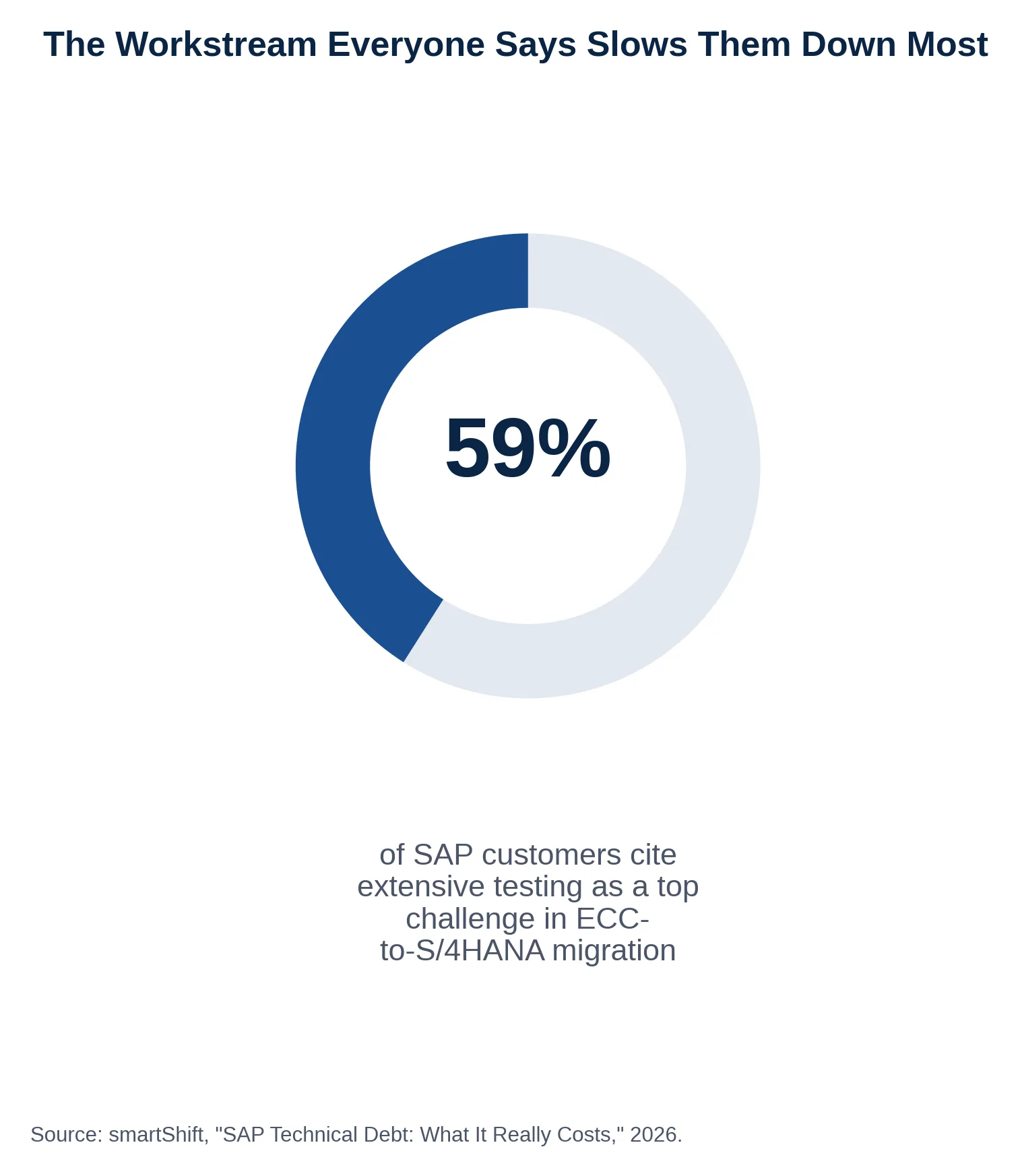
smartShift's research puts a number on what's otherwise a common but anecdotal complaint: 59% of
SAP customers cite extensive testing as a top challenge in migrating to S/4HANA. That figure lines up
with the broader research on why migrations run long. Testing is where custom code decisions, data
Page 1 of 4
SAP customers cite extensive testing as a top challenge in migrating to S/4HANA. That figure lines up
with the broader research on why migrations run long. Testing is where custom code decisions, data
 Orpington Technologies | SAP S/4HANA Migration Insights
© Orpington Technologies Inc. www.orpingtontech.com
quality issues, and fit-gap judgment calls all converge, and where they have to be proven correct against
real transactions, not just reviewed on paper.
real transactions, not just reviewed on paper.
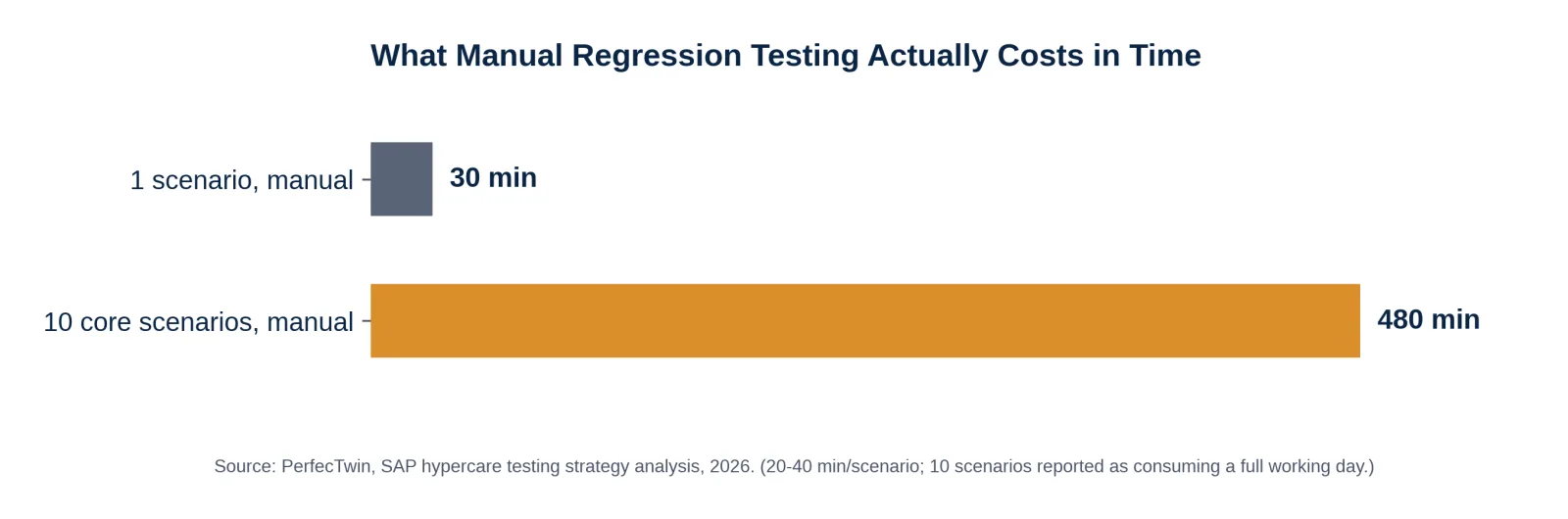
The scale of manual regression testing is part of why it bottlenecks so reliably. Analysis from PerfecTwin
on SAP hypercare and testing cycles finds that a single manual end-to-end test scenario takes 20 to 40
minutes to execute properly. Ten core scenarios (a modest regression suite by the standards of most
enterprise SAP landscapes) consume a full working day. Enterprise S/4HANA programs routinely need
to validate hundreds of scenarios across finance, logistics, and industry-specific processes. That's
where the math stops working on a fixed project timeline, unless someone either cuts test coverage or
automates it.
What It Takes to Stop Testing From Eating the Schedule
on SAP hypercare and testing cycles finds that a single manual end-to-end test scenario takes 20 to 40
minutes to execute properly. Ten core scenarios (a modest regression suite by the standards of most
enterprise SAP landscapes) consume a full working day. Enterprise S/4HANA programs routinely need
to validate hundreds of scenarios across finance, logistics, and industry-specific processes. That's
where the math stops working on a fixed project timeline, unless someone either cuts test coverage or
automates it.
Most programs underestimate testing for a simple reason: it looks like the last step, so it gets planned
like one. Budgets and timelines get set during blueprinting and build, when data migration and code
remediation are the visible work. Testing scope only becomes clear once the team can see the actual
list of business processes that need validating, by which point the schedule is already fixed. That
mismatch, more than any single technical issue, is why testing so often becomes the phase that
determines the go-live date rather than a phase that simply follows it.
The fix starts well before any test is executed. Programs that hold their cutover dates tend to scope
testing early, staff it with people who understand the business processes being validated, and treat the
resulting test plan as a real constraint on the schedule rather than something to compress later.
Skipping that discipline is what turns testing into the phase everyone blames when a go-live date slips,
when the real cause was a plan built without it.
For teams with the discipline in place, AI-assisted tools can meaningfully compress the work itself.
Models trained on a system's transaction history can generate candidate test scenarios automatically,
Page 2 of 4
Models trained on a system's transaction history can generate candidate test scenarios automatically,
 Orpington Technologies | SAP S/4HANA Migration Insights
© Orpington Technologies Inc. www.orpingtontech.com
and automated execution engines can then run them in parallel, cutting the 20-to-40-minute manual
execution time PerfecTwin's analysis describes down to seconds per case, the same shift software
teams made with continuous integration, applied to an SAP landscape. SAVIC Technologies found
efficiency gains of 25 to 40% in high-readiness environments using this approach, dropping to 10 to
20% where test documentation was less mature going in. That gap is the point: the tooling speeds up a
well-scoped testing plan, it doesn't produce one.
Time cost of manual regression testing at small scale, before multiplying it across a full enterprise test suite.
What Still Needs Human Judgment
execution time PerfecTwin's analysis describes down to seconds per case, the same shift software
teams made with continuous integration, applied to an SAP landscape. SAVIC Technologies found
efficiency gains of 25 to 40% in high-readiness environments using this approach, dropping to 10 to
20% where test documentation was less mature going in. That gap is the point: the tooling speeds up a
well-scoped testing plan, it doesn't produce one.
Automated execution is only as trustworthy as the scenarios and expected results it's checking against.
Building that initial library of validated scenarios, particularly for business-critical or highly customized
processes, still benefits from experienced testers who understand what "correct" actually looks like for a
given process. That includes edge cases a model trained on historical transaction patterns may never
have seen. AI-generated test cases are best treated as a strong first draft, one that shortens the path to
a validated test suite. They don't replace the people who know the business processes being tested.
Where This Leaves You
Building that initial library of validated scenarios, particularly for business-critical or highly customized
processes, still benefits from experienced testers who understand what "correct" actually looks like for a
given process. That includes edge cases a model trained on historical transaction patterns may never
have seen. AI-generated test cases are best treated as a strong first draft, one that shortens the path to
a validated test suite. They don't replace the people who know the business processes being tested.
With the 2027 deadline fixed and the support available for ECC shrinking every quarter, the programs
that hit their cutover date are the ones that scope testing honestly and early rather than treating it as
whatever time is left at the end. Orpington Technologies reviews test strategy and coverage as a
standard part of its ERP Diagnostic work, whether the migration is being delivered by Orpington directly
or by another partner under independent oversight. That review draws on migration delivery experience
across finance, logistics, and industry-specific SAP processes, and on AI-assisted testing tools where
they genuinely shorten the timeline, as one part of a broader plan for protecting a 2027 go-live date.
Learn more about Orpington's approach at orpingtontech.com.
Sources & Further Reading
[1]
smartShift — SAP Technical Debt: What It Really Costs and How to Measure It in Custom Code
Page 3 of 4
that hit their cutover date are the ones that scope testing honestly and early rather than treating it as
whatever time is left at the end. Orpington Technologies reviews test strategy and coverage as a
standard part of its ERP Diagnostic work, whether the migration is being delivered by Orpington directly
or by another partner under independent oversight. That review draws on migration delivery experience
across finance, logistics, and industry-specific SAP processes, and on AI-assisted testing tools where
they genuinely shorten the timeline, as one part of a broader plan for protecting a 2027 go-live date.
Learn more about Orpington's approach at orpingtontech.com.
Orpington Technologies | SAP S/4HANA Migration Insights
© Orpington Technologies Inc. www.orpingtontech.com
[2]
PerfecTwin — SAP Hypercare Testing Strategy: How to Cut Your Stabilization Period in Half
[3]
SAVIC Technologies — SAP AI ROI: Real Numbers, Enterprise Reality Check, 2026
Page 4 of 4