
Testing Is the Bottleneck: Why Regression Testing Decides When You Can Cut Over
 Orpington Technologies | SAP S/4HANA Migration Insights
© Orpington Technologies Inc.
www.orpingtontech.com
Orpington Technologies | SAP S/4HANA Migration Insights
© Orpington Technologies Inc.
www.orpingtontech.com
quality issues, and fit-gap judgment calls all converge, and where they have to be proven correct against real transactions, not just reviewed on paper.
The scale of manual regression testing is part of why it bottlenecks so reliably. Analysis from PerfecTwin on SAP hypercare and testing cycles finds that a single manual end-to-end test scenario takes 20 to 40 minutes to execute properly. Ten core scenarios (a modest regression suite by the standards of most enterprise SAP landscapes) consume a full working day. Enterprise S/4HANA programs routinely need to validate hundreds of scenarios across finance, logistics, and industry-specific processes. That's where the math stops working on a fixed project timeline, unless someone either cuts test coverage or automates it.
What It Takes to Stop Testing From Eating the Schedule
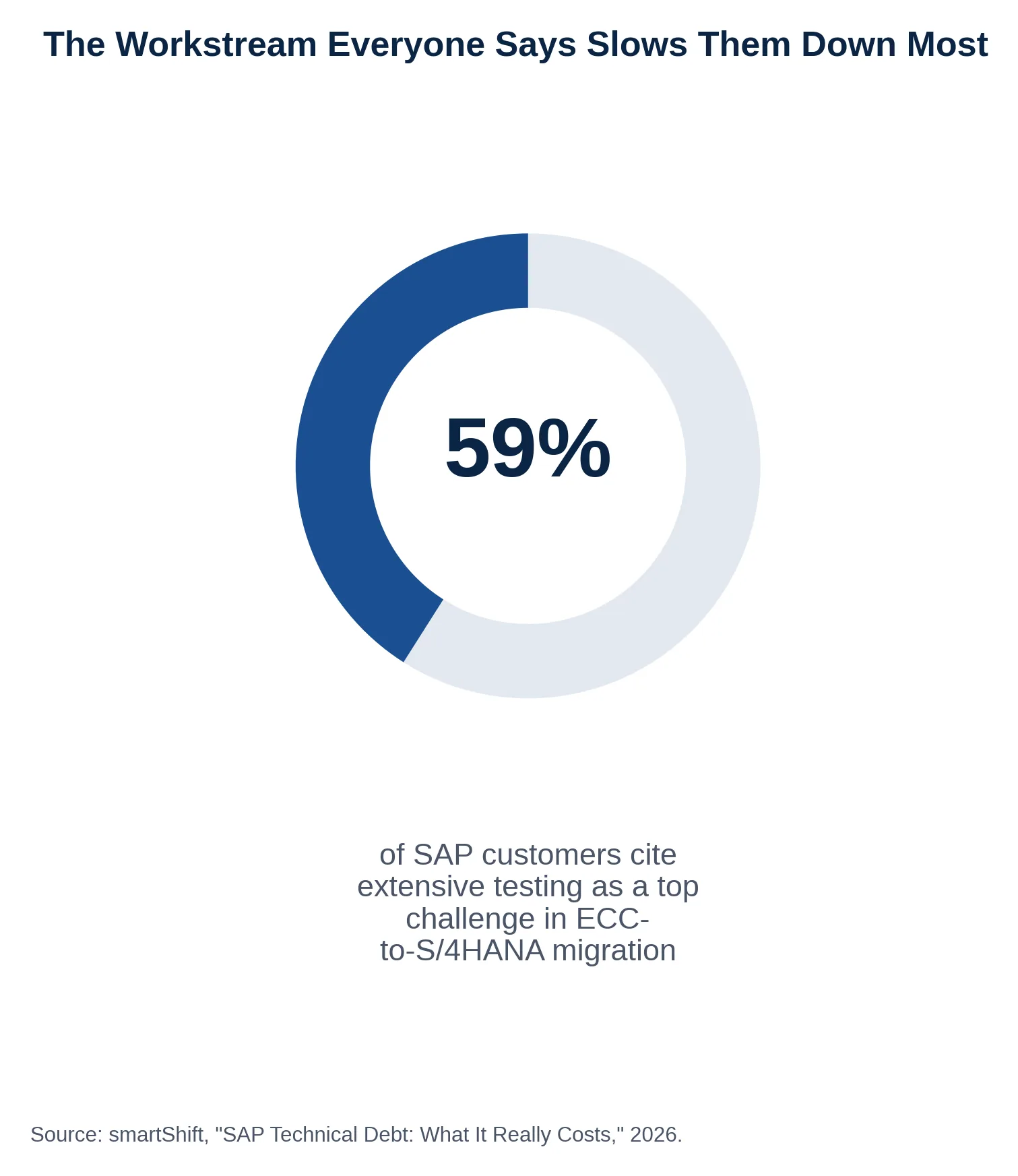
Most programs underestimate testing for a simple reason: it looks like the last step, so it gets planned like one. Budgets and timelines get set during blueprinting and build, when data migration and code remediation are the visible work. Testing scope only becomes clear once the team can see the actual list of business processes that need validating, by which point the schedule is already fixed. That mismatch, more than any single technical issue, is why testing so often becomes the phase that determines the go-live date rather than a phase that simply follows it.
The fix starts well before any test is executed. Programs that hold their cutover dates tend to scope testing early, staff it with people who understand the business processes being validated, and treat the resulting test plan as a real constraint on the schedule rather than something to compress later. Skipping that discipline is what turns testing into the phase everyone blames when a go-live date slips, when the real cause was a plan built without it.
For teams with the discipline in place, AI-assisted tools can meaningfully compress the work itself. Models trained on a system's transaction history can generate candidate test scenarios automatically,
Page 2 of 4