
The December 2027 Deadline: What Actually Ends, and What Doesn't
SAP's mainstream maintenance clock on ECC is not a rumour or a negotiating tactic. Here is exactly what stops, what survives, and why the calendar matters more than most IT roadmaps admit.

The December 2027 Deadline: What Actually
Ends, and What Doesn't
Ends, and What Doesn't
SAP's mainstream maintenance clock on ECC is not a rumour or a negotiating tactic. Here is exactly what stops, what survives, and why the calendar matters more than most IT roadmaps admit.
If you have sat through more than one SAP planning meeting in the last year, you have probably heard someone say the 2027 deadline “might get pushed back again.” It is an understandable hope — SAP has moved this date before. But every recent statement from SAP, and every analyst tracking the program, says the same thing: mainstream maintenance for SAP ERP 6.0 (ECC) on enhancement packages 6 through 8 ends on December 31, 2027, and the vendor has been unusually blunt about this one being final.
It helps to be precise about what “end of mainstream maintenance” actually means, because the phrase gets thrown around loosely. It does not mean SAP flips a switch and ECC stops
running on January 1, 2028. Your system will still boot, your batch jobs will still fire, your users will still log in. What disappears is everything SAP does behind the scenes to keep that system current: new support packages, legal and regulatory change packages that keep tax tables,
payroll rules and statutory reporting compliant, and standard-priority fixes for newly discovered bugs and security vulnerabilities.
© Orpington Technologies Inc.
www.orpingtontech.com
Page
1
of
3
running on January 1, 2028. Your system will still boot, your batch jobs will still fire, your users will still log in. What disappears is everything SAP does behind the scenes to keep that system current: new support packages, legal and regulatory change packages that keep tax tables,
payroll rules and statutory reporting compliant, and standard-priority fixes for newly discovered bugs and security vulnerabilities.
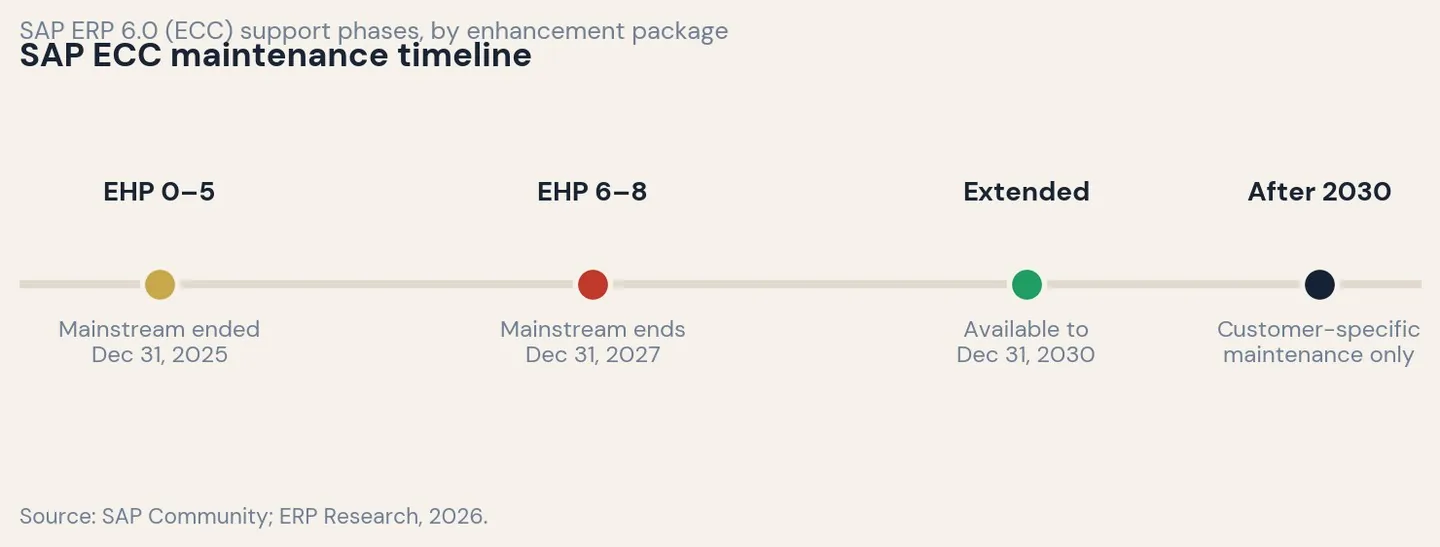
There is also an earlier deadline that catches people off guard. If your ECC system is still running enhancement package 0 through 5, mainstream maintenance for that release already
ended on December 31, 2025. Those systems moved automatically into what SAP calls customer-specific maintenance — a thinner tier that covers already-known issues but delivers no new legal updates or fixes at all. More than a few organizations are surprised to learn they crossed that line months ago, simply because nobody got around to applying a later enhancement package.
ended on December 31, 2025. Those systems moved automatically into what SAP calls customer-specific maintenance — a thinner tier that covers already-known issues but delivers no new legal updates or fixes at all. More than a few organizations are surprised to learn they crossed that line months ago, simply because nobody got around to applying a later enhancement package.
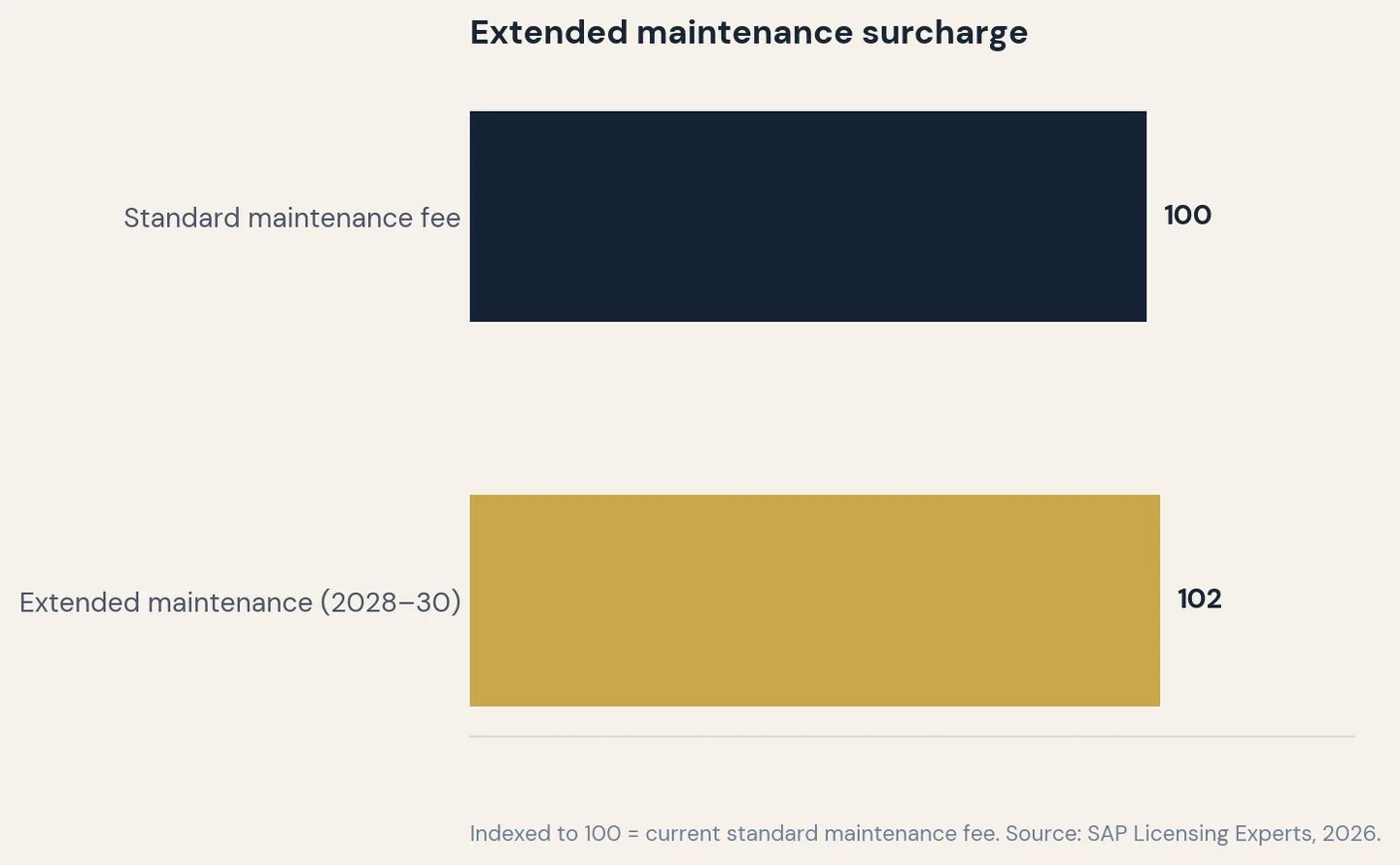
For everyone on EHP 6–8, SAP does offer a bridge: extended maintenance, running from January 1, 2028 through December 31, 2030, at a surcharge of roughly two additional percentage points on top of existing maintenance fees. For a company mid-migration, it can be
the difference between finishing calmly and finishing in a panic. SAP has been explicit, though, that this is a bridge and not a destination — it must be elected in advance, and organizations are advised to complete that paperwork by Q3 2027, ahead of the mainstream deadline itself.
the difference between finishing calmly and finishing in a panic. SAP has been explicit, though, that this is a bridge and not a destination — it must be elected in advance, and organizations are advised to complete that paperwork by Q3 2027, ahead of the mainstream deadline itself.
What happens after 2030 is the part that deserves real attention. There is no further extended tier. What remains is customer-specific maintenance, permanently: the same price as standard
support, none of its scope. No new legal change packages, no new security patches for vulnerabilities discovered after that point, no guaranteed response times. It is support in name only, structured to be uncomfortable enough that almost nobody chooses it as a destination
rather than a last resort.
© Orpington Technologies Inc.
www.orpingtontech.com
Page
2
of
3
support, none of its scope. No new legal change packages, no new security patches for vulnerabilities discovered after that point, no guaranteed response times. It is support in name only, structured to be uncomfortable enough that almost nobody chooses it as a destination
rather than a last resort.
Orpington Technologies | SAP S/4HANA Migration Insights
None of this calls for panic. It calls for a plan with real dates on it, built backward from December 2027 rather than forward from “whenever we get to it.” A useful first step, before a single line of a migration business case gets written, is simply confirming which enhancement package your production system is actually running — not which one everyone assumes it's
running. It is common for a mid-planning review to uncover that the real deadline sits two years
earlier than the one on the roadmap slide.
running. It is common for a mid-planning review to uncover that the real deadline sits two years
earlier than the one on the roadmap slide.
Firms that specialize in this transition see the pattern constantly: the organizations that treat the date as fixed and start scoping early are the ones who get to choose their migration
approach on their own terms, rather than have it chosen for them by a shrinking calendar. Orpington Technologies Inc., a Canadian ERP advisory and delivery firm, has built its SAP practice around exactly this kind of backward planning from SAP-set deadlines, which tends to be the difference between an orderly 18-month program and a rushed six-month scramble.
approach on their own terms, rather than have it chosen for them by a shrinking calendar. Orpington Technologies Inc., a Canadian ERP advisory and delivery firm, has built its SAP practice around exactly this kind of backward planning from SAP-set deadlines, which tends to be the difference between an orderly 18-month program and a rushed six-month scramble.
The date is not moving this time. The only real question left is how many of the decisions between now and then you make deliberately — and how many get made for you by the calendar.
What changes at each maintenance stage
Stage
Ends
What you lose
Mainstream (EHP 0–5)
Dec 31, 2025 (already passed)
New fixes, legal updates,
standard support
Mainstream (EHP 6–8)
Dec 31, 2027
New fixes, legal updates,
standard support
Extended maintenance
Dec 31, 2030 (EHP 6–8 only,
+~2% fee)
New product enhancements
Customer-specific maintenance
No fixed end date
Everything except known-issue
guidance
Sources & Further Reading
[1]
SAP Community – “Maintenance Timelines for SAP ERP 6.0 (‘ECC’)”, 2026
[2]
ERP Research – “SAP ECC 6.0 End of Support: 2027 & 2030,” July 2026
[3]
SoftwareSeni – “The Complete Guide to SAP ECC End of Support and What Comes Next,”
March 2026
© Orpington Technologies Inc.
www.orpingtontech.com
Page
3
of
3