
What ASUG's Latest Survey Reveals About Real-World Migrations
The American SAP Users Group talks to the people actually running these programs. Its most recent member research is a useful reality check against vendor talking points.

What ASUG's Latest Survey Reveals About
Real-World Migrations
Real-World Migrations
The American SAP Users Group talks to the people actually running these programs. Its most recent member research is a useful reality check against vendor talking points.
Vendor conference keynotes tend to describe SAP migrations in fairly triumphant terms. The
American SAP Users Group's member research is a useful corrective, because it asks the people actually doing the work rather than the people selling it. Its most recent report, developed with BearingPoint from 168 ASUG member responses, gives one of the more
grounded snapshots available of where organizations really stand.
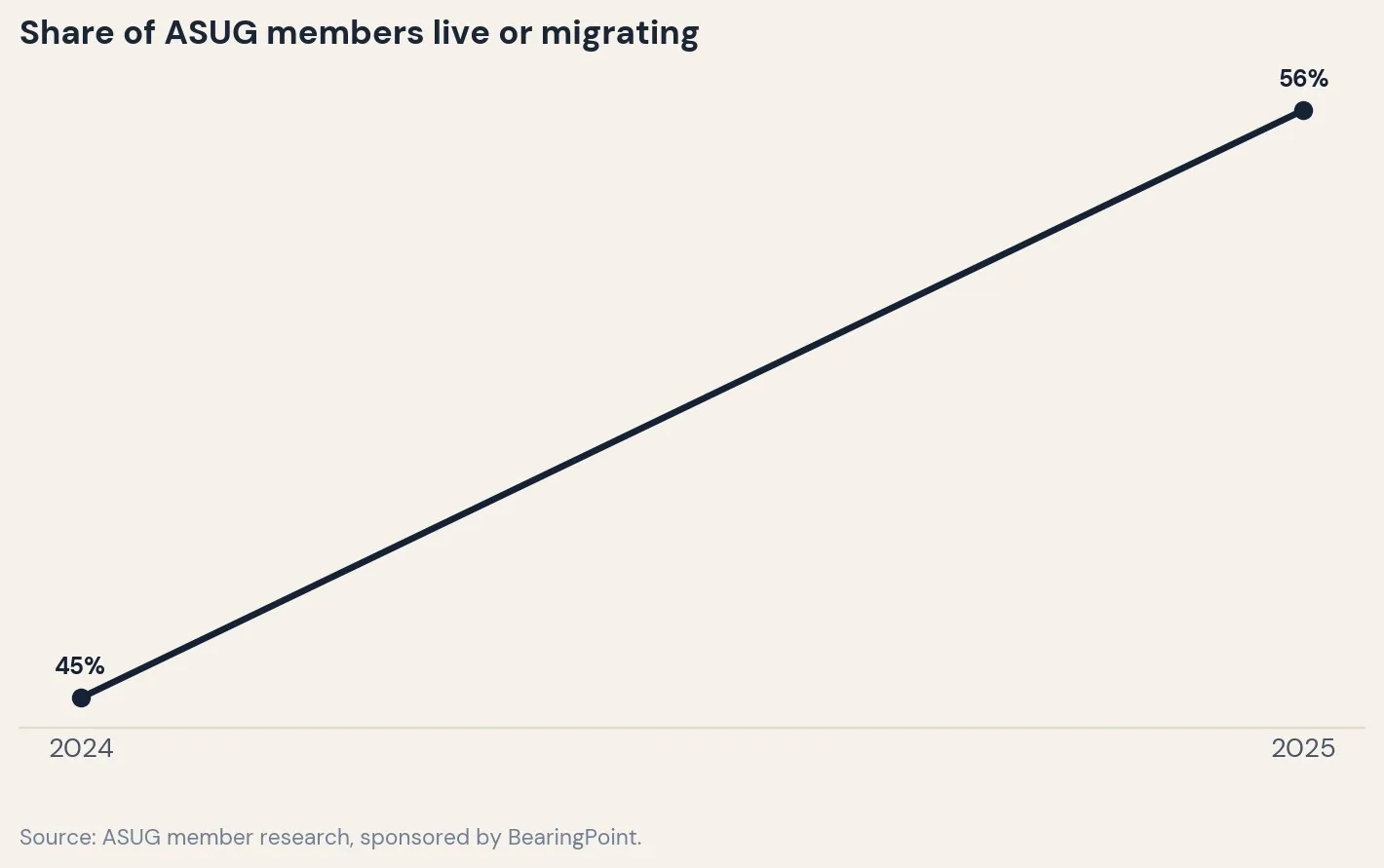
The headline number is genuine progress: 56% of ASUG members were, at the time of the
survey, either live on S/4HANA or actively in the process of moving — an 11-percentage-point increase over the year before. A separate Precisely/ASUG survey released a few months later found 59% of organizations fully or partially live, up 13 points from 2024. Both numbers point
the same direction: momentum is real and it is accelerating as 2027 approaches, even if the base of already-migrated organizations remains well under two-thirds.
© Orpington Technologies Inc.
www.orpingtontech.com
Page
1
of
3
survey, either live on S/4HANA or actively in the process of moving — an 11-percentage-point increase over the year before. A separate Precisely/ASUG survey released a few months later found 59% of organizations fully or partially live, up 13 points from 2024. Both numbers point
the same direction: momentum is real and it is accelerating as 2027 approaches, even if the base of already-migrated organizations remains well under two-thirds.
The survey's numbers on project duration are worth internalizing before setting a schedule: SAP
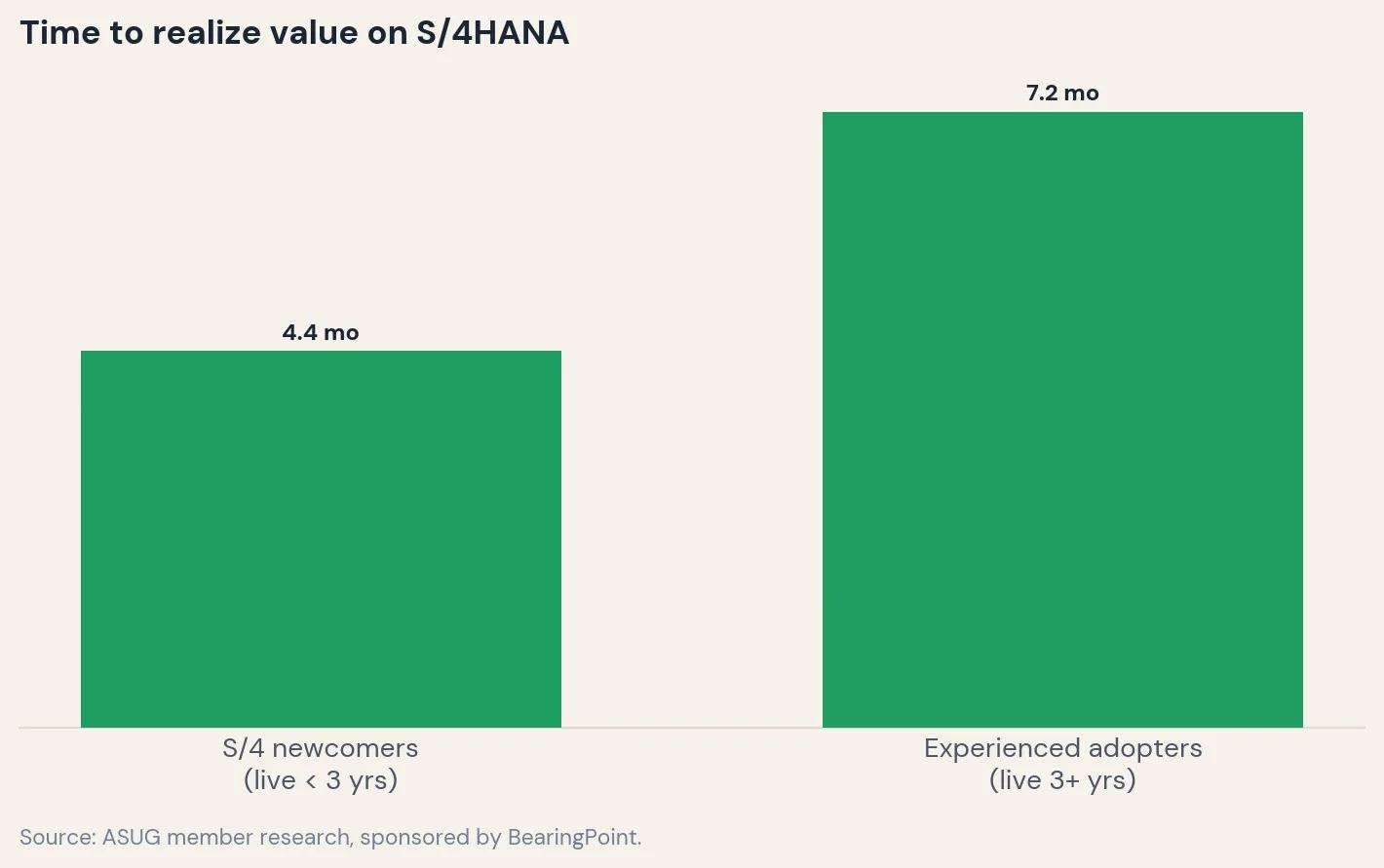
S/4HANA transitions took an average of one and a half years among those surveyed. That is a useful planning anchor, but it comes with a caveat the report itself highlights — organizations live on S/4HANA for more than three years (“pros,” in the report's framing) actually took longer
to realize business value from the system than more recent “S/4 newcomers” did: 7.2 months
versus 4.4 months respectively. Better tooling, clearer onboarding and more shared best practice across the SAP community appear to be compressing the value-realization curve for
organizations migrating now, relative to early adopters who had to find their own way.
Cost predictability also showed real improvement year over year. Only 31% of respondents reported costs exceeding expectations, an 18-percentage-point improvement from 2024,
while 34% reported costs landing in line with expectations, up 11 points. That is a genuinely encouraging trend, and it likely reflects a maturing market: more experienced system
integrators, better-understood pricing models, and organizations doing more thorough scoping
before committing to a number.
© Orpington Technologies Inc.
www.orpingtontech.com
Page
2
of
3
while 34% reported costs landing in line with expectations, up 11 points. That is a genuinely encouraging trend, and it likely reflects a maturing market: more experienced system
integrators, better-understood pricing models, and organizations doing more thorough scoping
before committing to a number.
Orpington Technologies | SAP S/4HANA Migration Insights
Risk factors identified in the survey cluster around a familiar theme: people and process, not technology. Forty-three percent of respondents cited change management — training and
user adoption — as a project risk, and 57% recommended starting change management work early, itself up 7 points from the prior year's survey. The single most commonly cited risk overall was having too many customizations complicating the migration journey, which echoes
findings from other research covered elsewhere in this series about the cost of over-
customized legacy environments.
Demand for outside help is also rising in step with the deadline. More ASUG members reported
hiring system integrators to support their migrations, describing SI engagement as the largest single cost category associated with the project — a trend consistent with the broader talent-
market tightening discussed elsewhere in this research, and one more reason early engagement with an experienced delivery partner tends to pay for itself.
Firms working in this space read surveys like ASUG's closely for exactly this reason. Orpington
Technologies Inc., the Canadian SAP advisory and delivery firm, structures its own migration methodology around the risk factors this kind of member research consistently surfaces — early change management, disciplined customization review, and realistic value-realization
timelines rather than optimistic ones.
Vendor talking points describe the destination. Survey data like ASUG's describes the actual road, potholes included — and it is a far more useful map to plan a migration by.
ASUG member research, key findings
Metric
Figure
Live or in process of moving to S/4HANA (2025)
56% (+11 pts vs. 2024)
Average migration duration
~1.5 years
Value realization time – recent “newcomers”
4.4 months
Value realization time – organizations live 3+
years
7.2 months
Costs exceeding expectations
31% (–18 pts vs. 2024)
Recommend starting change management early
57% (+7 pts vs. 2024)
Sources & Further Reading
[1]
ASUG – “SAP S/4HANA Adoption Trends, Insights, and Advice,” 2026 (sponsored by
BearingPoint)
[2]
ASUG – “The State of SAP S/4HANA Adoption: Trends, Successes, and Challenges”
© Orpington Technologies Inc.
www.orpingtontech.com
Page
3
of
3
years