
Industry Spotlight: Oracle Fusion Cloud ERP in Retail, Distribution, and Professional Services
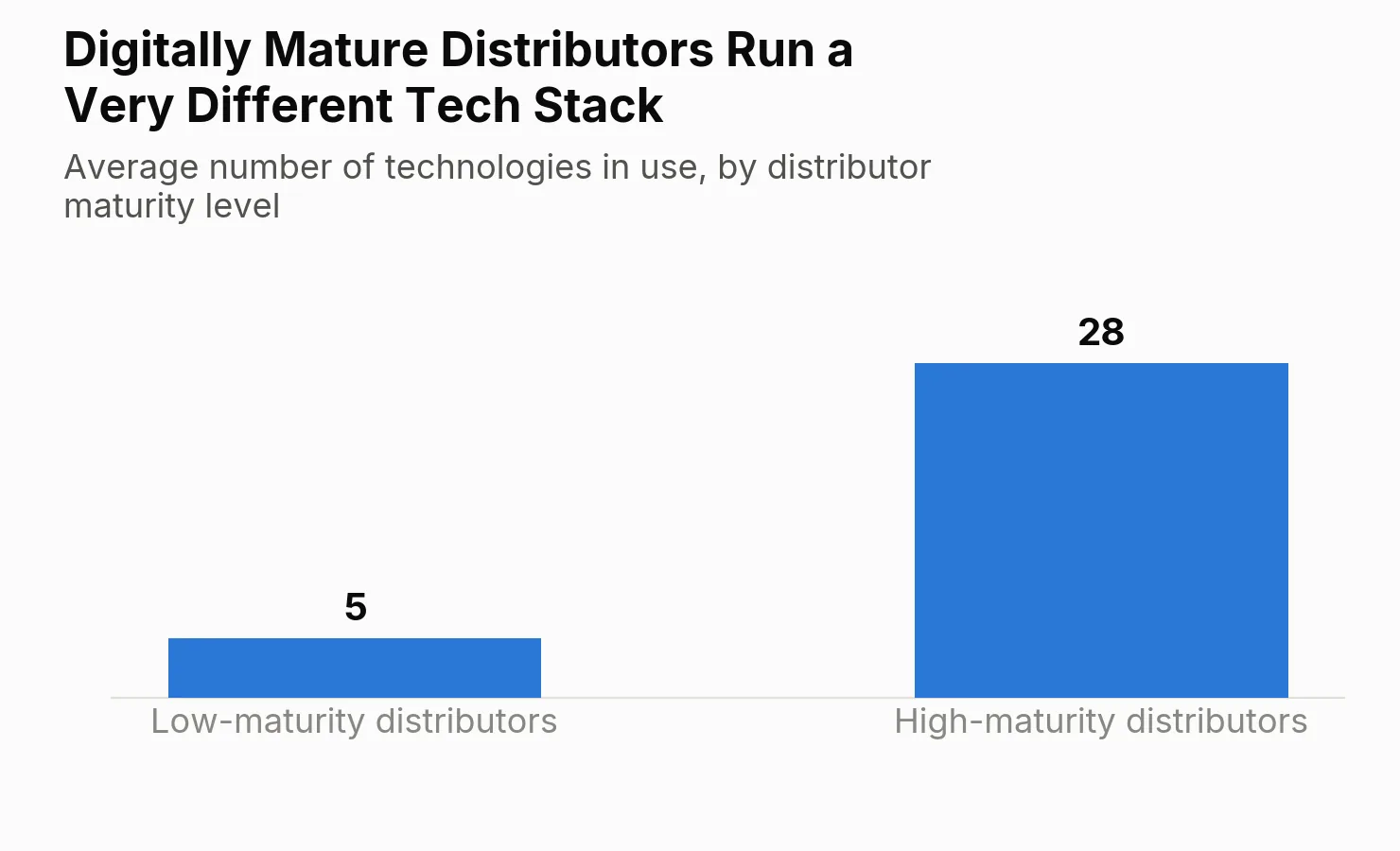
ERP, CRM, eCommerce, and analytics without ever fully integrating them, which tracks closely with the broader integration challenges covered earlier in this series.
Digital maturity in distribution correlates strongly with the breadth of an integrated technology stack, not just spending on
individual tools. Source: Xorosoft, 2026.
Warehouse management adoption sits at roughly 50% among surveyed distributors, but more advanced capability lags well behind that: RFID adoption is around 13%, and AI-driven warehouse management sits below 2%, even though nearly half of distributors identify warehouse automation as an important use case for AI going forward. For a distributor evaluating Oracle Fusion Cloud specifically, the practical implication is that the ERP's native supply chain and inventory capabilities need to genuinely integrate with whatever warehouse management system is in place, rather than duplicating or conflicting with it — getting that boundary right is one of the more consequential configuration decisions a distributor will make during implementation.
B2B eCommerce has also become close to universal rather than a differentiator: 71% of B2B companies now offer eCommerce, and among those that do, online sales represent 34% of total revenue on average. Buyers have adapted accordingly, now using an average of 10 different interaction channels with suppliers, up from just 5 in 2016 — meaning a distributor's ERP needs to support a genuinely omnichannel sales and fulfillment model, not treat digital ordering as a side channel bolted onto a traditional sales process.
55%
of distributors have invested in core systems like ERP, CRM, and eCommerce without fully integrating them — meaning the technology investment already exists at most companies; the return on it is what's still missing.
Source: Xorosoft / Distribution Strategy Group, 2026
© Orpington Technologies Inc. www.orpingtontech.com
Page No. 2 of 4