
Industry Spotlight: Oracle Fusion Cloud ERP in Retail, Distribution, and Professional Services
A generic description of "what an ERP does" tends to undersell how differently the same platform actually gets used across industries. A distributor's core challenge is inventory velocity and fulfillment accuracy across many SKUs and locations.
 ORACLE FUSION CLOUD ERP FOR GROWING BUSINESSES
Industry Spotlight: Oracle Fusion
Cloud ERP in Retail, Distribution,
and Professional Services
The same platform, configured to fit very different businesses
Cloud ERP in Retail, Distribution,
and Professional Services
A generic description of "what an ERP does" tends to undersell how differently the same platform
actually gets used across industries. A distributor's core challenge is inventory velocity and
fulfillment accuracy across many SKUs and locations. A professional services firm's core challenge
is turning billable hours into accurate, timely invoices without losing margin along the way. A
retailer's core challenge is unifying inventory and customer data across physical and digital channels
that too often operate as separate businesses in practice, even when they're supposed to be one.
Oracle Fusion Cloud ERP serves all three, but the configuration, the modules emphasized, and the
metrics that matter look quite different in each case.
Distribution and wholesale: the integration gap is the
whole story
Distribution and wholesale businesses show a particularly interesting pattern in recent research:
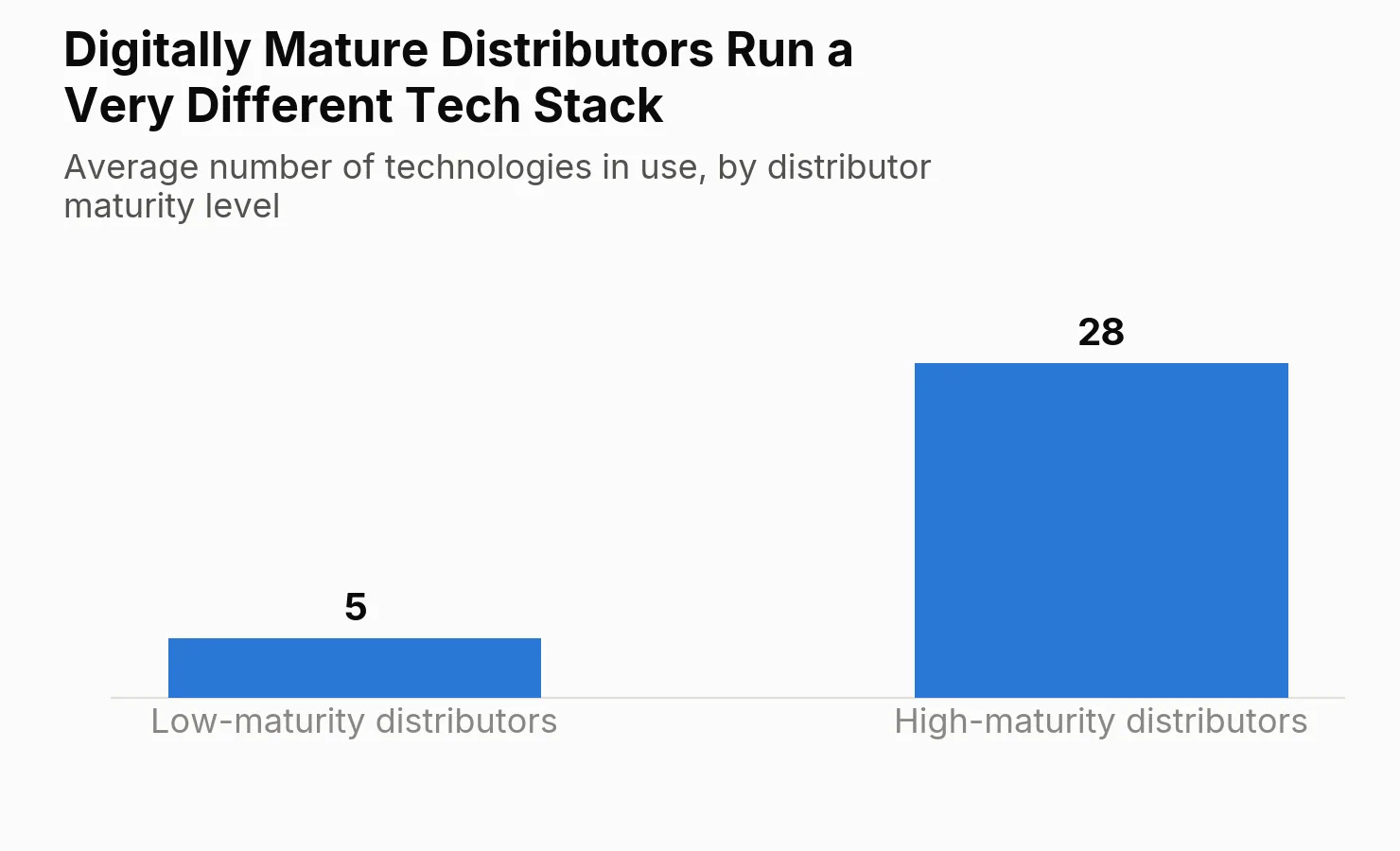
companies with more mature digital operations run an average of 28 different technologies,
compared with just 5 among low-maturity peers — a gap that reflects not just more spending, but a
fundamentally different operating model built around connected systems rather than isolated tools.
Yet even among fairly digitally invested distributors, 55% report having invested in core systems like
© Orpington Technologies Inc. www.orpingtontech.com
Page No. 1 of 4
companies with more mature digital operations run an average of 28 different technologies,
compared with just 5 among low-maturity peers — a gap that reflects not just more spending, but a
fundamentally different operating model built around connected systems rather than isolated tools.
Yet even among fairly digitally invested distributors, 55% report having invested in core systems like
ERP, CRM, eCommerce, and analytics without ever fully integrating them, which tracks closely with
the broader integration challenges covered earlier in this series.
Digital maturity in distribution correlates strongly with the breadth of an integrated technology stack, not just spending on
individual tools. Source: Xorosoft, 2026.
the broader integration challenges covered earlier in this series.
Warehouse management adoption sits at roughly 50% among surveyed distributors, but more
advanced capability lags well behind that: RFID adoption is around 13%, and AI-driven warehouse
management sits below 2%, even though nearly half of distributors identify warehouse automation as
an important use case for AI going forward. For a distributor evaluating Oracle Fusion Cloud
specifically, the practical implication is that the ERP's native supply chain and inventory capabilities
need to genuinely integrate with whatever warehouse management system is in place, rather than
duplicating or conflicting with it — getting that boundary right is one of the more consequential
configuration decisions a distributor will make during implementation.
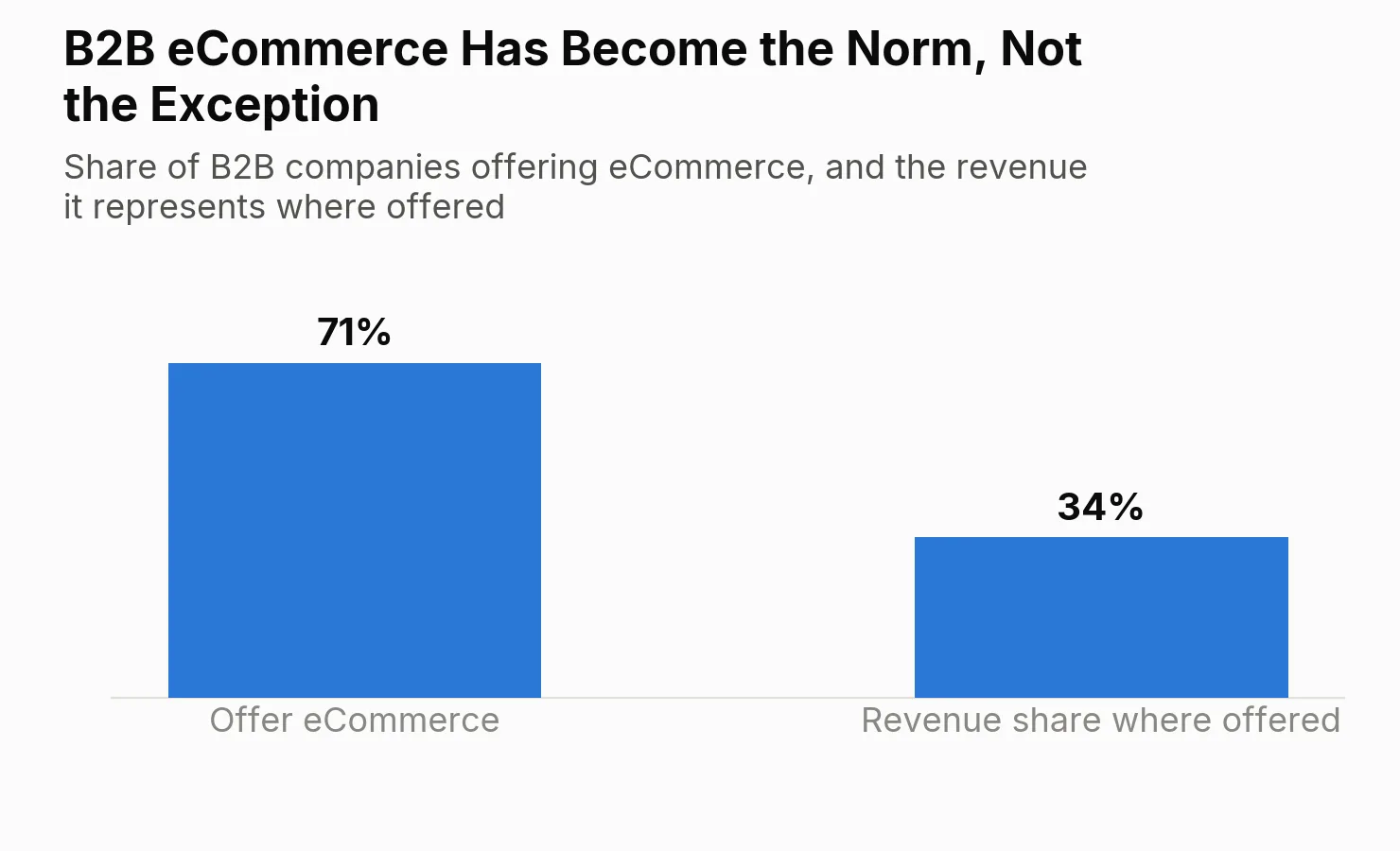
B2B eCommerce has also become close to universal rather than a differentiator: 71% of B2B
companies now offer eCommerce, and among those that do, online sales represent 34% of total
revenue on average. Buyers have adapted accordingly, now using an average of 10 different
interaction channels with suppliers, up from just 5 in 2016 — meaning a distributor's ERP needs to
support a genuinely omnichannel sales and fulfillment model, not treat digital ordering as a side
channel bolted onto a traditional sales process.
55%
companies now offer eCommerce, and among those that do, online sales represent 34% of total
revenue on average. Buyers have adapted accordingly, now using an average of 10 different
interaction channels with suppliers, up from just 5 in 2016 — meaning a distributor's ERP needs to
support a genuinely omnichannel sales and fulfillment model, not treat digital ordering as a side
channel bolted onto a traditional sales process.
of distributors have invested in core systems like ERP, CRM, and eCommerce without fully
integrating them — meaning the technology investment already exists at most companies; the
return on it is what's still missing.
Source: Xorosoft / Distribution Strategy Group, 2026
© Orpington Technologies Inc. www.orpingtontech.com
Page No. 2 of 4
integrating them — meaning the technology investment already exists at most companies; the
return on it is what's still missing.
 Professional services: margin lives or dies in the details
For professional services firms — consultancies, agencies, engineering and architecture practices —
the priorities inside Fusion Cloud shift heavily toward project accounting, resource management, and
billing accuracy, echoing the utilization challenges covered earlier in this series. The core question a
services firm needs its ERP to answer well isn't "how much inventory do we have," it's "is this specific
engagement actually profitable, and do we know that in real time rather than after the invoice goes
out." Getting project templates, billing rules, and cost allocation configured correctly for a firm's
specific engagement models tends to be the single highest-value and most implementation-intensive
part of a services-firm rollout.
B2B eCommerce has moved from competitive advantage to baseline expectation across distribution and wholesale. Source:
Xorosoft, 2026.
the priorities inside Fusion Cloud shift heavily toward project accounting, resource management, and
billing accuracy, echoing the utilization challenges covered earlier in this series. The core question a
services firm needs its ERP to answer well isn't "how much inventory do we have," it's "is this specific
engagement actually profitable, and do we know that in real time rather than after the invoice goes
out." Getting project templates, billing rules, and cost allocation configured correctly for a firm's
specific engagement models tends to be the single highest-value and most implementation-intensive
part of a services-firm rollout.
Retail and product-centric businesses: the omnichannel
reconciliation problem
Retail and other product-centric businesses running Fusion Cloud tend to lean most heavily on the
platform's inventory, order management, and financial consolidation capabilities, with the central
challenge being reconciling inventory and customer data across physical and digital channels that
too often get built and managed as if they were separate businesses. Manufacturing specifically
represents the largest single vertical by revenue share within the SMB cloud ERP market, at roughly
22.5%, while healthcare is the fastest-growing vertical by projected growth rate — both reflecting
industries where the operational complexity being managed (production processes in one case,
regulatory requirements in the other) makes an integrated system's value especially concrete and
easy to justify internally.
© Orpington Technologies Inc. www.orpingtontech.com
Page No. 3 of 4
platform's inventory, order management, and financial consolidation capabilities, with the central
challenge being reconciling inventory and customer data across physical and digital channels that
too often get built and managed as if they were separate businesses. Manufacturing specifically
represents the largest single vertical by revenue share within the SMB cloud ERP market, at roughly
22.5%, while healthcare is the fastest-growing vertical by projected growth rate — both reflecting
industries where the operational complexity being managed (production processes in one case,
regulatory requirements in the other) makes an integrated system's value especially concrete and
easy to justify internally.
The common thread across every industry
Despite these differences, the same underlying lesson from earlier articles in this series holds across
every vertical: the platform's capability matters less than how carefully it gets configured to match
how a specific business actually operates. A distribution company that implements Fusion Cloud
using a generic template built for manufacturing will end up fighting the system rather than
benefiting from it. The same is true in reverse. This is precisely why industry-specific implementation
experience — someone who has configured the platform for a business genuinely similar to yours
before — tends to matter as much as the platform choice itself.
The final article in this series
every vertical: the platform's capability matters less than how carefully it gets configured to match
how a specific business actually operates. A distribution company that implements Fusion Cloud
using a generic template built for manufacturing will end up fighting the system rather than
benefiting from it. The same is true in reverse. This is precisely why industry-specific implementation
experience — someone who has configured the platform for a business genuinely similar to yours
before — tends to matter as much as the platform choice itself.
Every article in this series has, in one way or another, pointed toward the same underlying question:
how do you know, before committing real budget and organizational energy, that an Oracle Fusion
Cloud ERP implementation is actually going to succeed at your specific company. That's the subject
of the eighteenth and final article in this series — go-live readiness, and the specific, measurable
signals that separate the implementations that deliver on their promise from the ones that join the
failure statistics cited throughout this series.
Sources
1. Wholesale Digital Transformation Statistics and Trends for 2026, Xorosoft —
https://xorosoft.com/wholesale-digital-transformation-statistics/
2. SMBs Cloud Enterprise Resource Planning Market, Mordor Intelligence —
https://www.mordorintelligence.com/industry-reports/smbs-cloud-enterprise-resource-planning-market
© Orpington Technologies Inc. www.orpingtontech.com
Page No. 4 of 4
how do you know, before committing real budget and organizational energy, that an Oracle Fusion
Cloud ERP implementation is actually going to succeed at your specific company. That's the subject
of the eighteenth and final article in this series — go-live readiness, and the specific, measurable
signals that separate the implementations that deliver on their promise from the ones that join the
failure statistics cited throughout this series.