
Industry Spotlight: Oracle Fusion Cloud ERP in Retail, Distribution, and Professional Services
 Professional services: margin lives or dies in the details
For professional services firms — consultancies, agencies, engineering and architecture practices — the priorities inside Fusion Cloud shift heavily toward project accounting, resource management, and billing accuracy, echoing the utilization challenges covered earlier in this series. The core question a services firm needs its ERP to answer well isn't "how much inventory do we have," it's "is this specific engagement actually profitable, and do we know that in real time rather than after the invoice goes out." Getting project templates, billing rules, and cost allocation configured correctly for a firm's specific engagement models tends to be the single highest-value and most implementation-intensive part of a services-firm rollout.
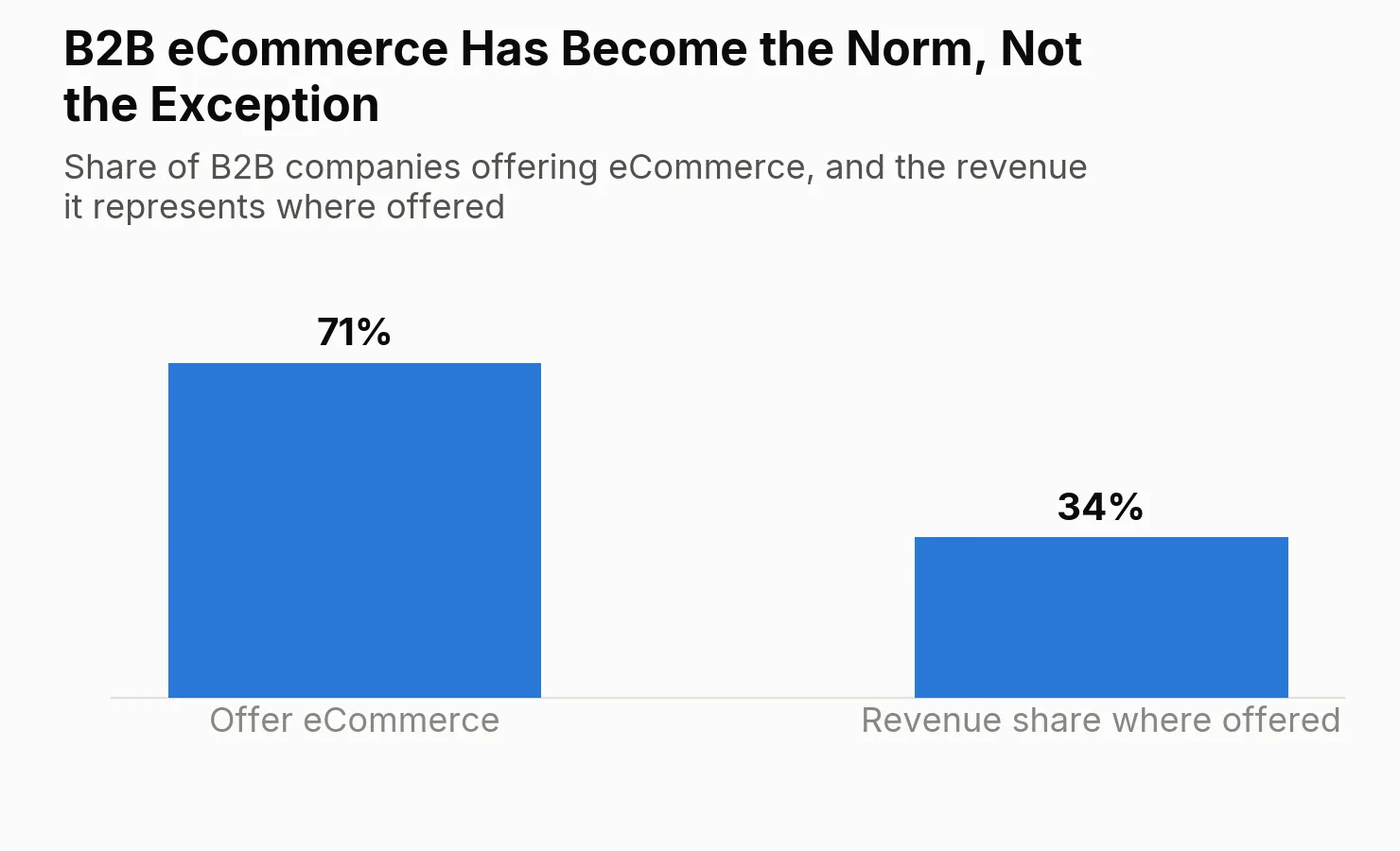
B2B eCommerce has moved from competitive advantage to baseline expectation across distribution and wholesale. Source:
Xorosoft, 2026.
Retail and product-centric businesses: the omnichannel reconciliation problem
Retail and other product-centric businesses running Fusion Cloud tend to lean most heavily on the platform's inventory, order management, and financial consolidation capabilities, with the central challenge being reconciling inventory and customer data across physical and digital channels that too often get built and managed as if they were separate businesses. Manufacturing specifically represents the largest single vertical by revenue share within the SMB cloud ERP market, at roughly 22.5%, while healthcare is the fastest-growing vertical by projected growth rate — both reflecting industries where the operational complexity being managed (production processes in one case, regulatory requirements in the other) makes an integrated system's value especially concrete and easy to justify internally.
© Orpington Technologies Inc. www.orpingtontech.com
Page No. 3 of 4