
Supply Chain Visibility: Oracle Fusion Cloud ERP for Distribution and Logistics
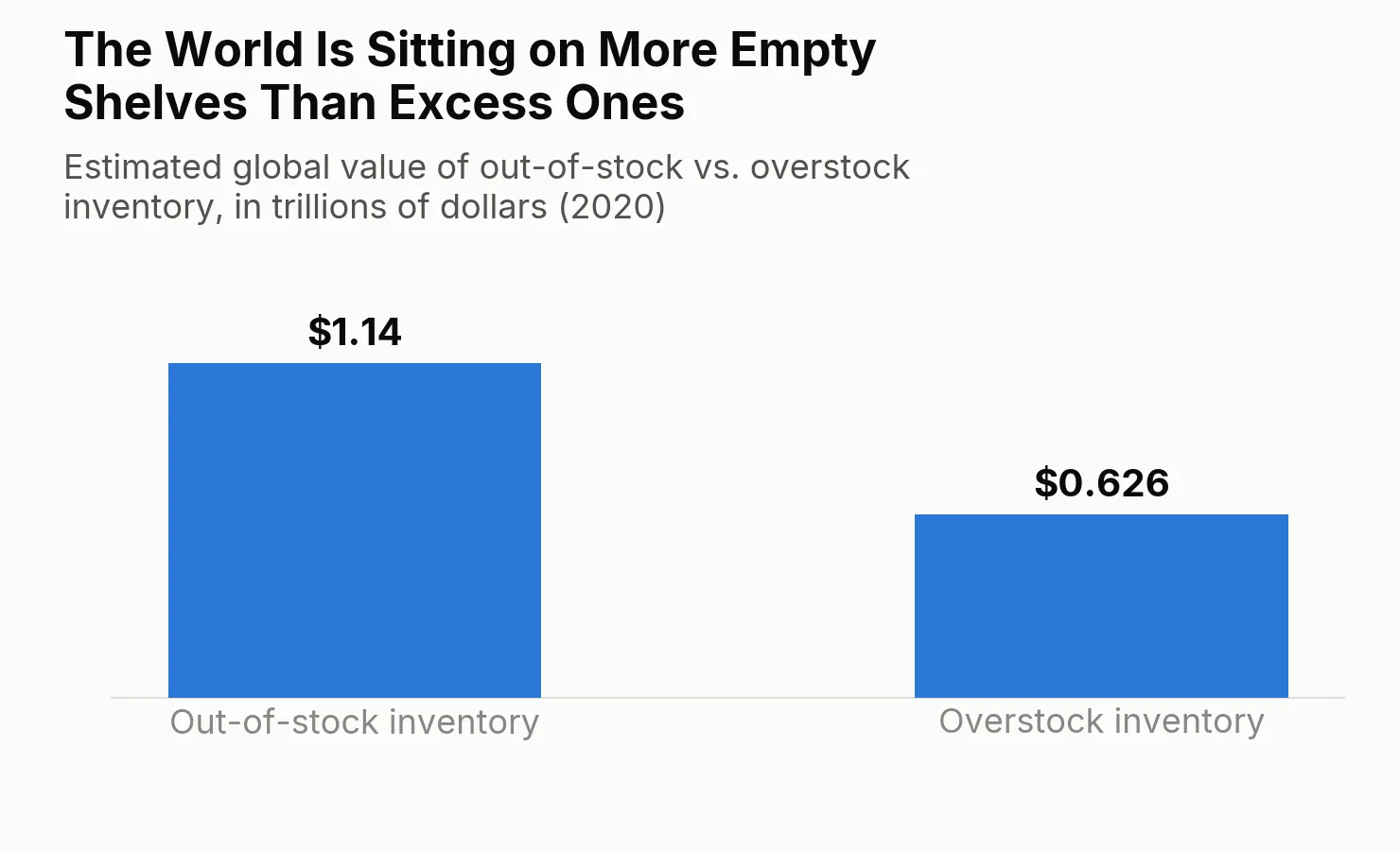
The consequences of that gap are measurable, and they cut in both directions. Globally, the value of out-of-stock inventory dwarfs the value tied up in overstock — an estimated $1.14 trillion in missed sales from empty shelves against $626 billion in excess inventory sitting unsold. Both numbers represent real money, but the imbalance says something important: most companies are more likely to lose a sale from not having enough of the right thing than to lose money from having too much of it.
Out-of-stock losses substantially exceed overstock losses worldwide — visibility failures cost more in missed sales than in
excess inventory. Source: Zippia, 2026.
Why small and mid-sized companies feel this more acutely
Larger enterprises can sometimes absorb inventory blind spots with sheer scale — enough safety stock, enough distribution centers, enough people whose whole job is expediting. Smaller companies don't have that luxury. A single stockout on a popular item can mean a lost customer, not just a lost sale, and 43% of small businesses don't formally track inventory at all, running instead on manager intuition and periodic physical counts. Thirty-four percent of businesses report late shipments specifically because a product they'd promised was actually out of stock when the order came through — a problem that visibility, not additional inventory, would have caught in advance.
69%
of companies say they lack total visibility into their own supply chain — meaning most businesses are, to some degree, managing inventory and fulfillment on partial information.
Source: Zippia, 2026
© Orpington Technologies Inc. www.orpingtontech.com
Page No. 2 of 4