
Supply Chain Visibility: Oracle Fusion Cloud ERP for Distribution and Logistics
Here's an uncomfortable question worth asking honestly: if a customer called right now and asked whether a specific item was in stock, at which location, and when it could ship — how confident would the answer actually be?
 ORACLE FUSION CLOUD ERP FOR GROWING BUSINESSES
Supply Chain Visibility: Oracle
Fusion Cloud ERP for Distribution
and Logistics
You can't manage what you can't see, and most companies can't see very much
Fusion Cloud ERP for Distribution
and Logistics
Here's an uncomfortable question worth asking honestly: if a customer called right now and asked
whether a specific item was in stock, at which location, and when it could ship — how confident
would the answer actually be? For a lot of small and mid-sized distributors, manufacturers, and
retailers, the honest answer involves a phone call to the warehouse, a few minutes of waiting, and a
number that's a best guess rather than a fact.
That's not a knock on the people running the warehouse. It's a reflection of just how little real
visibility most growing companies have into their own supply chains, despite how central inventory is
to the business. The data on this is more striking than most executives expect.
The visibility gap is bigger than almost anyone thinks
visibility most growing companies have into their own supply chains, despite how central inventory is
to the business. The data on this is more striking than most executives expect.
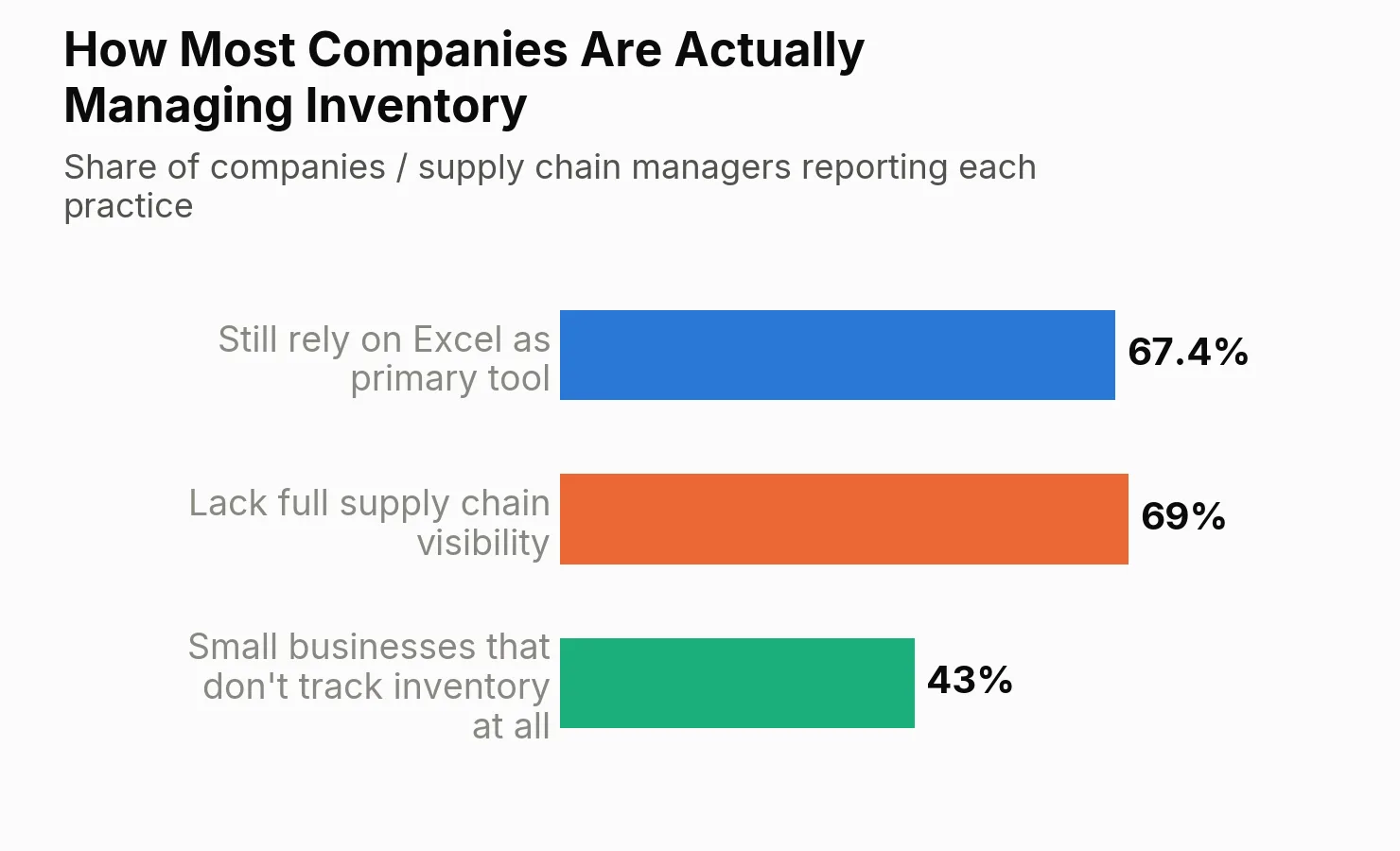
Only about 6% of companies report having full visibility into their supply chain. Sixty-nine percent say
they lack total visibility altogether. That's not a fringe problem affecting a handful of disorganized
companies — it's close to the norm. And it shows up in the tools people actually use day to day: more
than two-thirds of supply chain managers still rely on Excel spreadsheets as their primary
management tool, not because it's the best option, but because it's the one they've always had.
© Orpington Technologies Inc. www.orpingtontech.com
Page No. 1 of 4
they lack total visibility altogether. That's not a fringe problem affecting a handful of disorganized
companies — it's close to the norm. And it shows up in the tools people actually use day to day: more
than two-thirds of supply chain managers still rely on Excel spreadsheets as their primary
management tool, not because it's the best option, but because it's the one they've always had.
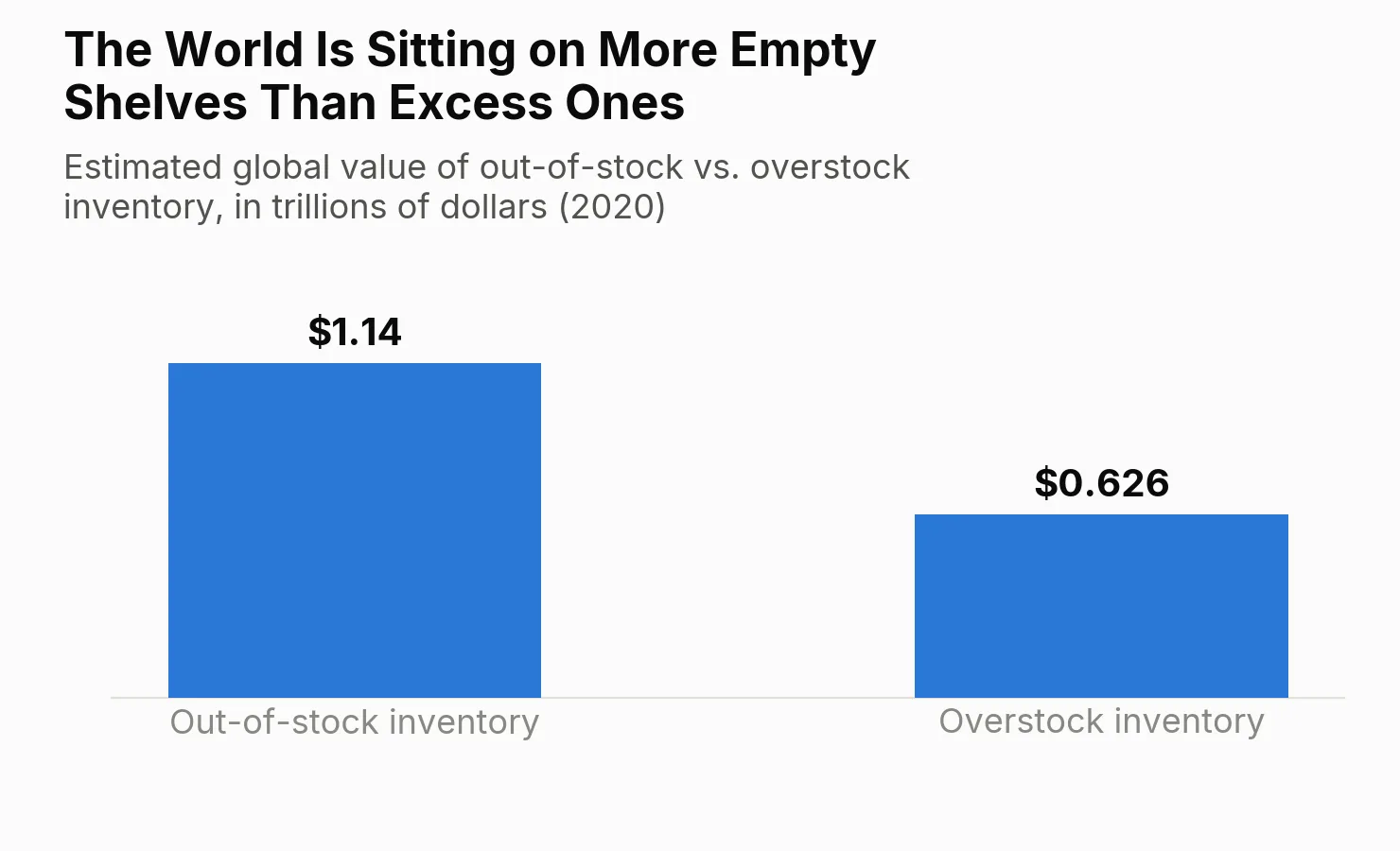
The consequences of that gap are measurable, and they cut in both directions. Globally, the value of
out-of-stock inventory dwarfs the value tied up in overstock — an estimated $1.14 trillion in missed
sales from empty shelves against $626 billion in excess inventory sitting unsold. Both numbers
represent real money, but the imbalance says something important: most companies are more likely
to lose a sale from not having enough of the right thing than to lose money from having too much of
it.
Out-of-stock losses substantially exceed overstock losses worldwide — visibility failures cost more in missed sales than in
excess inventory. Source: Zippia, 2026.
out-of-stock inventory dwarfs the value tied up in overstock — an estimated $1.14 trillion in missed
sales from empty shelves against $626 billion in excess inventory sitting unsold. Both numbers
represent real money, but the imbalance says something important: most companies are more likely
to lose a sale from not having enough of the right thing than to lose money from having too much of
it.
Why small and mid-sized companies feel this more
acutely
Larger enterprises can sometimes absorb inventory blind spots with sheer scale — enough safety
stock, enough distribution centers, enough people whose whole job is expediting. Smaller companies
don't have that luxury. A single stockout on a popular item can mean a lost customer, not just a lost
sale, and 43% of small businesses don't formally track inventory at all, running instead on manager
intuition and periodic physical counts. Thirty-four percent of businesses report late shipments
specifically because a product they'd promised was actually out of stock when the order came
through — a problem that visibility, not additional inventory, would have caught in advance.
69%
stock, enough distribution centers, enough people whose whole job is expediting. Smaller companies
don't have that luxury. A single stockout on a popular item can mean a lost customer, not just a lost
sale, and 43% of small businesses don't formally track inventory at all, running instead on manager
intuition and periodic physical counts. Thirty-four percent of businesses report late shipments
specifically because a product they'd promised was actually out of stock when the order came
through — a problem that visibility, not additional inventory, would have caught in advance.
of companies say they lack total visibility into their own supply chain — meaning most
businesses are, to some degree, managing inventory and fulfillment on partial information.
Source: Zippia, 2026
© Orpington Technologies Inc. www.orpingtontech.com
Page No. 2 of 4
businesses are, to some degree, managing inventory and fulfillment on partial information.
This is where the case for an integrated ERP system's supply chain module becomes concrete rather
than theoretical. When inventory, purchasing, warehouse operations, and order management all draw
from the same real-time data, the gap between "what the system says we have" and "what's actually
on the shelf" narrows dramatically, because there's no longer a lag between a transaction happening
and it being reflected in the numbers everyone's working from.
What Oracle Fusion Cloud actually does here
than theoretical. When inventory, purchasing, warehouse operations, and order management all draw
from the same real-time data, the gap between "what the system says we have" and "what's actually
on the shelf" narrows dramatically, because there's no longer a lag between a transaction happening
and it being reflected in the numbers everyone's working from.
Fusion Cloud ERP's supply chain and inventory management functions are built around the idea that
inventory data should update the moment something physically happens — a receipt, a pick, a
shipment, a transfer between locations — rather than at the end of a shift or after someone gets
around to entering it. That single change has an outsized effect on accuracy, because most inventory
discrepancies come from timing gaps, not from people entering numbers wrong.
The practical benefits compound from there. Demand and supply planning tools can work from
actual, current stock positions instead of a snapshot that's already a day or two old. Multi-location
businesses get a real answer to "do we have this anywhere," instead of having to call around.
Reordering can trigger automatically based on live consumption patterns rather than a manually
maintained reorder-point spreadsheet that nobody updates once the business outgrows it.
Manual, spreadsheet-based inventory management remains the norm even among companies that consider themselves
organized. Source: Zippia, 2026.
actual, current stock positions instead of a snapshot that's already a day or two old. Multi-location
businesses get a real answer to "do we have this anywhere," instead of having to call around.
Reordering can trigger automatically based on live consumption patterns rather than a manually
maintained reorder-point spreadsheet that nobody updates once the business outgrows it.
The financial stakes of getting this right are larger than they first appear. Broad research on supply
chain performance suggests that cutting supply chain costs from around 9% of revenue to 4% can
roughly double a company's profit — a reminder that supply chain efficiency isn't a back-office nicety,
it's one of the more direct levers on the bottom line available to a growing business.
© Orpington Technologies Inc. www.orpingtontech.com
Page No. 3 of 4
chain performance suggests that cutting supply chain costs from around 9% of revenue to 4% can
roughly double a company's profit — a reminder that supply chain efficiency isn't a back-office nicety,
it's one of the more direct levers on the bottom line available to a growing business.
Where this tends to go wrong
Visibility software can only be as good as the data feeding it, and companies migrating from
spreadsheet-based inventory management sometimes discover, partway through implementation,
that their historical stock records are far less accurate than assumed — years of manual adjustments
and undocumented workarounds baked into numbers everyone had trusted by default. Getting a
fresh, accurate baseline inventory count before go-live is unglamorous work, but skipping it just
imports the old inaccuracy into the new system with a more convincing interface.
It's also worth setting expectations about integration with warehouse operations specifically. An ERP
system's inventory module handles the transactional and planning side well, but companies with
more complex warehouse operations — multiple pick paths, automation, high SKU velocity — often
still pair it with a dedicated warehouse management layer that integrates back into the ERP, rather
than expecting the ERP alone to run the physical warehouse floor.
Next in the series
system's inventory module handles the transactional and planning side well, but companies with
more complex warehouse operations — multiple pick paths, automation, high SKU velocity — often
still pair it with a dedicated warehouse management layer that integrates back into the ERP, rather
than expecting the ERP alone to run the physical warehouse floor.
Inventory and procurement are the parts of the business most people associate with "supply chain,"
but they're only half of what a growing company needs to manage well. The other half is the people
actually doing the work — which is where this series turns next, into workforce management and
what cloud HR platforms are doing differently for companies that have outgrown a purely manual
approach to payroll and staffing.
Sources
1. 18 Stunning Supply Chain Statistics [2026], Zippia —
https://www.zippia.com/advice/supply-chain-statistics/
2. Cloud ERP Statistics for 2026 & Beyond, Anchor Group Technology —
https://www.anchorgroup.tech/blog/cloud-based-erp-statistics
© Orpington Technologies Inc. www.orpingtontech.com
Page No. 4 of 4
but they're only half of what a growing company needs to manage well. The other half is the people
actually doing the work — which is where this series turns next, into workforce management and
what cloud HR platforms are doing differently for companies that have outgrown a purely manual
approach to payroll and staffing.