
Data Readiness: The Workstream That Decides Your S/4HANA Timeline
 Orpington Technologies | SAP S/4HANA Migration Insights
© Orpington Technologies Inc.
www.orpingtontech.com
Orpington Technologies | SAP S/4HANA Migration Insights
© Orpington Technologies Inc.
www.orpingtontech.com
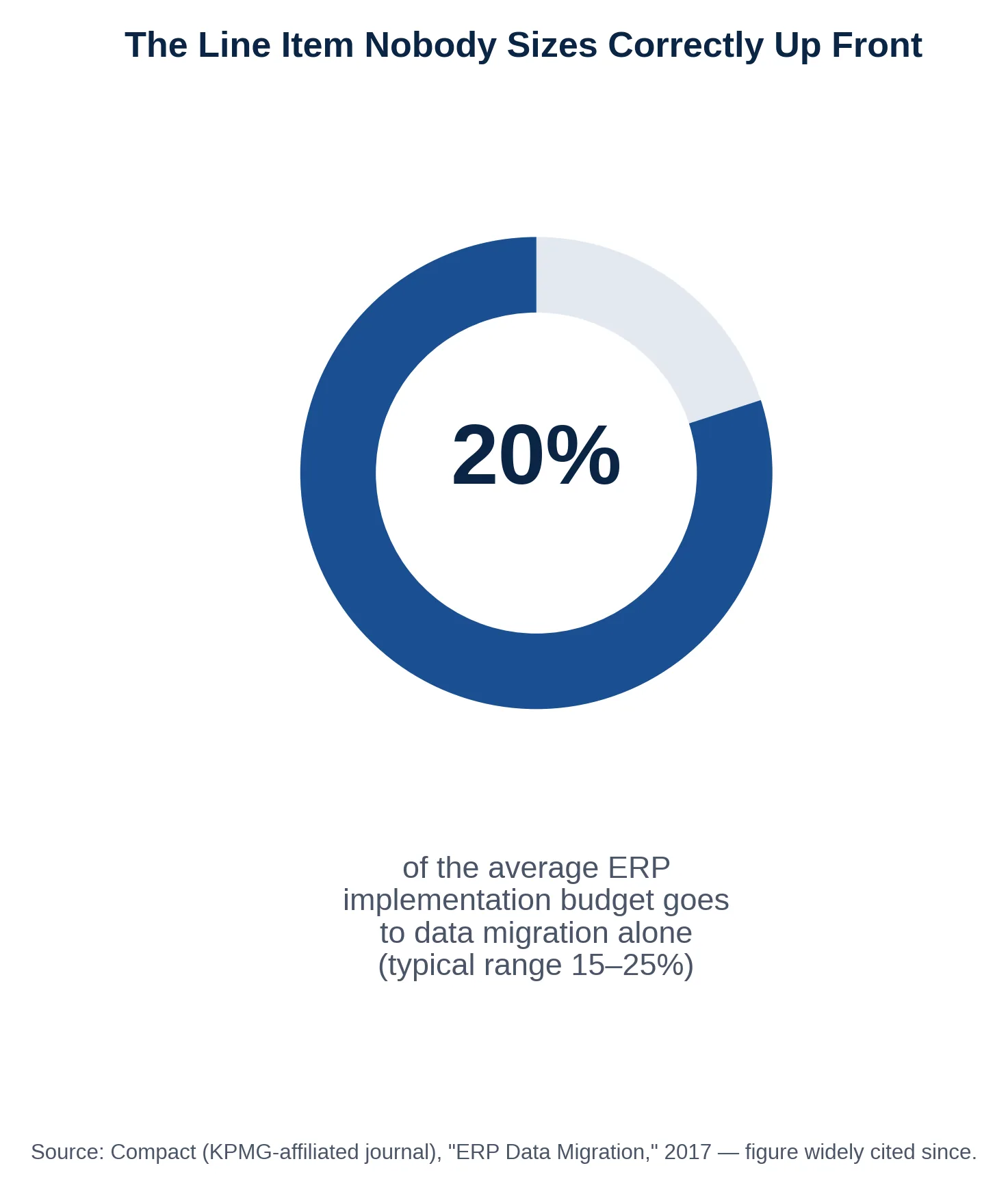
KPMG-affiliated journal, found that data migration typically consumes 15–25% of an ERP implementation's overall budget, a figure specialists in the field still cite as broadly accurate today even though the tooling around it has changed considerably.
That spend doesn't buy certainty. Analysis from DataFlowMapper, synthesizing outcomes across data-migration-specific engagements, puts the risk of missing the planned timeline at 30–41% of projects. The risk of failing to fully meet objectives, meaning the data that lands in the new system still isn't clean, complete, or trustworthy, runs as high as 83%, depending on how the project was scoped and governed going in.
Data migration's typical share of total ERP implementation spend.
Why This Work Can't Start Late
The mechanics of data migration haven't changed: extract, profile, cleanse, transform, load, reconcile. What changes is how badly that sequence goes wrong when it starts late. Profiling an entire legacy landscape by hand, tracing every duplicate customer record, every orphaned material master, every currency-conversion error left over from a system change a decade ago, takes a data analyst working steadily for weeks before anyone has a real picture of what's wrong. Cleansing takes longer still, and each fix can surface a new problem underneath it.
Basis Technologies' modeling of S/4HANA transformations found that projects require more than 75% additional resourcing relative to baseline estimates, and data work is a significant share of where that overrun shows up. Most of that overrun traces back to the same root cause: profiling and cleansing that should have started months before cutover planning instead got squeezed into the weeks right before it, when there's no longer room to fix what gets found.
AI-assisted profiling tools are one of the more useful recent additions here. Fuzzy-matching models can flag probable duplicate records even when two entries don't share an exact key, and anomaly-detection models catch values that are syntactically valid but statistically implausible, the kind of thing manual
Page 2 of 4